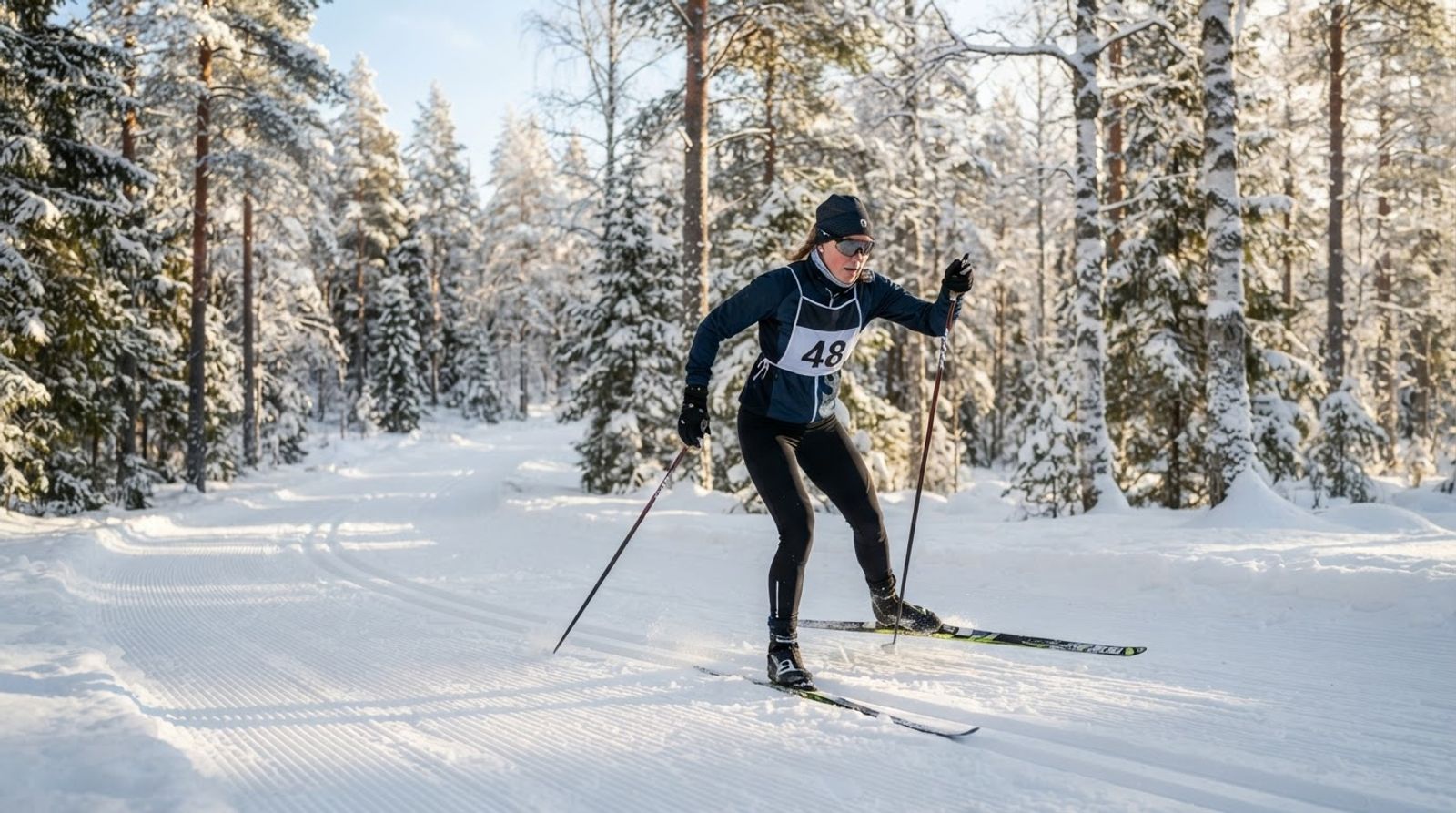
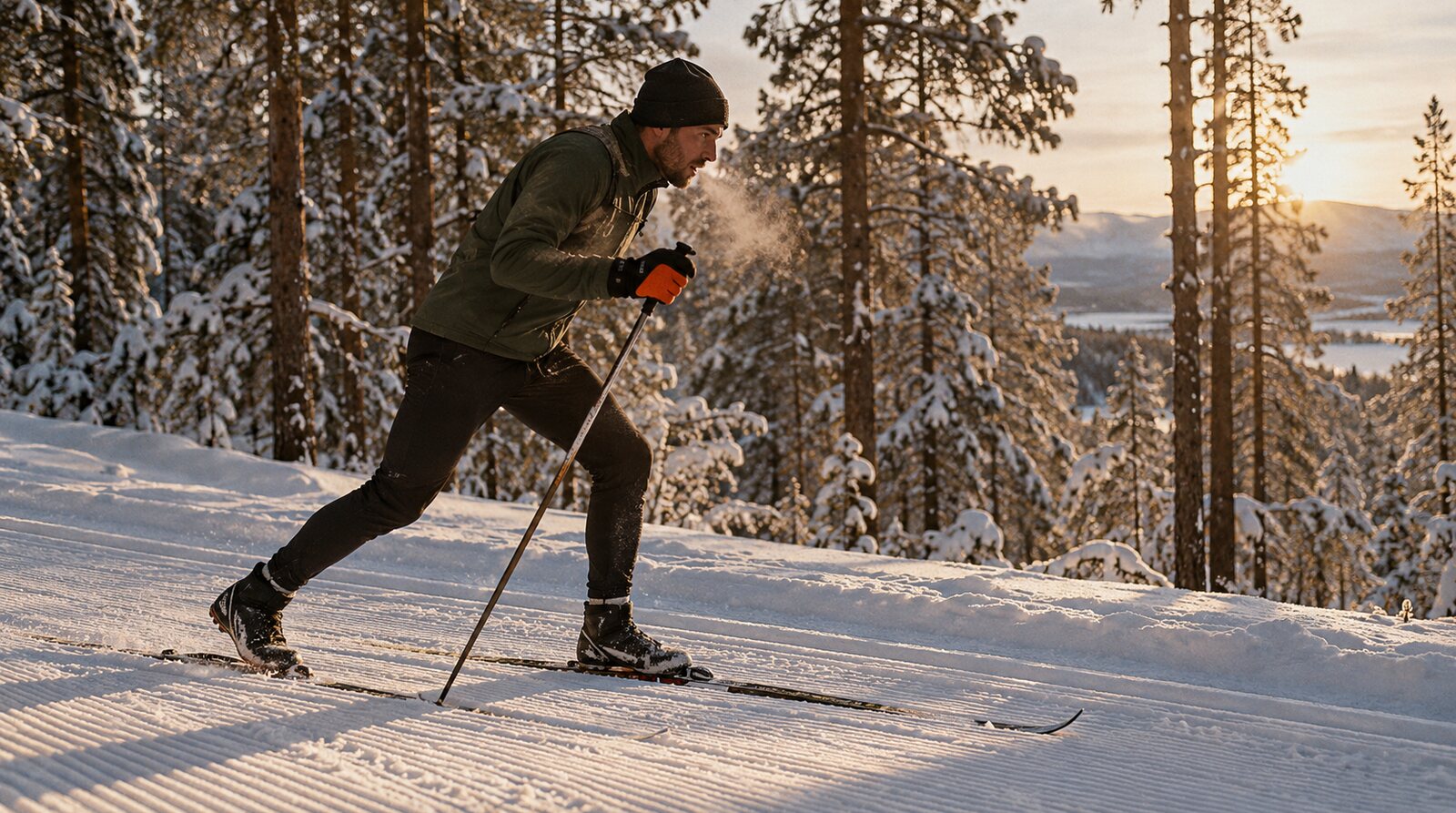
The ski season lasts a few months, but skiers prepare for it all year round. An amateur who steps onto skis with the first snow after a summer without training spends the first weeks just getting back into shape and arrives at mass-start races tired. A skier’s preparation is made up of periods of the year and several types of workouts, each with its own purpose. Below is how it works, how to control intensity and how to build a week in summer and in winter.
In short: what you need to know
- A skier trains all year. In summer — running, walking and ski imitation with poles uphill, roller skis, strength. In winter — snow, technique and speed.
- The base is easy volume. Almost all the time a skier trains in the easy zone, where breathing still allows you to talk.
- Few intense workouts — one or two a week: intervals or tempo, most often on climbs.
- Strength and general conditioning — once or twice a week, especially in summer and autumn.
- On the first snow, volume grows gradually: technique and short sessions first.
- If you need a ready-made programme for a goal, the ready-made skier training plans section has plans for a first season, classic, skate, a marathon and the summer base.
Preparation by period of the year
| Period | What matters most |
|---|---|
| Spring, after the season | Recovery: free activity, running, cycling without a plan and without hard workouts |
| Summer | Volume and base: cross-country running, walking and ski imitation with poles uphill, roller skis, strength |
| Autumn | Volume grows, intervals appear on roller skis and uphill, specific strength for the push-off |
| Winter | Snow: technique, volume on skis, speed, races |
| Before a race | Taper of 1–2 weeks: less volume, intensity kept in short efforts |
The boundaries of the periods depend on when the snow arrives where you live and when your main race is. If snow appears in December and the marathon is in February, the winter period leaves only two or three months — so summer and autumn work decides more than it seems.
Six types of skier workouts
| Workout | What it is for |
|---|---|
| Long easy | Endurance and getting used to long work with the whole body |
| Tempo | Holding a confident pace for a long time without fading |
| Intervals | Speed on climbs and a reserve for the race |
| Technique | An economical stride: less effort for the same kilometre |
| Strength and conditioning | Push-off strength in the legs and arms, a stable core |
| Recovery | Unloading after hard days without full rest |
Long easy
The main workout of the week by time. Zone 2: steady breathing, you can speak in phrases, and on climbs the effort does not rise to breathlessness — better to switch to walking or herringbone. In winter this is 1.5–3 hours on skis depending on your level, in summer a long cross-country run, roller skis or a hike with poles in the mountains. When preparing for a marathon, the long workout gradually reaches a time close to your race time.
Tempo
Efforts in zone 3: already demanding, you can talk in short phrases. Usually 2–3 efforts of 10–20 minutes on flat or gently rolling terrain with easy skiing between them. Tempo teaches you to hold an even stride when the finish is still far away and energy is already being spent.
Intervals
Most often uphill: 4–6 efforts of 3–5 minutes in zones 4–5, with the descent or easy skiing as rest. In summer the same is done as imitation: walking or bounding with poles uphill. Before intervals — a 15–20-minute warm-up. If the last effort is noticeably slower than the first, the start was too fast.
Technique
A separate session or part of an easy one: short efforts with drills. In classic — the leg kick and shifting your weight onto the gliding ski, double poling. In skate — balance on one ski, coordinating arms and legs, the different skate techniques on climbs and flats. Skiing sections without poles is useful: you immediately see where balance is lost. The intensity is low — when you get tired, technique falls apart and the drill loses its point.
Strength and conditioning
Once or twice a week: squats and lunges, core exercises, band or cable pulls imitating the pole push, plyometrics in small volume. In summer and autumn there is more strength work, in winter a maintenance minimum. Core stability is covered in more detail in the article on anti-rotation core exercises.
Recovery
30–60 minutes of easy skiing in zone 1 on a flat trail or a relaxed walk. The goal is to get the blood moving after a hard day without adding fatigue. If a recovery session turns into a normal one, it is better to replace it with full rest.
How to control intensity
The heart rate zones are the same as in the article on heart rate zone training, as a percentage of maximum heart rate. On skis heart rate has two peculiarities. On climbs it rises quickly, so on a long workout watch your effort and ease off in advance, not once you are already out of breath. In frost an optical sensor under the sleeve is more often wrong — a chest strap is more reliable. Without sensors the talk test works: if you cannot say a sentence on an easy workout, you are not doing an easy workout.
How to build a week: in summer and winter
| Days per week | Summer · winter |
|---|---|
| 3 days | Summer: imitation or uphill intervals, strength with an easy run, a long run or roller-ski session. Winter: technique with efforts, tempo or intervals, a long session on skis. |
| 4 days | The same three plus a recovery session or a separate strength session, not the day before intervals. |
| 5 days | Two hard workouts not on consecutive days, the long one at the weekend, strength and one easy session. In winter one of the hard ones can be a race. |
- At least one easy day between two hard ones, and no intervals the day after a long workout.
- The long one at the weekend: it is the hardest to shorten without losing its point, and in winter it is easier to get to the trail at weekends.
- Every third or fourth week is an easier one: volume about a third lower.
- If skiing is not your only sport, how to combine it with running in winter is covered in the article on winter as a base for runners.
How to train in summer without snow
- Cross-country running is the main summer volume; hills give a load close to ski climbs.
- Walking and ski imitation with poles uphill — walking and bounding. This is the most specific summer workout: both legs and arms work, and heart rate rises as on a ski climb.
- Roller skis — technique and speed close to snow. You need a helmet, gloves, smooth asphalt and a road without cars; roller skis have no brakes and pick up speed quickly on descents.
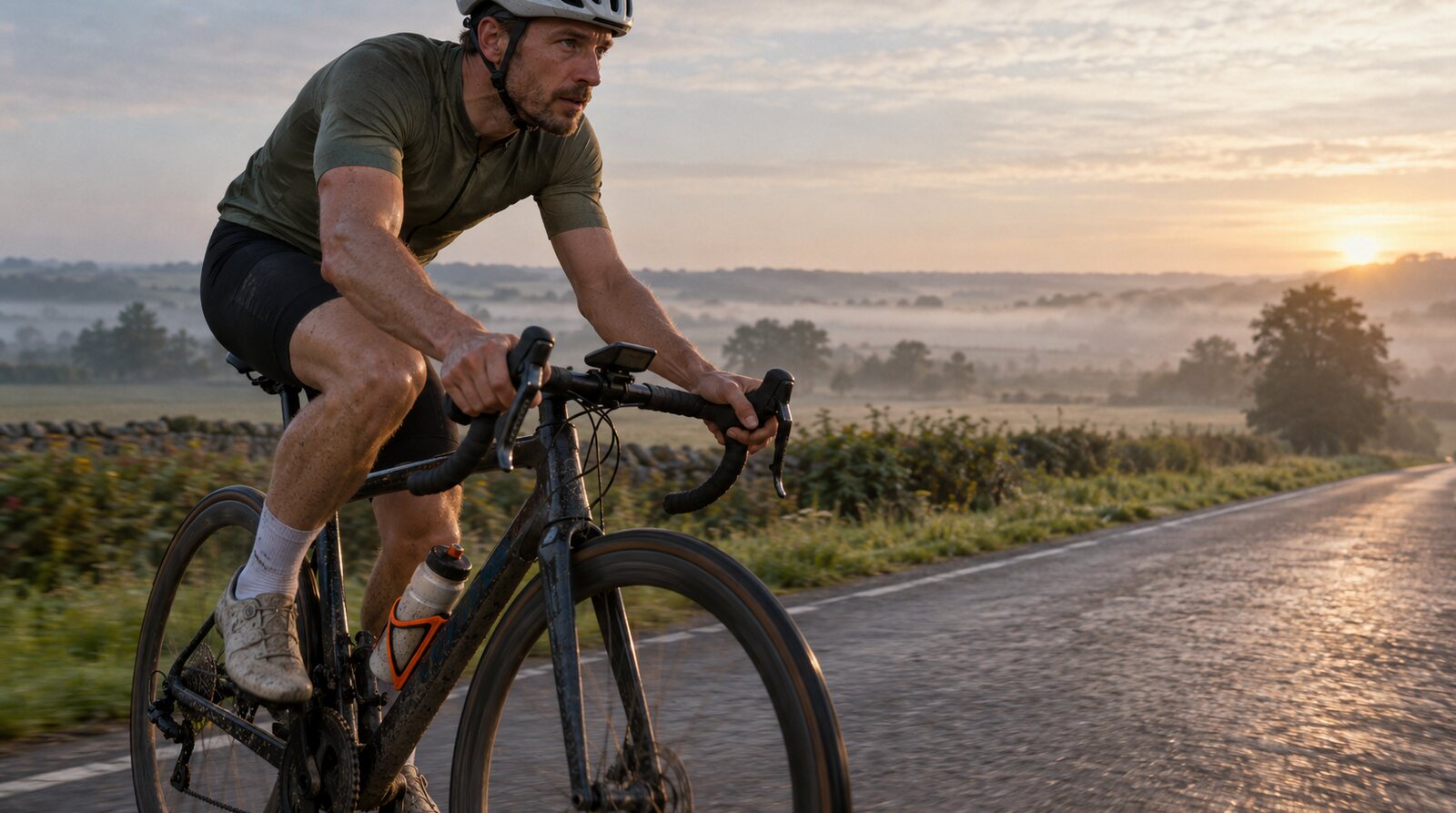
- Cycling — volume without impact, especially on days after hard workouts; how to build bike workouts is covered in the article on cycling training.
- Strength — in summer there is more of it than at any other time of year. A ready-made summer preparation plan is roller skis and the summer base.
Classic and skate: what changes
The types of workouts are the same for classic and skate; the difference is in technique and specific strength. Skate requires more balance and loads the glutes and extensors more in the sideways push-off, so it involves more balance work and single-leg exercises in strength training. Classic depends more on grip: with poorly chosen grip wax a workout turns into a fight against slipping back, and intensity jumps around. Roller skis for classic and skate are also different. Plans by style are classic technique and skate technique.
Common mistakes
- All workouts at one pace. Easy ones are too fast, hard ones not hard enough — fitness does not grow.
- A sharp rise in volume on the first snow. It is tempting to make up for lost time over a weekend, but muscles that have not worked for half a year respond with fatigue and pain. The first one or two weeks — technique and short sessions.
- Only skiing without strength work. Without push-off strength and a stable core, technique falls apart by the end of a long race.
- An empty summer. A break from spring until the snow costs more than the first weeks on skis give back.
- Judging by speed. Snow, wax and the trail change speed more than fitness; compare heart rate and feel on similar workouts.
Preparing for a marathon and a mass-start race
For a ski marathon the long workout gradually grows to a time close to your race time, and on it you need to practise eating and drinking on the move: over a distance of several hours without carbohydrates your energy runs out long before the finish. For a short mass-start race such as “Lyzhnya Rossii” regular three to four workouts a week for a month or two and getting to know the course are enough. In both cases the last one or two weeks are the taper: less volume, short fast efforts, fresh legs at the start. A ready-made plan is ski marathon preparation.
When to stop
Tired legs and arms after a long session, breathlessness on a steep climb, sluggishness the morning after intervals — the normal price of training. Chest pain, feeling faint or fainting, numbness in an arm or the face are a reason to stop the workout immediately and see a doctor. In frost watch your skin: whitening and loss of sensation on the cheeks, nose or fingers are signs of frostbite; you need to get somewhere warm, and if sensation does not return or blisters appear, see a doctor.
Ready-made plans by goal
- Your first ski season — if you are getting on cross-country skis for the first time.
- Classic technique and skate technique — preparation by style.
- Ski marathon — the long distance.
- Summer base — preparation before the snow.
Frequently asked questions
How should a skier train in summer without snow?
The base comes from hill running and walking with poles uphill, technique and speed from roller skis, and impact-free volume from cycling. Plus one or two strength sessions a week: in summer they take the most time.
How many workouts a week does an amateur skier need?
For noticeable progress three or four are usually enough: one or two hard ones, a long one and easy ones. A fifth workout makes sense when recovery keeps up and there is a goal such as a marathon.
Do I need roller skis?
They are not essential, but they are the closest to skiing in technique. Without roller skis the summer base can be built on running, ski imitation with poles and strength, leaving technique for the snow. If you use roller skis — only with a helmet and on a road without cars.
How do I prepare for a ski marathon or “Lyzhnya Rossii”?
For a marathon — gradually lengthen the long workout, practise eating on the move and don’t skip the taper. For a short mass-start race — regular three to four workouts a week and one or two sessions on a similar course.
Where should I start on the first snow?
With short technique sessions and easy volume. For the first one or two weeks don’t chase speed and time: let your muscles and technique come back, then gradually lengthen your workouts.
Does a skier need strength training?
Yes: leg and arm strength and a stable core keep your technique together towards the end of the distance. Once or twice a week in summer and autumn, in winter a short maintenance session.
Need a plan that takes into account your style, goal and free days? Get a personal plan from the AI cross-country ski coach at 1trAIner. Tell it about your skiing experience, style, goal and free days — the AI will put together a plan from the season down to individual workouts, taking into account when you have snow. Connect Garmin or Apple Watch through the app, or describe your workouts in the chat if you have no watch. If there is no snow and workouts fall through, write about it in the chat — the plan will be adjusted. The first 7 days are free.