Clothing is the only part of your gear that you have to choose anew every day. Running shoes last a season, a watch lasts years, but the decision "what to wear" is made before every outing, and getting it wrong costs you workout quality: in an extra layer you're wet and overheated after twenty minutes, and in a missing one you spend the second half of the session thinking only about how to stay warm.
Let's go through the whole working range for an amateur — from minus twenty to forty degrees of heat. One caveat right away: at the edges of this range the question stops being about clothing and becomes a question about whether you should go out at all.
The plus ten rule
The main mistake is dressing by the thermometer. After ten to fifteen minutes of work the body reaches its operating mode and starts warming itself: muscles produce heat, blood flow moves to the skin, and subjectively it feels about ten degrees warmer than the forecast shows.
Hence the working rule: dress as if it were 10 °C warmer outside. The check is simple — in the first minutes you should feel slightly chilly. If you go out and feel cozy right away, then in twenty minutes you'll be hot, and clothes wet with sweat will start chilling you on the way back.
The rule has adjustments for the type of work:
- Easy running and long runs at low heart rate warm you less — take plus five, not plus ten.
- Intervals and tempo runs warm you more — plus fifteen. But remember the warm-up and cool-down: you'll be cold during them, and a removable layer is a must.
- Walking, hiking, strength training outdoors — the rule doesn't work at all. Little heat is produced, there are many pauses, dress according to reality.
And one more caveat: the rule was derived for dry, windless weather. In rain and strong wind, "slightly chilly in the first minutes" easily turns into "cold for the whole workout", because the body doesn't have time to make up for the losses. In such weather, take a smaller warm-up allowance, and be sure to apply the wind and precipitation adjustments from the next section.
Wind and rain: the second temperature
The forecast shows air temperature, but you feel cold according to the perceived temperature. Wind carries away the warmed air from the layer of clothing, and the difference turns out to be significant. The adjustments below are for headwind; with a tailwind you shouldn't apply them, otherwise you'll dress warmer than needed and overheat.
- up to 3 m/s — no adjustment;
- 3–7 m/s — minus three degrees;
- 7–12 m/s — minus six;
- more than 12 m/s — minus ten and mandatory face protection.
Hence a subtlety that is often forgotten: on an out-and-back loop, exactly half of the route will be colder than the calculated temperature, and you need to plan clothing for that half. If the route allows, design it so that you return with the wind: on the way back you are wet, and a headwind at that moment is more dangerous.
Rain adds another minus five: wet fabric loses its ability to retain heat. Wet snow is worse — minus seven, because it both soaks and sticks.
Adjustments add up, but precipitation is counted once: wet snow replaces rain, not adds to it. Wind of 10 m/s and wet snow at zero on the thermometer give minus thirteen — that is the number to look at in the table below.
The chart below brings the whole range into one picture. The temperature on it is already the feels-like temperature, i.e. taking into account wind and precipitation, but without the warm-up bonus.
Three layers and why each one
Winter clothing works not by thickness but by system. There are three layers, and each has its own job.
Base layer wicks moisture away from the skin. Synthetic or merino wool. Cotton below +10 °C is forbidden: it absorbs water and holds it against the body, turning into a cold compress. It is often a cotton T-shirt under a jacket, not the frost, that causes a person to get cold.
Insulating layer retains heat: fleece or light synthetic insulation. Needed from −5 °C and below, and in wind — already from zero.
Shell layer protects from wind and water. A windbreaker or membrane jacket.
Three thin layers are always better than one thick one, because the system can be adjusted: unzip, take off, put in a waist bag. One warm jacket leaves no options — you are either too hot or too cold in it.
Membrane: the same rule as for footwear
With membrane jackets the same story repeats as with Gore-Tex in running shoes: people buy it "for rain," but it's needed for something else.
A membrane is needed for cold and slush, not for warm rain. In warm rain during active effort it turns into a greenhouse: vapor from inside doesn't have time to escape, and you end up wetter from the inside than you would have been from the outside. In summer rain at +15 and above, it's smarter to run in a T-shirt and change at home than to bundle up in a membrane.
But at zero with wet snow and wind, a membrane is indispensable: there the task isn't staying dry, but keeping the wind from blowing heat out of your wet clothes.
Cold: from zero to minus twenty
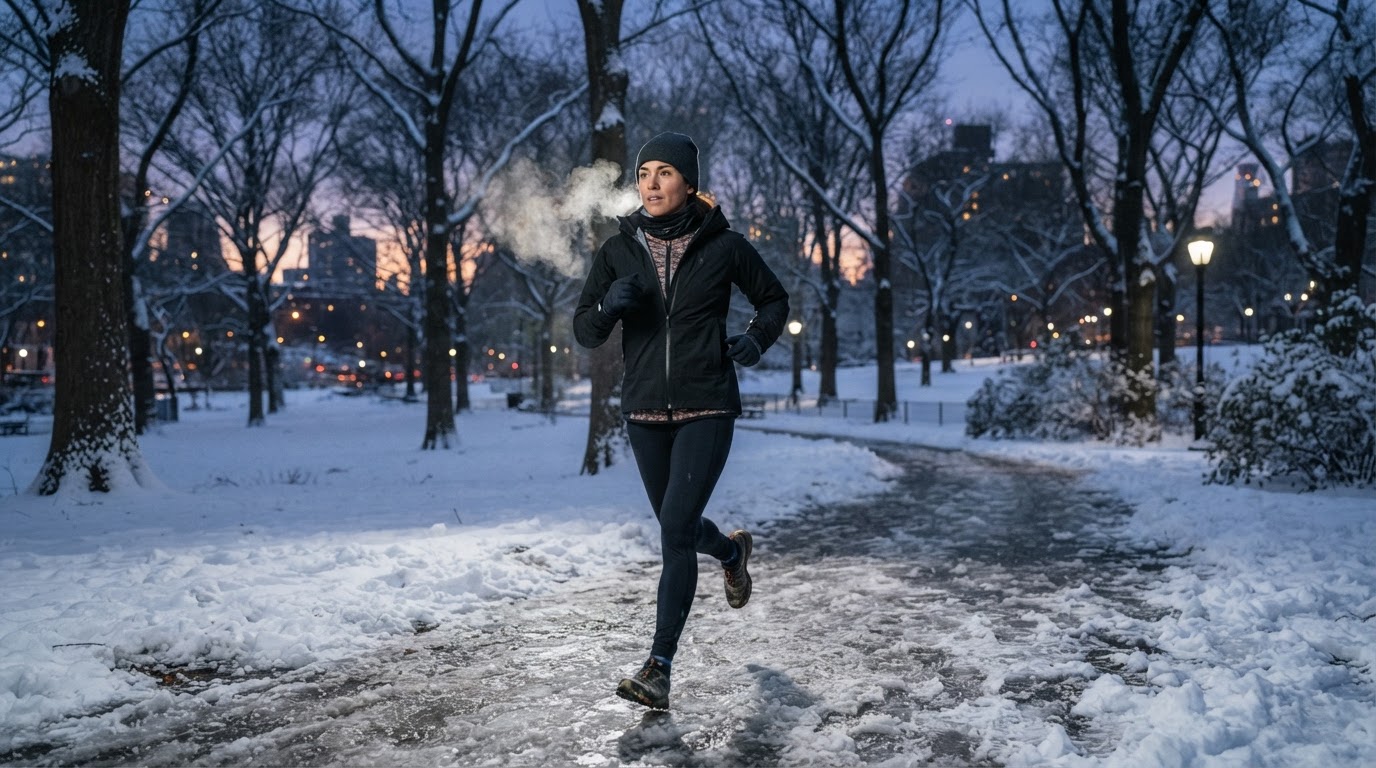
The basic kit from −5 °C: a thermal layer, wind protection, insulated tights, a hat, gloves, a buff for your neck. From −10 °C a fleece goes between the base layer and the windbreaker — from that point there are three layers, and beyond that the number doesn't grow, only the density of each changes.
From −15 °C gloves give way to mittens: in a mitten your fingers warm each other, in a glove each one freezes on its own. Your face is covered with a buff or mask — not so much against the cold as to avoid breathing frosty air directly.
A common winter mistake is dressing "just right" and not accounting for stops. A traffic light, waiting for a companion, stretching afterward — three minutes without movement in the cold takes away your entire reserve. Take a layer for pauses, even if it seems unnecessary.
Below −20 °C we don't plan a quality workout — and here you should count the feels-like temperature, not the thermometer: minus eighteen with wind at 12 m/s is colder than minus twenty-two in calm air. What's left is either an easy run of up to forty minutes with your face covered, or moving indoors. Intervals in severe frost are not a feat but a noticeable risk of airway spasm and dropping out of training for a week.
Heat: from plus twenty-five
Above +25 °C clothing stops being the main question. The body cools by evaporating sweat, and when the air is hot and humidity is high, sweat stops evaporating. Humidity above 80 % in heat adds another three to five degrees to the feels-like temperature: the thermometer reads +28, but make decisions as if it were +32.
- +25…+30 — drop intervals and pace work, keep easy running, move it to the morning before nine or the evening after eight.
- +30…+35 — only easy running or walking, up to an hour, on a route with shade and access to water. Your pace will be slower than usual, and that in itself is not a loss of fitness.
- above +35 — no outdoor training. Gym, pool, or a rest day.
When to stop a workout immediately
A slow pace in the heat is normal. What's listed below is not, and it's no longer about "toughing it out":
- your skin has become dry, sweating has stopped while the effort continues;
- chills or goosebumps in the heat;
- headache, dizziness, nausea;
- confusion, strange behaviour, loss of coordination;
- a feeling of being hot "from the inside" while running doesn't get any easier.
If any of these signs appear, you need to stop, get into the shade, lie down and raise your legs, take off extra layers, cool your neck, armpits and groin with water or ice, and drink in small sips. Confusion, disorientation or fainting is a reason to call an ambulance, not to "lie down and rest": these are signs of heat stroke, and it develops quickly.
Clothing in the heat: light-coloured, loose, mesh. A dark T-shirt in the sun feels like several extra degrees. A cap and sunglasses are a must, plus sunscreen on your shoulders and neck.
An important detail about drinking: drink according to thirst. Pouring water into yourself "just in case" doesn't protect against overheating, but it does create a risk of diluting your electrolytes — on long summer workouts this is a real, not theoretical, problem.
The little things that decide
- Sun and cloud cover. On a clear day it feels about three degrees warmer, on an overcast day about three degrees colder.
- Start time. For a morning workout, dress for the temperature at the start, not for the day's forecast: in the shoulder seasons the difference between seven in the morning and noon easily reaches ten degrees.
- Visibility. From dusk onwards, wear reflective elements or a light, regardless of what the thermometer says.
- Hands and ears get cold first. If it's cold but your core is fine, add gloves and a hat, not another sweater.
And lastly: clothing doesn't replace common sense about the workout itself. In extreme weather, first decide what to do with the plan, and only then what to wear. How weather changes your choice of surface and shoes is covered separately in the review of tread and membrane, and the load on your legs in bad weather — in the article about downhills.
In 1trAIner, the AI coach builds your plan as a cascade Season → Month → Week → Day. The weather forecast for your training locations is pulled in automatically, and the daily plan comes with clothing and shoe recommendations. First 7 days free.
This material is for information purposes and does not replace a doctor's consultation. If you have pain or suspect an injury, the decision on permissible load and return to training is made by a doctor.