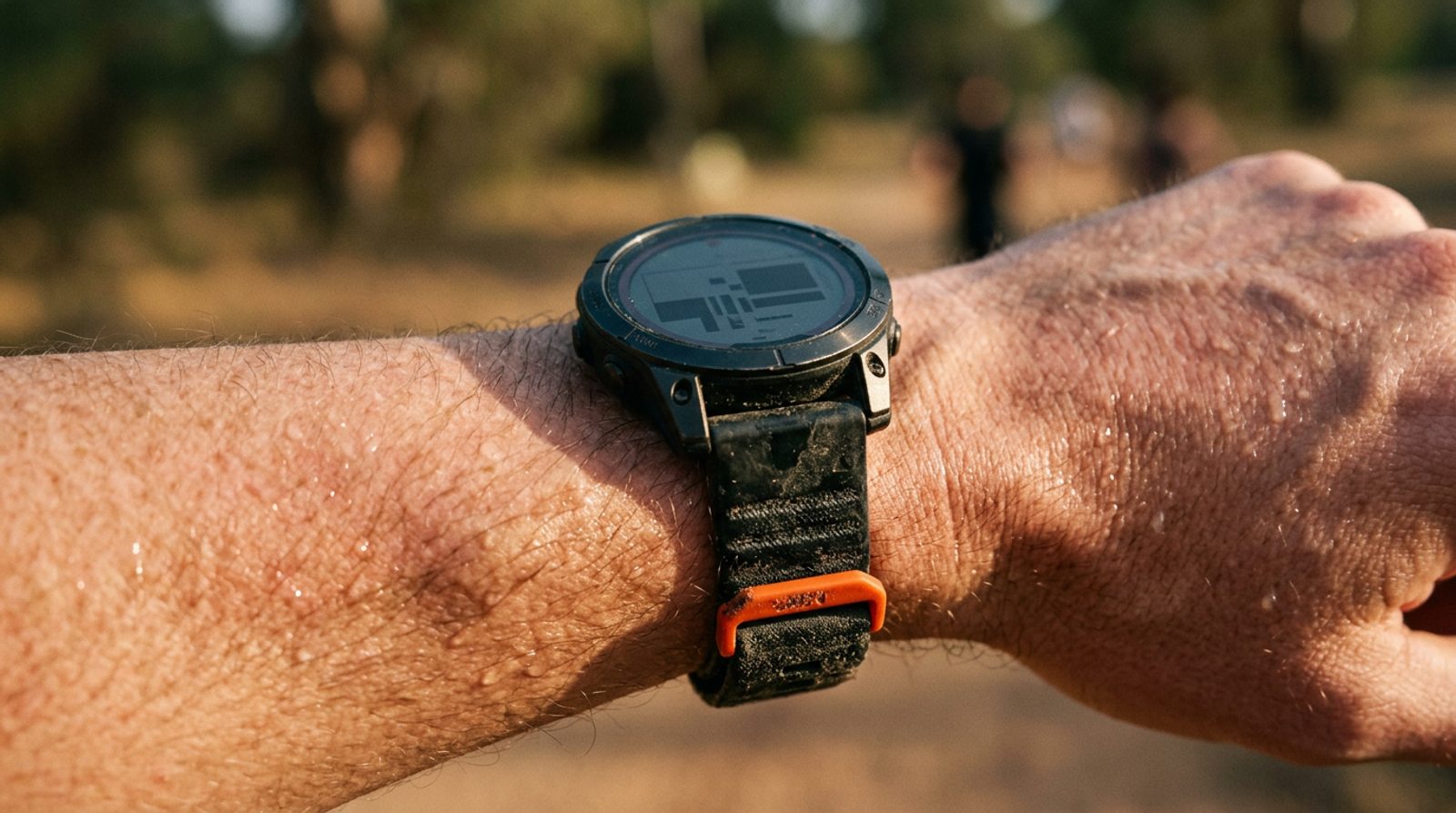
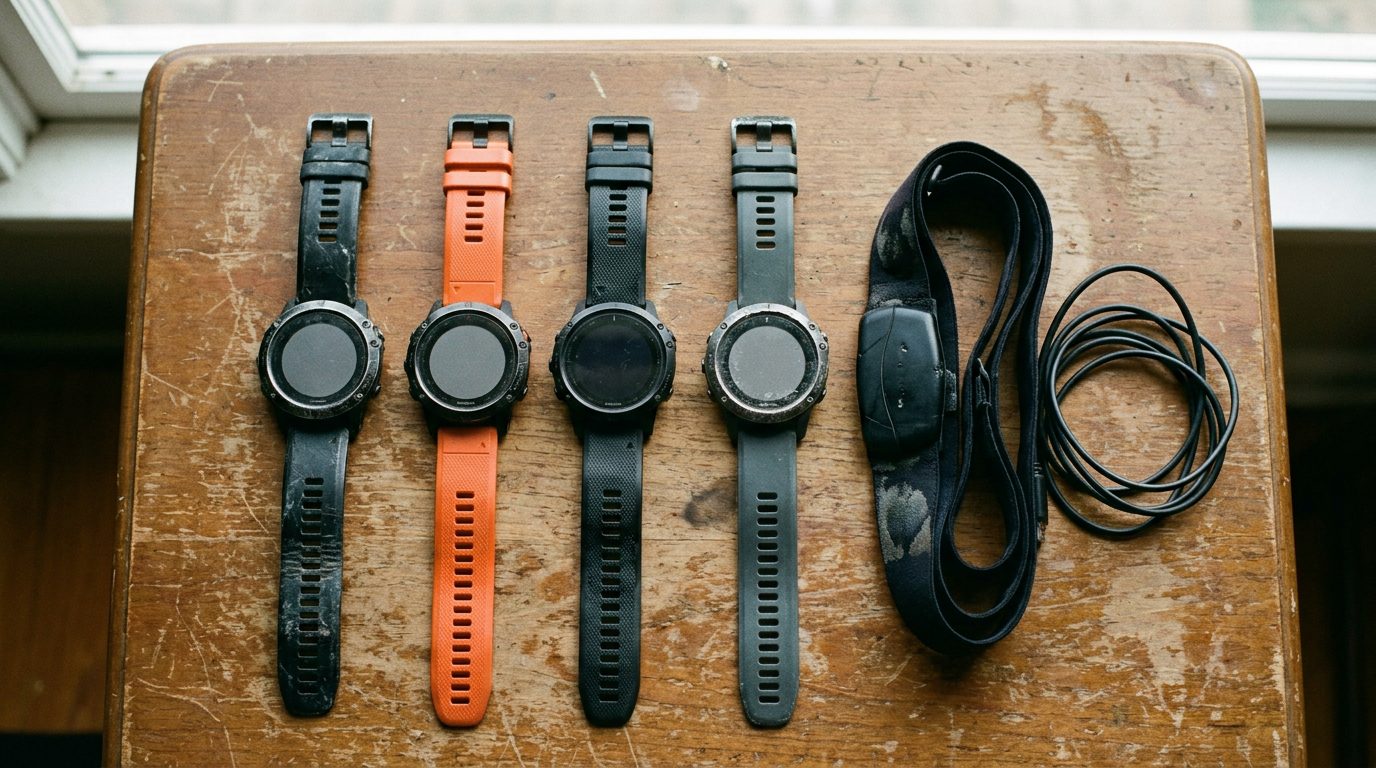
The watch market has long split into two camps, and the debate about "which is better" is pointless until you say what for. The sports four — Garmin, Suunto, Polar, Coros — are training tools: all-day battery life, buttons that work with wet fingers, maps without a phone, training analytics as the core product. Smartwatches — Apple, Samsung, Huawei — are health and comfort devices: medical sensors, apps, payments, ecosystem, but modest battery life and less depth in sports metrics.
Let's go through them one by one: what each brand really hooks you with, what from the marketing lists is just the basics, how watches calculate readiness and peak form, what to choose for your level and type of races, and who has the most complete distance analytics.
Quick reference cheat sheet
| Brand | Key highlight | Best for | Weak spot |
|---|---|---|---|
| Garmin | Deepest navigation plus satellite communication and LTE on the wrist, almost everything without a subscription | Runners, triathletes, mountains, "everything at once" | Price, cluttered menu |
| Suunto | Free offline maps of the whole world and ZoneSense — HRV-based zones without a chest strap | Trail running, ultra, mountains | Almost no smart features |
| Polar | Orthostatic recovery test, split training load, wrist-based running power | Structured plans and recovery monitoring | Maps and navigation are simpler |
| Coros | Battery life and free EvoLab platform with a shared coach calendar | Ultra, working with a coach, value for money | Minimal smart features |
| Apple | iPhone ecosystem and medical sensors: ECG, apnea, hypertension | iPhone owners, city, health | Battery life 1–1.5 days |
| Samsung | Body composition right from the wrist and Wear OS with Gemini | Android owners, health and "smarts" | Sports metrics accuracy is lower |
| Huawei | Two weeks of battery life, golf and freediving at a moderate price | Price, design, battery life | Sync with external services |
Current lineup for autumn 2026: Apple Watch Series 12 and Ultra 4, Galaxy Watch 9 and Watch Ultra 2, Huawei Watch GT 6 Pro and Watch 5, Garmin fēnix 9 and 9 Pro (the Pro inReach version — with satellite and LTE), Suunto Race S and Vertical, Polar Vantage V3 and Grit X2 Pro, Coros Pace Pro and Vertix 2S.
What makes each brand stand out
Garmin wins with breadth. In the ninth generation of fēnix, versions with satellite communication and LTE right in the watch appeared: calls, messages and SOS without a phone — for expeditions this is a decisive argument. Alongside it, an updated stamina with its own zones and a energy reserve curve, an extended backpack mode (weight changes on the go, calorie targets up to a hundred kilograms of load) and Epic — assembling a multi-day hike into one story. Navigation remains the gold standard: routable maps, ClimbPro, points ahead, round-trip routes. Most importantly, almost all of this works without a subscription.
Suunto gives away for free what others charge extra for: full-colour offline topo maps of the whole world with contour lines and GPX import. The second truly unique thing is ZoneSense: determining aerobic and anaerobic zones from heart rate variability using the optical sensor, in real time and without a chest strap. Plus the language of professionals in the app — TSS, CTL, ATL and TSB, like in TrainingPeaks.
Polar is the most "lab-like" brand. Training Load Pro splits load into cardio, muscular and subjective; no one else has this split. Recovery Pro paired with the H10 chest strap performs an orthostatic test — the only direct measurement of nervous system readiness in its class. Running power is calculated right from the wrist, without a foot pod. And a separate little thing that matters in ultra: the Vantage can be charged right during a workout recording.
Coros sells battery life and honest pricing. Pace 3 lasts up to 38 hours of GPS, Vertix 2S — up to 118, in normal mode that's two to three weeks. The EvoLab and Training Hub platforms are free and include race predictions, Marathon Level, four-week analytics and a shared calendar with a coach — things others charge a subscription for.
Apple Watch finally closed its main gap in 2026: the Series 12 and Ultra 4 got their own Readiness score from 0 to 10 with four verdicts — Recover, Pace Yourself, Ready, Go For It. Measurement frequency also increased: background heart rate every five seconds, heart rate variability every five minutes. The medical side is still the strongest: ECG, hypertension notifications, sleep apnea detection, temperature. Ultra 4 adds a dive computer, a siren, and about three days of battery life.
Samsung is unique in measuring body composition right from the wrist: bioimpedance calculates fat, skeletal muscle, and water, just like a smart scale. New features include Daily Cardio Load, which recommends training and rest on its own, and Heart Health Score, which replaced last year's Vascular Load. Plus Wear OS with the full Google suite and AI tips.
Huawei stands out for battery life: two weeks in titanium at a moderate price. Specialized modes include golf with 3D course maps, freediving with a depth sensor, and trail running with contour lines. Running technique analysis provides ground contact time, leg balance, and vertical oscillation with tips, while RAI serves as an analog of VO₂ max.
The basics that actually help in training
Let's separate the gimmicks from the basics. Here's the set that all seven brands have in current models in 2026, and it covers 90% of an amateur's needs:
- Dual-band GPS — accurate track in the city and under tree cover;
- optical heart rate and heart rate zones — intensity management (detailed in the heart rate zones breakdown);
- VO₂ max or analog — aerobic endurance assessment;
- training load — protection against overtraining;
- recovery time — when you can train hard again;
- heart rate variability — the most sensitive indicator of fatigue;
- sleep and its quality — the foundation of recovery;
- race prediction — a pace guide for the race;
- interval and structured workouts — the watch guides you through the plan;
- navigation and GPX import, multisport, notifications, music, payments.
The difference between brands here isn't in presence but in quality: how accurate the heart rate is during intervals, how clearly the interval editor is built, what happens to the track in the forest, and whether all this drains the battery in four hours.
How watches calculate readiness
Any readiness system — and each brand calls it differently — is made up of three blocks.
Load. How much and how hard you trained: acute over the last seven days versus chronic over four to six weeks. Nervous system state. Heart rate variability, resting heart rate, sleep quality — this includes not only training stress but also life stress: a flight, a deadline, a sleepless night. Feedback from the body. Heart rate recovery rate and subjective feelings.
These three blocks yield two answers: "can I train hard today" and "are you approaching peak form". Everything else is differences in units of measurement.
| Brand | Readiness for today | Peak form for a race | Recovery |
|---|---|---|---|
| Garmin | Training Readiness 0–100, Body Battery, morning report | Peaking status, race calendar, Race Predictor | Recovery Time, HRV Status, Sleep Score |
| Polar | Nightly Recharge and FitSpark, Recovery Pro | Cardio Load Status, Running Index | Orthostatic test, ANS charge |
| Coros | Recovery 0–100%, Running Efficiency | Intensity Trend → Performance, Marathon Level | Recovery Timer, nighttime HRV |
| Suunto | Resources and Recovery widget | TSB — form minus fatigue | 7-day HRV, sleep, TSB |
| Apple | Readiness 0–10, Vitals | Training Load trend, Go For It verdict | HRV every 5 minutes, Vitals |
| Samsung | Energy Score, Daily Cardio Load | Fitness Index, load tips | Energy Score, sleep with apnea |
| Huawei | Training Index, Recovery % | Training Index → Excellent, Predicted Times | Recovery Time, heart rate recovery |
Three systems deserve a closer look, because they are built in fundamentally different ways.
Garmin gives the most granular score: Training Readiness is recalculated throughout the day from sleep, accumulated recovery, variability status, acute training load, and stress over the past three days. Below 25 — your body needs rest, 25–49 — time to ease off, 50–74 — you can train, 75–94 — a window for a hard workout, above 95 — a rare peak state.
Polar is the only one that offers not an estimate but a measurement. An orthostatic test with a chest strap: measuring variability while lying down and right after getting up, in the morning, three or more times a week. This is the gold standard of sports science brought into a everyday watch; the price is discipline and a strap on your chest.
Apple took a third path and published a verdict, but not thresholds: Readiness shows a score and explains what exactly is pulling it down — lack of sleep, deviations in Vitals, training load. The algorithm is built on data from the Apple Heart and Movement Study.
What to do with all this in practice — more detail in the breakdown of Garmin recovery metrics; the logic there is common to all brands.
Peak form and tapering
The idea of peaking is the same for everyone: form and fatigue grow together but fall at different rates. Weeks of work raise chronic form and at the same time accumulate fatigue. Before a race you reduce volume — fatigue goes away in days, form holds for weeks, and in that gap you arrive at the start fresh.
Next comes the question of terminology. With Suunto, everything is named honestly: TSB = chronic training load minus acute, and a small positive balance around +5…+15 is the classic race-week state. Coros calculates the same thing via Intensity Trend: after a recovery week the index drops into the 50–79% range, and the status changes to Performance. Garmin shows the Peaking status and ties pace guidance to the date of your main race. Huawei says Excellent. Polar doesn't offer a separate pre-race status, but the combination of Cardio Load Status and Recovery Pro does a great job of catching overtraining.
Apple and Samsung don't have a separate pre-race module. Workable substitutes: with Apple — stable Readiness at the Go For It level with calm Vitals, with Samsung — declining Daily Cardio Load and rising Fitness Index. Neither gives a race distance result prediction.
An important caveat the watches don't mention: tapering only works on top of completed preparation. A recovery period doesn't create form, it reveals it. If the volume of recent months was random, the Peaking status on the screen only means you rested well.
Recovery: what to look at in the morning
The practical minimum takes half a minute and looks like this.
- Sleep. Score above your norm? A dip — not a day for records.
- Heart rate variability. In your corridor or below? Low for several days in a row — accumulated stress, and not necessarily training-related.
- Readiness score. Training Readiness, Recovery %, Readiness, Energy Score — the "permission" from your watch.
- Your own feelings. If the watch says "ready" but your body doesn't, trust your body: no sensor knows you didn't sleep because of nerves.
Two rules that remove most of the questions. An easy workout with a low score — you can, that's what recovery is. A hard one with a low score — postpone it: key work on a tired nervous system gives stress without adaptation. A week before a race, a normal HRV is within your corridor, recovery above 70%, and your brand's pre-race status.
Separately about recovery time: on Garmin it's limited to four days, on Coros it recalculates hourly, on others — their own hours up to a hundred percent. But in all systems this time is until a hard workout, not until any workout. You can run base even at forty percent.
What to choose for your level
| Level | Goal | What we recommend | Key metrics |
|---|---|---|---|
| Beginner | First 5–10 km, routine, weight | Apple (if iPhone), Huawei GT, Coros Pace 3 | Heart rate, zones, sleep, activity |
| Progressing amateur | Half marathon or marathon, 3–5 workouts per week | Garmin Forerunner 570/970, Coros Pace Pro, Polar Vantage M3, Suunto Race S | Load, VO₂ max, intervals, prediction, recovery |
| Competitive | Personal record, trail running, triathlon, ultra | Garmin fēnix 9, Polar Vantage V3 or Grit X2 Pro, Coros Vertix 2S, Suunto Vertical | Taper, accurate GPS, battery life, working with a coach |
The logic of upgrading is simple: while the goal is "to run regularly", a smartwatch covers it completely. As soon as a plan with intervals, load control, and a race date appears, the sports four start to pay off.
By race type, the picture looks like this. Road from 5K to marathon — Forerunner, Coros Pace Pro or Apple Ultra: what matters is accurate GPS in the city, buttons and battery life for three to five hours. Trail running and mountains — Suunto, fēnix, Vertix, Grit X2 Pro: offline maps, barometer, track navigation and dozens of hours of operation; how to read elevation gain and calculate your pacing is covered in the articles about elevation data and cutoff times. Triathlon — Garmin, Coros, Polar: switching disciplines with a physical button and enough battery for the whole race, including Ironman (see the breakdown of your first sprint distance). Multi-day events and expeditions — fēnix 9 Pro with satellite communication, Suunto Vertical, Vertix 2S.
Should you stay with Apple or Samsung
Short answer: for city road races up to a marathon — yes, especially on Ultra. For trail running, ultra, triathlon, and races for a result, sports watches are noticeably more reliable.
A smartwatch is enough if the race takes place in the city in normal weather, the goal is to finish and enjoy, and connection, music, and payment after the finish matter no less than splits. The iron gaps in the latest generations are closed: physical buttons have appeared, dual-band GPS, battery life of about three days on Ultra, and running power on Apple.
It's worth switching to a sports watch when you hit one of five:
- battery life — six to ten hours of GPS with music and LTE is the limit, while ultra needs dozens;
- maps and barometer — in the mountains, track navigation without a phone is not a luxury;
- buttons — a touchscreen doesn't work with wet hands and in gloves, and in triathlon you need to switch disciplines blindly;
- training language — TSS, CTL, TSB, Peaking and Performance statuses out of the box are only available on the sports four;
- working with a coach — a shared calendar and segment breakdown are built into Coros, Suunto, and Garmin, while for Apple these are third-party apps and subscriptions.
A working compromise that people actually use: sports watch for workouts and races, smartwatch for everyday life. If you have to pick one and the races are serious, go with a sports watch without hesitation.
Who has the deeper race analysis
Full distance analytics means seven layers: per-kilometre splits and manual laps, your state on each of them (heart rate, zones, power, cadence), a colour-coded track on the map, running dynamics, the physiological effect of the workout, comparison with past runs, and live tools right during the race.
| Brand | Depth | Strengths | What's missing |
|---|---|---|---|
| Garmin | Maximum | Splits and laps, colour pace map, Training Effect, running dynamics with a chest strap, PacePro, Live Segments | Full dynamics only with an external sensor |
| Coros | High | EvoLab: splits, cadence, stride length, balance, ground contact time, power, race report — free | Fewer graphical layers |
| Polar | High | Wrist-based power, Hill Splitter with automatic climb analysis, layered zones | Simpler maps, fewer comparisons |
| Suunto | Medium | Racing against your past self, custom fields, TSS and TSB | Layer-by-layer breakdown is more modest |
| Apple | Medium | Splits, zones, power, cadence, stride length, ground contact | Segments require third-party apps |
| Huawei | Medium | Running form, RAI, heart rate recovery | Basic segment analytics |
| Samsung | Basic | Splits, zones, elevation | Almost no running dynamics |
Bottom line on analytics: maximum detail on "what happened at each kilometre" — Garmin; almost the same for free — Coros; a physiological breakdown with power and climbs — Polar; racing against your past self and the TSS/TSB language — Suunto. Staying on Apple — add a third-party app for segments and maps plus a service for post-analysis, and you get the level of a mid-range Garmin.
What to do with all of this
A watch is a measuring instrument, not a coach. It honestly shows that yesterday's workout cost you more than usual, but it won't tell you what to do with your plan for the next three weeks if this keeps up. A readiness score answers the question "should I push today", while the question "is the month built correctly" stays off the screen.
In 1trAIner, the AI coach pulls together data from Garmin and Apple Watch, smart scales and a training diary and builds a plan as a cascade Season → Month → Week → Day — and when recovery drops for several days in a row, it rebuilds the week rather than a single workout. The first 7 days are free.
If you're still choosing a watch and the race is already scheduled, take a look at two more breakdowns: how to dress for the weather — because wrist data won't save you from the wrong layer, and how to prepare for altitude, where no sensor can replace having enough days in the plan.
This material is for information purposes and does not replace a doctor's consultation. Readings from optical heart rate, variability and blood oxygen sensors are not medical data: if you have concerns about your heart, breathing or sleep, the decision is made by a doctor, not a watch. Model specifications are based on public data from autumn 2026 and depend on the region and firmware version.