
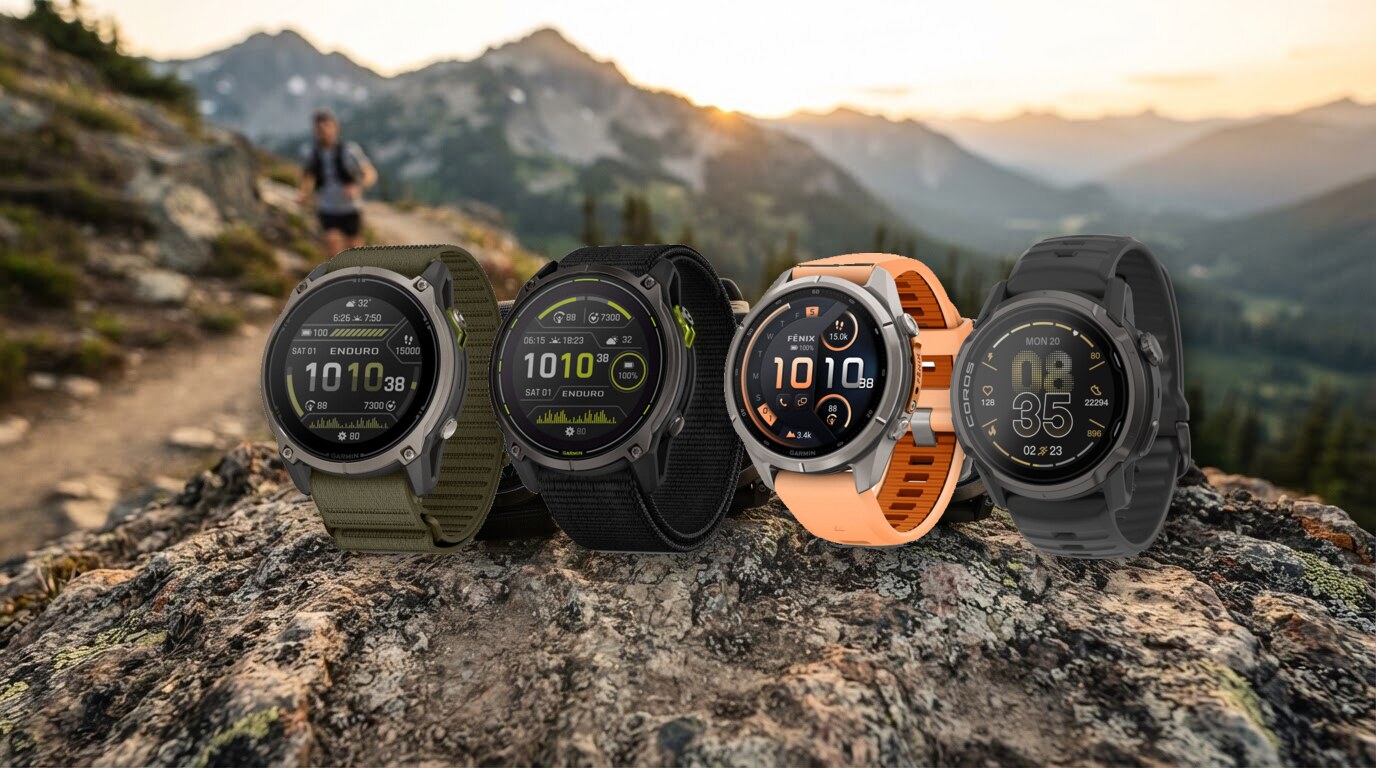
The best watch for trail running depends on how long you run in one go. For ultras and multi-day races, Garmin Enduro 4 leads this selection: up to 80 h of training without recharging and 66 g on the wrist. If price and a compact size matter, and training rarely lasts longer than two days, COROS APEX 4 costs $479: 64 g, up to 53 h of training, maps, sapphire, a titanium bezel, a speaker and a microphone. fēnix 9 is the flagship with an AMOLED display and calls from the watch, while fēnix 9 Pro is the only model here with LTE and satellite connectivity.
The launch of Enduro 4 prompted this comparison. It is an Enduro 3 with new internals: according to official specifications, the case, display and battery are unchanged, as is the $899.99 price, while storage has doubled and features from fēnix 9 have been added. Below are a comparison table based on official Garmin and COROS specifications, a breakdown of the differences and guidance on choosing a watch. Prices are manufacturers' suggested retail prices in the US; pricing and availability differ in other countries.
Comparison table
| Specification | Enduro 4 | Enduro 3 | fēnix 9, 51 mm | fēnix 9 Pro Solar, 51 mm | COROS APEX 4, 46 mm |
|---|---|---|---|---|---|
| Price (US) | $899.99 | $899.99 at launch | from $999.99 (range) | from $1,099.99 (Pro range) | $479 (42 mm — $429) |
| Display | MIP 1.4″, 280×280, touchscreen, solar charging | MIP 1.4″, 280×280, touchscreen, solar charging | AMOLED 1.4″, 454×454, touchscreen | MIP 1.4″, 280×280, touchscreen, solar charging | MIP 1.3″, 260×260, touchscreen |
| Glass | sapphire | sapphire | sapphire | sapphire | sapphire |
| Case dimensions | 51×51×15.7 mm | 51×51×15.7 mm | 51×51×14.7 mm | 51×51×16.6 mm | 46.2×46.2×13.7 mm |
| Weight with strap | 66 g | 63 g | 91 g | 102 g | 64 g (silicone), 51 g (nylon) |
| Case | polymer, titanium bezel | polymer, titanium bezel | polymer, titanium case back | titanium | polymer, titanium bezel |
| Storage | 64 GB | 32 GB | 64 GB | 64 GB | 32 GB |
| Maps on the watch | yes | yes | yes | yes | yes, downloadable |
| Watch mode | up to 36 days / 90 with solar charging | up to 36 days / 90 with solar charging | up to 29 days | up to 30 days / 57 with solar charging | up to 24 days |
| Training, all satellite systems | up to 80 h / 144 h with solar charging | up to 80 h / 144 h with solar charging | up to 54 h | up to 75 h / 124 h with solar charging | up to 53 h |
| Training, dual-frequency mode | up to 60 h / 90 h with solar charging | up to 60 h / 90 h with solar charging | up to 45 h | up to 54 h / 75 h with solar charging | up to 41 h |
| Training, maximum power saving | up to 210 h / unlimited with solar charging | up to 210 h / unlimited with solar charging | up to 145 h | up to 186 h / 1000 h with solar charging | no separate mode listed in the specifications |
| Flashlight | yes | yes | yes | yes | no |
| Speaker and microphone | no | no | yes, calls and voice | yes, calls and voice | yes, calls and voice |
| LTE and satellite connectivity | no | no | no | yes, inReach, subscription required | no |
| Water resistance | 10 ATM | 10 ATM | 10 ATM, diving to 40 m | 10 ATM, diving to 40 m | 5 ATM, not for diving |
Garmin calculates solar charging figures at 50,000 lux: three hours outdoors per day for watch mode, and continuous sunlight for training. The gain is much smaller in cloudy weather, so figures without solar charging offer a fairer comparison. The table uses the current specifications page for COROS APEX 4: the launch press release listed up to 65 h with all satellite systems for the 46 mm version; the current figure is up to 53 h.
Enduro 4 versus Enduro 3: what is new
There are few hardware differences. The case, display and main battery life modes match in the official specifications: up to 36 days in watch mode, up to 80 h of training with all satellite systems, up to 120 h in extended battery mode and up to 320 h with solar charging. Enduro 4 is 3 g heavier — 66 g versus 63 g. Here are the actual changes:
- 64 GB of storage instead of 32. Twice as much space for offline maps and music — useful for those running in new regions without a phone.
- 50% more RAM and a new mapping engine. According to Garmin, maps scroll up to 30% faster, and a perspective view has been added for navigation.
- Grade-adjusted pace targets. You can set a target pace adjusted for terrain (grade-adjusted pace) in a workout and see a rolling adjusted pace — a fairer measure than regular pace on trails and hilly routes.
- Stamina zones and stamina curve. A new way to view your remaining energy at the current effort.
- Garmin Epic. Multi-day hikes, stage races and expeditions are combined from individual activities into a single story in Garmin Connect.
- Rowing and rucking. For indoor rowing — VO2max and a power curve; for rucking — load weight that can be changed during the activity.
- A new ComfortFit strap made of fabric with a QuickFit attachment.
The announcement does not say whether Enduro 3 will receive some of these features through a firmware update. If you already wear an Enduro 3 and have enough storage for maps, the reason to upgrade comes down to the new features — it is worth waiting for clarity on updates.
Enduro 4 versus fēnix 9: two different approaches
fēnix 9 is a flagship with an AMOLED display, three sizes (43, 47 and 51 mm), diving to 40 m, and a speaker and microphone for calls and voice commands from the wrist. The Pro version has a titanium case, an AMOLED display with brightness up to 3000 nits, and LTE and satellite connectivity with inReach messaging — a separate plan is required. The Pro range also includes a Solar version with a MIP display and solar charging: up to 57 days in watch mode, but 102 g on your wrist. fēnix 9 and Enduro 4 share the new features — Garmin Epic, stamina, rowing, rucking, faster maps and 64 GB of storage.
Enduro 4 excels at what people buy it for: it is 25 g lighter than the 51 mm fēnix 9 and 36 g lighter than fēnix 9 Pro Solar, and it lasts up to 80 h with all satellite systems versus 54 h for fēnix 9. The MIP display is easy to read in sunlight without using battery power for a backlight, but falls short of AMOLED in sharpness and color. Enduro has no speaker or microphone: only fēnix 9 lets you call and dictate from your wrist.
COROS APEX 4: a mountain watch that costs less than Garmin
COROS APEX 4 is a COROS mountain watch in two sizes: 46 mm for $479 and 42 mm for $429. The 46 mm version weighs 64 g with a silicone strap and 51 g with a nylon strap — close to Enduro 4 at 66 g. Its MIP touchscreen is protected by sapphire glass, and the bezel is made of Grade 5 titanium. It has the essentials for trail running: downloadable Landscape maps with trail and street names and Topo maps, checkpoints and navigation back to the start, off-route alerts, dual-frequency navigation, a barometric altimeter and a compass. A speaker and microphone allow calls through a connected phone directly from the watch, voice notes and spoken prompts.
The main differences from Enduro 4 are battery life and solar charging. Up to 53 h with all satellite systems is enough for single-day trails and most ultras lasting up to a day, but leaves less reserve than Enduro for multi-day races without recharging. The APEX 4 specifications do not list solar charging or a flashlight; water resistance is 5 ATM, with no diving. The 42 mm version is lighter at 56 g but has shorter battery life: up to 34 h of training and up to 15 days in watch mode.
Which watch to choose for trail running
- Ultramarathons, multi-day races, mountains — Enduro 4. Maximum battery life at a low weight, a flashlight and solar charging.
- Single-day trails and ultras lasting up to a day, with a budget of up to $500 — COROS APEX 4. Maps, sapphire, titanium, a speaker and up to 53 h of training for almost half the price of Enduro 4.
- Already own Enduro 3 — upgrading makes sense if you need more map storage or want the new features right now. Battery life will not improve with the upgrade.
- A bright AMOLED display, calls and voice features from the watch, different sizes, diving — fēnix 9. Battery life is shorter, but still comfortably covers most training sessions during the week.
- Connectivity without a phone in the mountains and on the water — fēnix 9 Pro: it is the only model with LTE and satellite messaging.
All four models work with 1trAIner
Garmin watches connect through the Garmin integration: workouts and daily metrics — sleep, HRV, resting heart rate and Body Battery — are imported into 1trAIner automatically. COROS APEX 4 connects through the COROS integration: workouts are imported, along with sleep, HRV and training load if the watch recorded them; the daily plan can be sent to the COROS calendar by enabling this in your account. The AI coach recalculates the plan based on actual training load and recovery. For an explanation of HRV and how to interpret it on your watch, see the guide to heart rate variability (HRV).
Frequently asked questions
Which watch is best for trail running?
For ultras and multi-day races in this selection, Garmin Enduro 4 offers up to 80 h of training without recharging at a weight of 66 g. For single-day trails and ultras lasting up to a day on a budget of up to $500, COROS APEX 4 offers up to 53 h of training, maps, sapphire and titanium. fēnix 9 suits those who want an AMOLED display and calls from the watch, while fēnix 9 Pro adds LTE and satellite connectivity.
How does Garmin Enduro 4 differ from Enduro 3?
According to official specifications, the case, display and battery life are the same, as is the US price of $899.99. Enduro 4 has 64 GB of storage instead of 32, 50% more RAM, faster maps and new features: grade-adjusted pace targets, stamina zones, Garmin Epic, and tools for rowing and rucking. It is 3 g heavier, at 66 g.
How long does the Garmin Enduro 4 battery last?
According to Garmin — up to 36 days in watch mode and up to 90 days with solar charging, up to 80 h of training with all satellite systems and up to 120 h in extended battery mode, or up to 320 h with solar charging. Garmin calculates solar figures at 50,000 lux.
How does COROS APEX 4 differ from Garmin Enduro 4?
APEX 4 costs almost half as much ($479 versus $899.99), weighs almost the same (64 g versus 66 g), and also offers maps, sapphire and a titanium bezel, plus a speaker and microphone. Enduro 4 lasts longer — up to 80 h of training versus 53 h for APEX 4 — and adds solar charging, a flashlight and 10 ATM water resistance.
Which should you choose: Enduro 4 or fēnix 9?
Enduro 4 is for ultras, multi-day races and those who value low weight and battery life. fēnix 9 is for those who want an AMOLED display, calls and voice commands from the wrist, a choice of three sizes and diving to 40 m, with the Pro version also offering LTE and satellite connectivity.
Do these watches work with 1trAIner?
Yes. Garmin watches connect through the Garmin integration, and COROS APEX 4 through the COROS integration. Workouts, sleep and recovery data are imported into 1trAIner automatically, and the AI coach takes them into account in the plan.
Specifications are based on official product pages, specifications pages and press releases from Garmin and COROS as of October 6, 2026. The cover uses official watch images from the manufacturers’ websites: Garmin Enduro 4, Garmin Enduro 3, Garmin fēnix 9, COROS APEX 4; the background is an illustration. Garmin, Enduro, fēnix, COROS and APEX are trademarks of their respective owners.