Meeting the finish cutoff on paper doesn't mean you'll complete the trail running course: an aid station can close before the finish. You need to account not only for your average pace over the whole distance, but also for the time of each section, your stops, and the buffer before each cutoff. A working schedule answers a specific question: what time do I need to leave the nearest checkpoint so that the next one stays reachable without trying to run faster than you're capable of.
Why the finish cut-off is not enough
Cut-off is the maximum time to pass a checkpoint. Organizers may separately limit arrival at a checkpoint, departure from it, and the finish. If the cut-off applies to departure, arriving two minutes before closing is not enough for a ten-minute stop. You need to read the rule in the regulations, not guess from a label on the course map.
A 12-hour finish for 50 km looks like an allowed 14 minutes 24 seconds per kilometre including stops. But this average says nothing about the location of the climbs. If the first big elevation gain is before an early checkpoint, you might miss its cut-off, even though the estimated finish time formally fits within twelve hours.
- Time basis. Clarify whether the cut-off is counted from the mass start, your wave start, or a set time of day. Don't substitute the official count with the time on your watch.
- All mandatory points. Write down the distance, elevation gain between checkpoints, closing time, and cut-off rule. Check the current version of the route and regulations.
- Buffer at the checkpoint. This is the cut-off minus the estimated arrival or departure time — depending on the rules. It is this remaining time, not the buffer at the finish, that shows the nearest constraint.
It's convenient to keep two columns: time from start and time of day. The first helps calculate segments, the second — to check against the organizers' signs. If the start is delayed or the route changed, the schedule must be checked again. Early checkpoints are especially important: a large buffer after the last pass does not compensate for being late to it.
How to convert the profile into minutes
Break the route by checkpoints, and long stretches also by noticeable changes in terrain. For each segment, estimate the kilometres of flat, ascent, and descent, as well as elevation gain. Take distances from one source so they add up to the course length. A kilometre of steep ascent cannot be recorded simultaneously as flat and ascent.
For a first approximation, a simple model works: moving time = kilometres of flat and ascent × base minutes per kilometre + hundreds of metres of gain × additional minutes + kilometres of descent × separate minutes per kilometre. Here, horizontal progress on the ascent is already accounted for by the base pace, and the surcharge reflects slowing due to elevation gain. We do not subtract elevation loss separately: it is accounted for by the descent pace.
- Flat. Use a sustainable pace on similar trail with a race vest, not a result from a short road run. For our example, this is 8 min/km, but sand, mud, and narrow trail can noticeably change the number.
- Ascent. Choose the surcharge based on your own training. If a 4 km ascent with 600 m gain takes 68 minutes, the base part at 8 min/km equals 32 minutes. The remaining 36 minutes gives 6 additional minutes per 100 m of gain.
- Descent. Calculate it separately. In the example we use 9 min/km: a rocky descent can be slower than a smooth trail. On a smooth road and on wet roots, different benchmarks are needed.
A linear model describes very steep slopes, stairs, queues, and sections where you have to use your hands poorly. Such places are better calculated separately based on the time to cover similar terrain. Do not add an elevation gain allowance to the already calculated ascent time: otherwise you will count the same difficulty twice.
Check the coefficients on several long outings, recording movement and stops separately. Compare the first and last third of the workout: the pace of fresh legs should not be applied to the whole day. Increase duration and difficulty gradually; the purpose of the test is to collect data, not to run the entire race in advance.
What to include beyond moving time
Planned time losses and a free buffer are different things. If you have set aside ten minutes for an aid station in advance, they are already included in the schedule. The remainder up to the cutoff is left for deviations from the plan. You cannot call the same ten minutes both a stop and a safety margin.
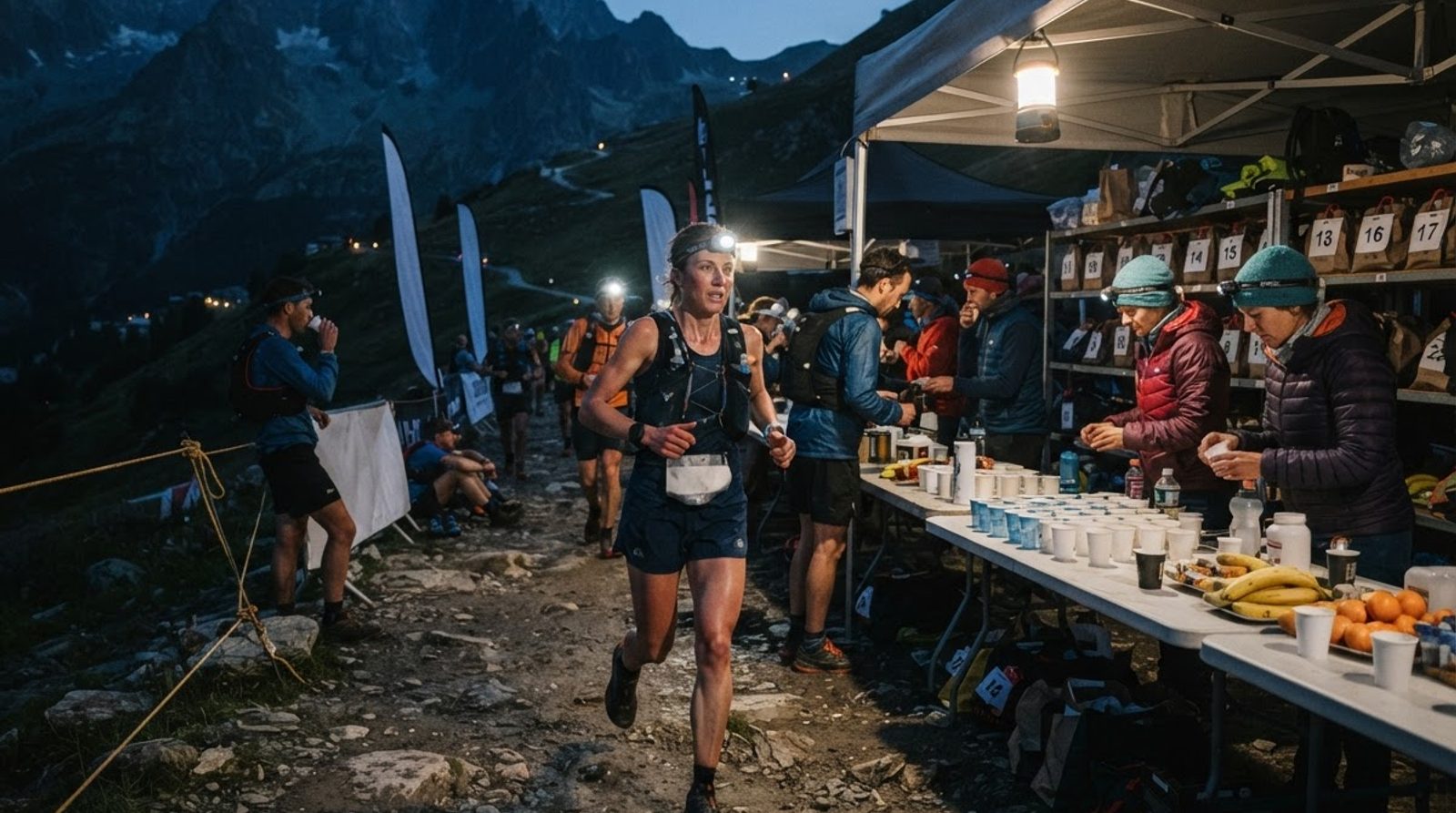
- Aid stations. For an estimate, you can allocate 5–10 minutes for a simple station and 10–15 minutes for one with additional tasks. The time depends on queues, water placement, and whether you need to take things out of your backpack. It is better to test your sequence of actions in training.
- Changing clothes. Allocate, for example, 5–10 minutes to change a layer and repack items. If this happens during a stop at a station, count only its total duration, and do not add up overlapping actions.
- Night. For the first scenario, you can increase the time of the night section by 10–20 percent. This is not a universal rule: a familiar wide trail and an unfamiliar rocky slope require different times. Also consider the stop to prepare your headlamp.
- Navigation. A small reserve of 10–20 minutes for the entire distance covers only short checks and minor mistakes. It does not make a major off-route detour acceptable. At complex junctions, it is better to check the track immediately.
- Fatigue. As a starting hypothesis, add 10–20 percent to the moving time on later sections and then refine it based on long workouts. If the late pace is already taken from the end of such outings, an additional increase may be unnecessary.
In addition to the main schedule, make a less favorable scenario: for example, slower descents after rain and two longer stops. Recalculate all points, not just the total. A buffer of 20–30 minutes before a difficult leg may turn out to be modest, even if it looks large next to a short stop. Its sufficiency depends on the length of the section and the uncertainty of the pace.
Example: 50 km and 2500 m of elevation gain
Let's take a hypothetical distance with aid stations every 10 km and a finish at the 50th. This is a training route, not a description of a specific race. The total descent is also 2500 m. We use 8 min/km for flat terrain and the horizontal part of ascents, plus 6 minutes per 100 m of elevation gain; descents are calculated at 9 min/km. There are no technical obstacles on the route that require separate calculation.
All times below are from the start. At the four intermediate stations, the cutoff applies on exit, and at the finish — on arrival. The stops are 8, 10, 12, and 10 minutes. The twelve minutes at the third station already include changing clothes. We do not plan additional stops outside the stations in the main schedule.
- 0–10 km. Flat 4 km, ascent 4 km with 600 m of elevation gain, descent 2 km with 200 m of loss. Moving: 8 × 8 + 6 × 6 + 2 × 9 = 118 minutes. Arrival at 1:58, stop 8 minutes, exit at 2:06. With a cutoff of 2:30, the buffer is 24 minutes.
- 10–20 km. Flat 3 km, ascent 4 km with 700 m of elevation gain, descent 3 km with 500 m of loss. Moving: 7 × 8 + 7 × 6 + 3 × 9 = 125 minutes. Add 5 minutes for navigation delays. Arrival at 4:16, exit after 10 minutes at 4:26. Cutoff 5:00, buffer 34 minutes.
- 20–30 km. Flat 4 km, ascent 2 km with 400 m of elevation gain, descent 4 km with 700 m of loss. Moving: 6 × 8 + 4 × 6 + 4 × 9 = 108 minutes. Add 10 minutes for fatigue and 5 for navigation. Arrival at 6:29, exit after 12 minutes at 6:41. Cutoff 7:15, buffer 34 minutes.
- 30–40 km. Flat 3 km, ascent 3 km with 600 m of elevation gain, descent 4 km with 400 m of loss. Moving: 6 × 8 + 6 × 6 + 4 × 9 = 120 minutes. Add 15 minutes for fatigue and 5 for navigation. Arrival at 9:01, exit after 10 minutes at 9:11. Cutoff 9:45, buffer 34 minutes.
- 40–50 km. Flat 4 km, ascent 1 km with 200 m of elevation gain, descent 5 km with 700 m of loss. Moving: 5 × 8 + 2 × 6 + 5 × 9 = 97 minutes. Add 20 minutes for fatigue, 15 for darkness, and 5 for navigation. Finish at 11:28. With a cutoff of 12:30, 62 minutes remain.
Sum check: base movement — 568 minutes, stops — 40, fatigue — 45, darkness — 15, navigation — 20. Total 688 minutes, or 11 hours 28 minutes. We assume that the last leg takes place in darkness, and the previous ones in daylight. In a real race, this needs to be checked against the start time and sunset; if delayed, the night section may begin earlier.
The bottleneck here is the first station with a 24-minute buffer, not the finish. If each of the 18 km of descent takes two minutes longer, the total will increase by 36 minutes. On exit from the fourth station, the buffer will decrease from 34 to 8 minutes: by that point, 13 km of descents have been covered. The finish still looks achievable, but the intermediate schedule has already become fragile.
If your schedule starts to slip
At each checkpoint, compare your actual time with the plan and recalculate the next cutoff: available time = closing time of the next checkpoint − current time. From that, subtract a realistic time for the remaining section and any mandatory stop if there is a cutoff at the exit. A negative remainder cannot be fixed by simply hoping for a faster descent.
- First, cut the unnecessary at stops. Decide in advance what to refill and take out. Reducing idle waiting, repacking your backpack, and long conversations is more useful than trying to make up the same minutes with a burst after the checkpoint.
- Don't skimp on the essentials. Water, nutrition, appropriate clothing, a working headlamp, and checking your direction remain part of completing the route. If there's no time for them, the schedule needs revising, not abandoning these actions.
- Look for the cause of the delay. A one-off queue won't necessarily repeat. But if all climbs are slower than calculated, update the coefficient for the remaining elevation gain. An old forecast in this situation only hides the problem.
- Don't try to win it all back on difficult terrain. A steep climb and technical descent often give almost no safe gain from extra effort. On an easy trail you can return to your sustainable pace, but don't turn the rest of the route into a chase.
If the next cutoff is only reachable at a pace you couldn't hold even when fresh, discuss the situation with the volunteers and follow the rules. Don't cut the course and don't continue after an official withdrawal. A good calculation isn't needed to guarantee a finish, but to see the limit earlier and make a decision without rushing.
In 1trAIner, the AI coach builds a plan as a cascade Season → Month → Week → Day. Data from Garmin and Apple Watch syncs automatically, the week is recalculated after each workout; the first 7 days are free.
This material is for informational purposes and does not replace a doctor's consultation.