A strong quadriceps doesn't replace a strong posterior chain. To push off, control the leg during swing, and keep the pelvis stable under load, a runner needs the glutes, hamstrings, and spinal extensors. If strength training comes down to squats and lunges, part of this work easily stays out of the picture. The goal isn't to add more exercises, but to give each group a clear load and leave energy for running.
What the posterior chain does and why it gets overlooked
The posterior chain is a collective name for related muscle groups, not a single muscle. They work together but perform different tasks. So feeling fatigue in the lower back after a deadlift doesn't necessarily mean the glutes and hamstrings got the right load.
- Glutes. The gluteus maximus is one of the main drivers of hip extension during push-off, especially when effort increases, such as on a climb or during acceleration. The gluteus medius and minimus help control the pelvis when standing on one leg. At the same time, push-off itself isn't created by the pelvis alone: the lower leg and foot also contribute.
- Hamstrings. The biceps femoris, along with other muscles in this group, helps extend the hip and flex the knee. At the end of the swing, they eccentrically brake knee extension and lower leg movement: the muscle produces force while lengthening.
- Spinal extensors. They help maintain torso position and transmit force. Their job in a bridge or deadlift is not to replace hip movement with noticeable lower back arching.
The quadriceps is easier to notice: after unfamiliar squats, it reminds you on the stairs, and the work of the front thigh is easier to imagine. The posterior chain isn't visible in the mirror during running, and the usual load on it may not produce such obvious soreness. But that's not a property of "muscles that don't hurt": after the first Nordic, the hamstrings can respond very noticeably. Soreness doesn't measure the benefit of a workout.
When strength or control of the posterior chain is lacking, part of the task may shift to the quadriceps and lower back. This isn't a diagnosis based on running form and isn't a universal explanation for pain. The practical point is simpler: the posterior chain shouldn't be skipped in any discipline, even if regular running doesn't cause discomfort.
Hip thrust and bridge: extend the hip, not the lower back
In a glute bridge, the shoulders stay on the floor; in a hip thrust, the upper back rests on a stable bench. Both options allow you to load hip extension without a complex balance task. For road running, this is a convenient focus for strength work on the glutes; for trail running, it's an important base that is then supplemented with movements for the terrain.
- Starting position. Feet are firmly on the floor, knees move roughly in the direction of the toes. In the hip thrust, the support doesn't slip or press on the neck. The distance from the feet to the pelvis is chosen so that the movement remains controlled.
- Lift. Lift the pelvis using the glutes, keeping the ribs down, without puffing out the chest. There's no need to reach the pelvis as high as possible: finish the movement where the hip has extended and the lower back hasn't yet started compensating for height.
- Top position. Pause for 1–2 seconds, then lower the pelvis calmly. Aim for about two seconds on the way down, without dropping or bouncing off the floor.
The main mistake is overextending the lower back for a few extra centimeters of lift. If the pause at the top only happens with arching, reduce the height or resistance. Feeling effort in the glutes is useful as feedback, but a stable torso position and repeatable technique matter more.
To get started, you can aim for 2 sets of 8–12 reps with body weight or light resistance. With experience and in the base period, the volume can be higher, and closer to a race — lower. This is not a mandatory norm: finish the set with a few technically clean reps in reserve. Pain is not a reason to find a way to complete the prescribed number at any cost.
Nordic: a small dose, high eccentric load
In the Nordic hamstring curl, you kneel with your shins securely anchored, and your torso and hips slowly lean forward in roughly one line. Your hamstrings resist the fall and lengthen under load. This is a different emphasis than in the bridge: here the work of the knee flexors is especially noticeable.
You need soft padding under your knees, secure anchoring of your shins, and free space for your hands in front. Do not use random furniture that might shift. Lower only to the point where you still control the movement, then catch your weight with your hands. To return, help with your hands or a suitable band: coming back up solely by hamstring strength is not required at the start.
Start with 1–2 sets of 3–5 reps in a short, controlled range of motion. You can aim to lower over 2–3 seconds, but don't hold that pace at the cost of a sharp collapse at the end. For a beginner, it's more important to master a few careful reps; for an experienced runner, take into account the training load already accumulated during the week. Increase the range of motion and volume gradually, not at the same time.
Nordic hamstring curls create a high eccentric load, and soreness may appear with a delay. Don't start abruptly, and don't schedule your first session 2–3 days before a long run or ahead of a key speed workout. After an unfamiliar load, recovery sometimes takes longer: the calendar interval alone does not guarantee readiness. If your gait and usual running technique change, progression is postponed.
Managing braking on descents is a separate task: Nordic does not replace preparation for terrain. More on that in the article “Strength for trail: six exercises for descents”. Here it is enough to remember that new strength exercises and unfamiliar descents should not be added in large doses at the same time.
Single-leg Romanian deadlift: strength together with balance
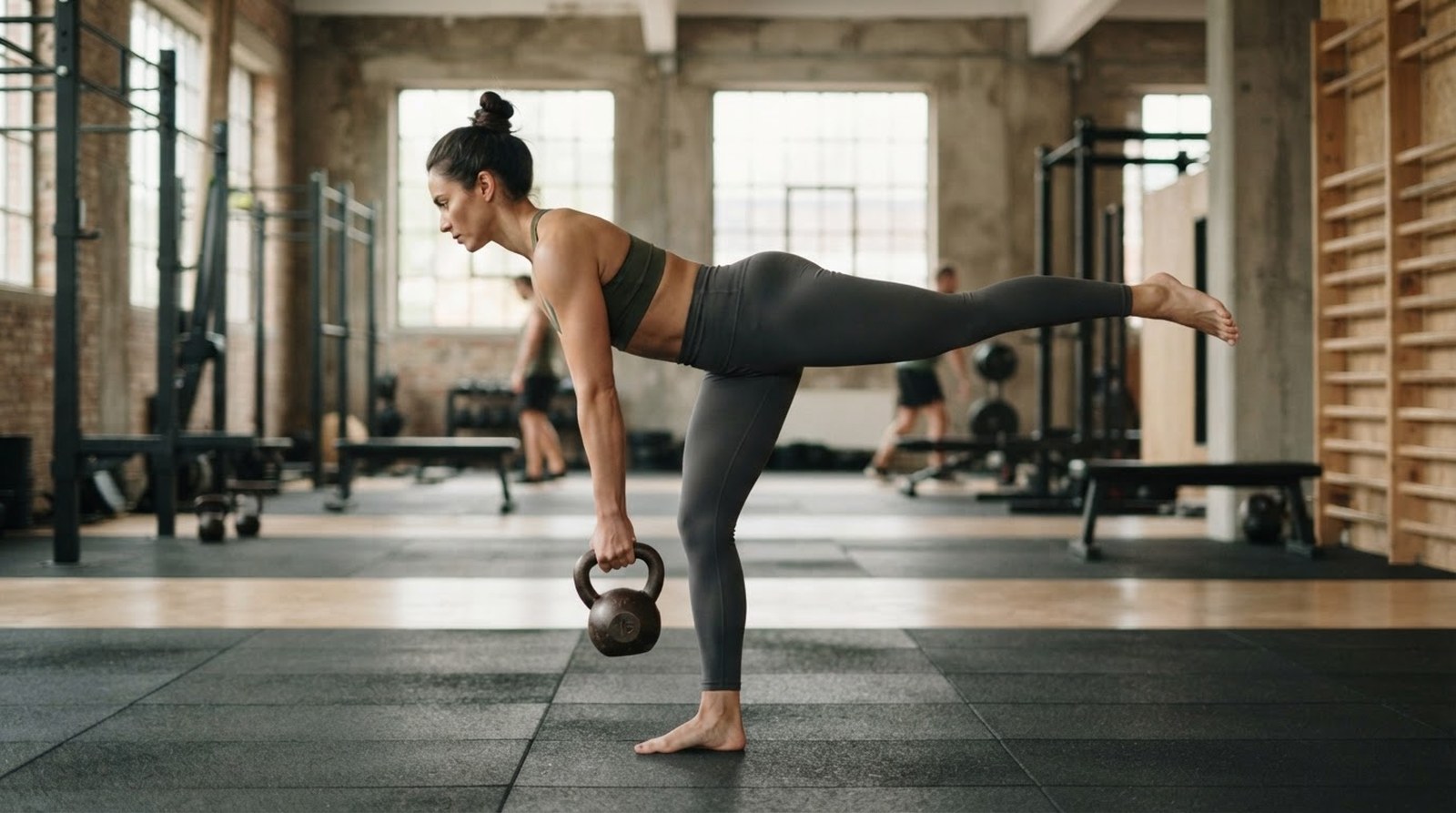
The single-leg Romanian deadlift links the work of the glutes and hamstrings with pelvic control in single-leg support. The support knee is slightly bent, the pelvis moves back, and the free leg goes back along with the torso lean. The movement occurs mainly at the hip joint, not by rounding the back or rotating the pelvis outward.
You do not need to reach the floor with the weight. The working depth ends where you can still keep the pelvis level and maintain your back position. At the start, it is acceptable to hold on to a rack with one hand: this helps load the muscles instead of turning every rep into an attempt not to fall. Details and progression options are in the article on single-leg exercises for runners.
A guideline for a mastered movement is 2 sets of 6–10 reps per side with a smooth 2–3 second lowering. Experience, the training phase, and how you respond after the session determine the weight and volume; the less confident side sets the feasible level. More reps are not needed if the pelvis is already rotating and balance is maintained in jerks.
Pelvic mobility: let the hip move freely
The feeling of tight hip flexors does not always mean the muscles are actually shortened. But limited hip extension can shorten the backward leg movement, and trying to compensate for it can increase the arch in the lower back and the feeling that it is being pulled. Do not force a longer running stride: what matters more is available movement in the hip joint without substituting movement of the back.
Before running, gentle dynamic work is suitable: controlled swings with a small amplitude, steps into a shallow lunge, smooth hip movements in a lunge position with the knee supported. A guideline is 5–8 easy repetitions per side, without bouncing jerks or trying to push through the limitation. The volume depends on your habit with the warm-up and how freely you can move.
Long static holds are better moved to a separate short session, not placed immediately before fast sessions, and not turned into a competition for depth. Mobility complements strength, it does not replace it. If the restriction is accompanied by pain or persists regardless of warm-up, the cause and whether the load is acceptable should be determined by a doctor.
How to keep the essentials and fit them into the running week
If time is short, the single-leg Romanian deadlift and hip thrust cover the main part of the basic strength task for the posterior chain in all three disciplines. The first adds pelvis control and load in a hinge, the second allows you to focus separately on hip extension. This is not the whole of strength training: the exercises do not replace work for the lower leg, foot, and specific running load. Nordic can be added in a small dose when there is recovery capacity for it.
Before the mountain season, it makes sense to set aside 8–12 weeks for a foundation of eccentric and basic single-leg exercises. This is a block for developing pure strength, not a refusal to run for three months. To start, one or two short strength training sessions per week can serve as a guideline: the frequency is chosen based on experience, running volume, and recovery. New exercises are first learned with light resistance.
Closer to the race, the principle of specificity applies: some exercises and the nature of the load increasingly replicate the real mechanics of the distance. Basic strength is maintained with less volume, not reset to zero. Strength to failure before a key running session steals its quality; adding weight makes sense only when technique is stable and the next important workout does not suffer.
Technique matters more than weight and the plan on paper. With pain above 3–4 out of 10, stop the exercise; sharp or increasing pain is also a reason to stop, even if the rating is lower. This scale does not permit enduring any mild pain. With pain and suspected injury, the decision to continue the load is made by a doctor, not by a table of sets.
In 1trAIner, the AI coach builds the plan as a cascade Season → Month → Week → Day. Data from Garmin and Apple Watch watches sync automatically, and after each workout the week is recalculated. The first 7 days are free.
This material is for informational purposes and does not replace a doctor's consultation. Decisions about load with pain, injuries, and health limitations are made by a doctor.