In running, there is never support on both legs at once: while one leg takes the load and pushes the body off, the other swings forward, and in the flight phase there is no support at all. That's why two-legged barbell squats only cover part of the task. They build strength but don't replace the work of holding the pelvis level, directing the knee, and transferring force through one foot. For this, a runner needs three basic movements: the split squat, the single-leg deadlift, and the step-up.
Why single-leg exercises matter
On two legs, it's easier to distribute effort and unnoticeably shift part of the work to the stronger side. In a single-leg movement, the difference becomes more noticeable: on one side the pelvis stays level, on the other it rotates; one leg lifts the body calmly, the other looks for help in a push or swing. This isn't a diagnosis but useful information for choosing the load. The working weight should allow you to perform the movement on both legs with comparable quality.
For road running, repeatability of movement and stability under accumulating fatigue are important. On trails, uneven foot placement and changes of direction are added. In the mountains — high stepping, steep inclines, and long work on climbs. The basic exercises are common to these disciplines; the emphases and their place in the plan change. The posterior chain shouldn't be skipped in any of them, even if the main race is on flat asphalt.
At the same time, strength training doesn't have to literally copy the running stride. First, it builds a reserve of strength in controlled conditions. Closer to the race, the principle of specificity applies: some exercises and their parameters are selected to match the real mechanics of the distance. For example, the step-up becomes closer to high stepping on a steep climb, but balancing with a heavy barbell doesn't become more necessary because of that.
Bulgarian split squat: base number one
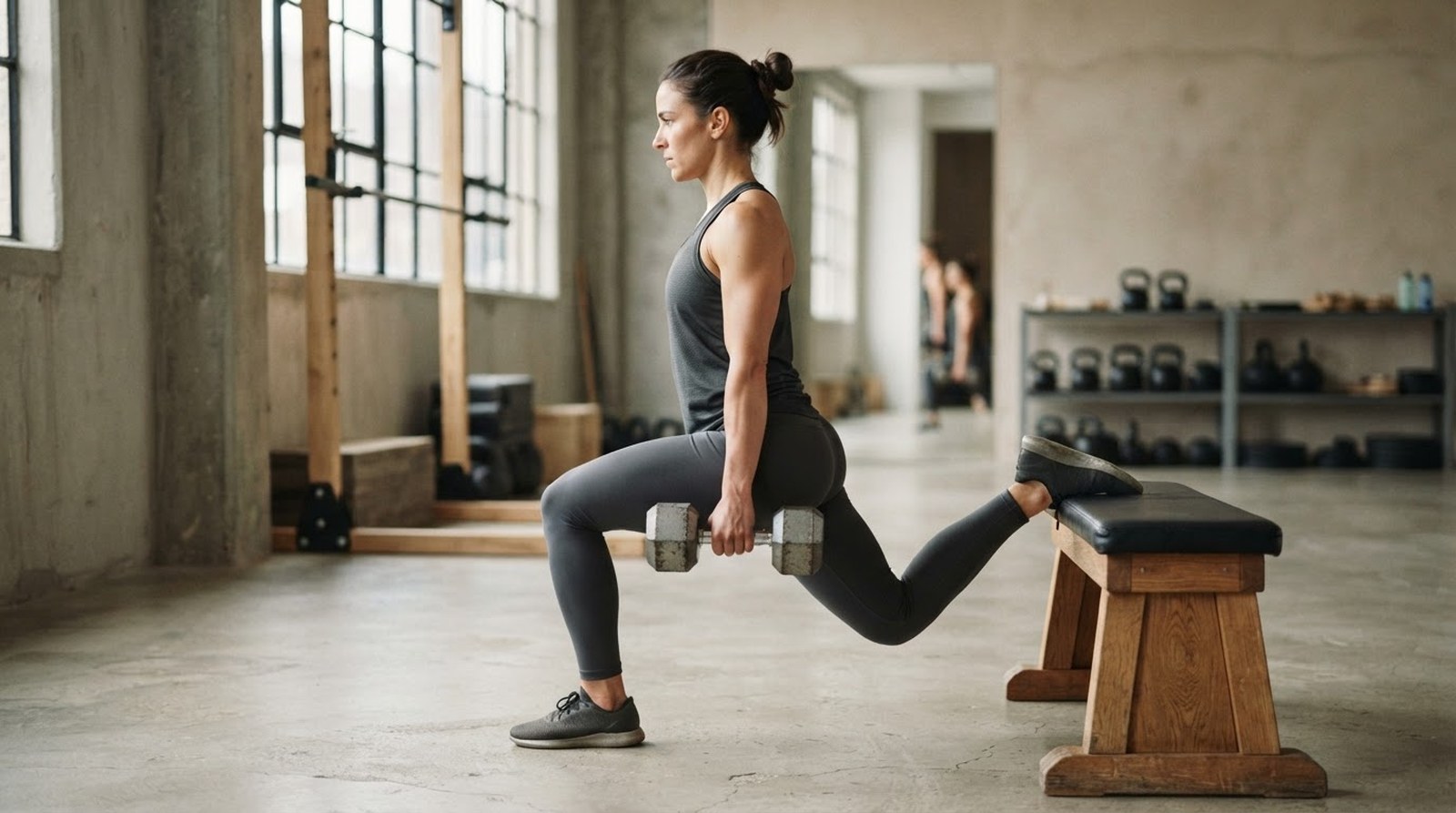
In this trio, the Bulgarian split squat is the number one basic exercise for road runners, trail running, and mountains. It loads the quadriceps and glutes while also requiring pelvic stability. The rear leg remains on the support and helps maintain position, so it is not a complete copy of the single-leg stance phase of running. However, the exercise allows you to gradually develop front-leg strength without the complex balance challenge.
- Starting position. Place the rear foot on a low, stable support. Bring the front foot forward enough to lower without losing balance. There's no universal distance between the feet: it depends on body proportions and available range of motion.
- Lowering. Keep the pelvis level, without rotating or tilting to the side. The front knee moves in the direction of the toes, and the foot maintains stable contact with the floor. A slight forward lean is acceptable if the back stays under control.
- Rising. Rise primarily using the strength of the front leg, without jerking or swinging. Don't seek depth that forces you to tuck the pelvis or lose knee position.
Start without weight, holding onto a rack or another reliable support if needed. This isn't a simplification for the sake of a checkmark: support removes unnecessary struggle for balance and lets you focus on the strength movement. After mastering the technique, aim for 2–3 sets of 6–10 reps per leg. A beginner may need less volume; during a demanding running week, it will also be lower. Pain isn't a reason to just reduce the number of reps and push through it.
Lower under control: about 2–3 seconds down can be a convenient guideline for learning, not a mandatory pace for every session. For mountains there is an additional point: different foot positions partly replicate the asymmetry of technical terrain. But you don't need to increase the height of the rear support for the sake of "mountain specificity": a stable pelvis and front-leg work matter more.
Single-leg Romanian deadlift: posterior chain and balance
If the split squat is responsible for movement with noticeable knee flexion, the Romanian deadlift teaches you to work through the hip joint. Here the emphasis shifts to the glutes and hamstrings. Balance adds a control challenge, but it shouldn't interfere with the main work. If all your attention goes into not falling over, start with light support from your hand.
- Hip movement. Slightly bend the knee of your supporting leg and push your hips back. The free leg moves back together with the torso lean, rather than being lifted separately.
- Back position. Keep your back neutral and your head calm. Think of the lean as movement at the hip joint, not an attempt to round your lower back.
- Rotation control. Don't let your pelvis open toward the free leg. Reduce the range of motion if you can't yet keep it in position.
The main mistake is reaching your hand or the dumbbell toward the floor at the cost of rounding your lower back. The floor is not the goal. The bottom point is where you can still maintain your back position and pelvic control. Return by extending at the hip joint, without leaning your torso back at the end of the rep.
To learn the movement, aim for 2 sets of 6–8 calm reps per side, first without weight. The volume depends on your experience and your other running loads: after a new exercise, your hamstrings may make themselves felt, and not right away. Add weight when you can repeat the lean without your pelvis rotating, not when you manage to reach lower for the first time.
Step-ups: strength for climbing and power hiking
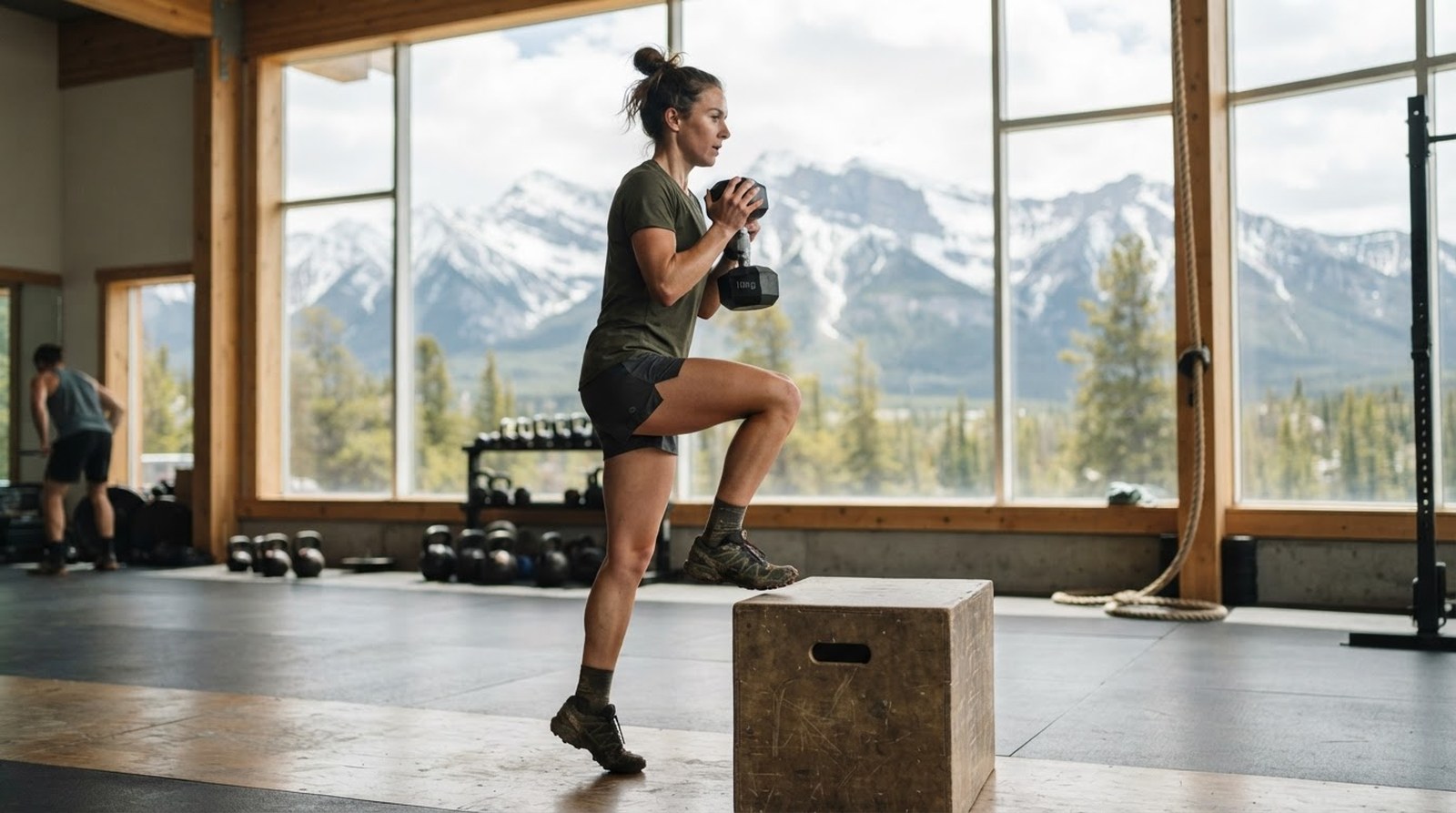
A weighted step-up onto a platform is the most direct of these three patterns for climbing and power hiking, that is, brisk walking on a steep incline. You need to place your foot higher and lift your body onto it. The movement looks simple, but it's easy to turn it into a jump off the lower leg. Then the exercise looks completed, while the upper leg gets a completely different task.
Choose a stable platform with a non-slip surface and place your whole foot on it. Shift the effort to the upper leg, rise without pushing off the lower leg and without pulling your pelvis sideways. Come down calmly, staying in control. If you have to hop before every step-up, the height or the weight is still too much.
- Starting height. Start with a low platform and no weight. The criterion is being able to rise using the upper leg and keep your pelvis steady, not a specific number on the box.
- Height for power hiking. 50–60 cm can be a guideline for a trained runner if you have enough mobility and pelvic control. This is not a mandatory standard: with a different height, proportions, or limited range of motion, it's wiser to stay lower.
- Added weight. Add it only after you've mastered the movement. Don't increase the platform, the weight, and the number of reps at the same time: otherwise it's hard to tell what exactly broke your technique.
A guideline for strength work is 2–3 sets of 6–10 reps per leg, but after the first attempts the volume may be lower. Closer to a mountain race, step-up parameters are tied to the nature of the climbs and the overall load of the week. At the same time, a series on the box doesn't replace practice walking on a real incline, where you need to choose your step, rhythm, and foot placement.
Balance: a supplement, not a replacement for strength
Single-leg balance develops control of body position and proprioception — the ability to sense the position and movement of your joints. For the ankle, this is an important part of reacting to uneven ground. On roots and rocks, this skill can be extra insurance against a roll, but not a guarantee: fatigue, speed, the surface, and where you place your foot all matter.
For mountains this task is critical because the support surface constantly changes. For flat roads, separate work on an unstable surface has almost no effect on the specific demands of running and is usually not a priority. You can start with a single-leg stance on a hard floor next to a reliable support. When that feels calm, add small movements with the free leg or move to a moderately unstable surface.
A few short attempts of 20–30 seconds each are a possible guideline for getting familiar, not a standard. End the attempt when control gives way to constant saving hops. An unstable surface does not replace basic strength, and heavy weight is not combined with instability. If you have a history of ankle injury or current symptoms, the decision on permissible load is made by a doctor.
Progression: technique, volume, then weight
Before the mountain season, it is useful to plan 8–12 weeks of a base block of pure strength: start with controlled eccentric work and basic single-leg movements, not immediately with heavy sets or complex combinations. "Pure strength" here means an emphasis on strength sessions, not cancelling running. The duration and density of the block depend on experience, calendar, and load tolerance.
- Technique and range of motion first. Find the range in which the foot, knee, pelvis, and back stay controlled. Gradually expand it without losing control; greater depth alone does not make a repetition better.
- Then volume. Add repetitions in the mastered range or one set. Assess not only the session but also how you feel on your next runs.
- Then weight. Increase the load in small steps when the previous volume is performed confidently. If technique falls apart, return to the previous load.
Start with the less confident leg and choose the total volume based on its quality repetitions. Noticeable asymmetry is a reason to work on control and gradually even out capabilities, not to set a record with the strong side. There is no need to automatically add twice as much work to the weak leg. If the difference appeared suddenly, is accompanied by pain, or is related to an injury, the decision on further loads is made by a doctor.
Eccentric work can cause delayed soreness: feeling fine right after a session doesn't yet show the full reaction. Don't introduce it abruptly and don't schedule new or unusually heavy eccentric work 2–3 days before a long workout. We cover descent-specific preparation separately in the article "Strength for trail running: six exercises for descents". The goal here is to master the basics, not to fit every type of training into one evening.
Strength training to failure before a key running session steals running quality, so leave repetitions in reserve and account for recovery. Technique matters more than weight. With pain above 3–4 out of 10, stop the exercise; a lower rating does not mean the pain should be ignored. The decision on the causes of pain and whether to continue is made by a doctor, not by a table of sets.
In 1trAIner, the AI coach builds the plan as a cascade Season → Month → Week → Day. Data from Garmin and Apple Watch watches sync automatically, and the week is recalculated after every workout. The first 7 days are free.
This material is for informational purposes and does not replace a doctor's consultation. In case of pain, injury, or doubts about whether a load is permissible, the decision is made by a doctor.