Calves, Achilles, and feet often get attention last: their work is less visible than barbell squats, they don't bother you for a while, and they don't always give the feeling of a hard workout. Meanwhile, with every running step, the muscles and tendons in this area transmit forces that are multiples of body weight. The exact load depends on speed, incline, and technique, but the absence of pain doesn't yet mean the tissues are ready for any volume. A small regular block here is more useful than trying to catch up on everything before a race.
Calf Raises: Why You Need Two Knee Positions
The gastrocnemius and soleus muscles work together to lift the heel and transmit force through the Achilles tendon. But knee position changes their contribution. The gastrocnemius crosses both the knee and ankle joints, while the soleus crosses only the ankle. So one familiar version of calf raises doesn't cover the whole task, and a bent knee doesn't turn the exercise into full isolation of one muscle.
- Straight knee. Standing raises keep a noticeable load on the gastrocnemius. The knee is straight without hard hyperextension, and the body doesn't help the movement with a jerk.
- Bent knee. Seated raises with resistance on the thigh or standing with a held bend shift the emphasis to the soleus. It's important not to straighten the knee as you fatigue.
- Foot control. Pressure is distributed over the forefoot, the heel doesn't roll to the side, and the toes don't grip the floor. Holding on with a hand helps train strength, not just balance.
A working guideline is 2–3 sets of 10–15 reps in the chosen position: smooth up, a short pause at the top, controlled lowering. This isn't a mandatory starting volume for both positions right away. Without experience, you can start with fewer sets on two legs, then master the basic single-leg version, and only after that add resistance. The weight is suitable if the last reps still look like the first ones.
For road running, this block often becomes focus number two or three after more general strength tasks; for trail running, it's an important base for long work on varied terrain. The priority changes with experience, training phase, and tissue condition. The calf doesn't replace the rest of the posterior chain: glutes and hamstrings can't be skipped in any running discipline.
Eccentric Lowering: Load Without a Jerk
In the eccentric phase, the muscle-tendon complex holds the load while lengthening. The Achilles transmits force, and the muscles control the downward movement of the heel. This isn't an attempt to stretch the tendon harder and isn't a universal treatment for pain. For a healthy runner, the exercise can be part of strength training; with tendinopathy, the choice of movement, range, and mode is a doctor's call.
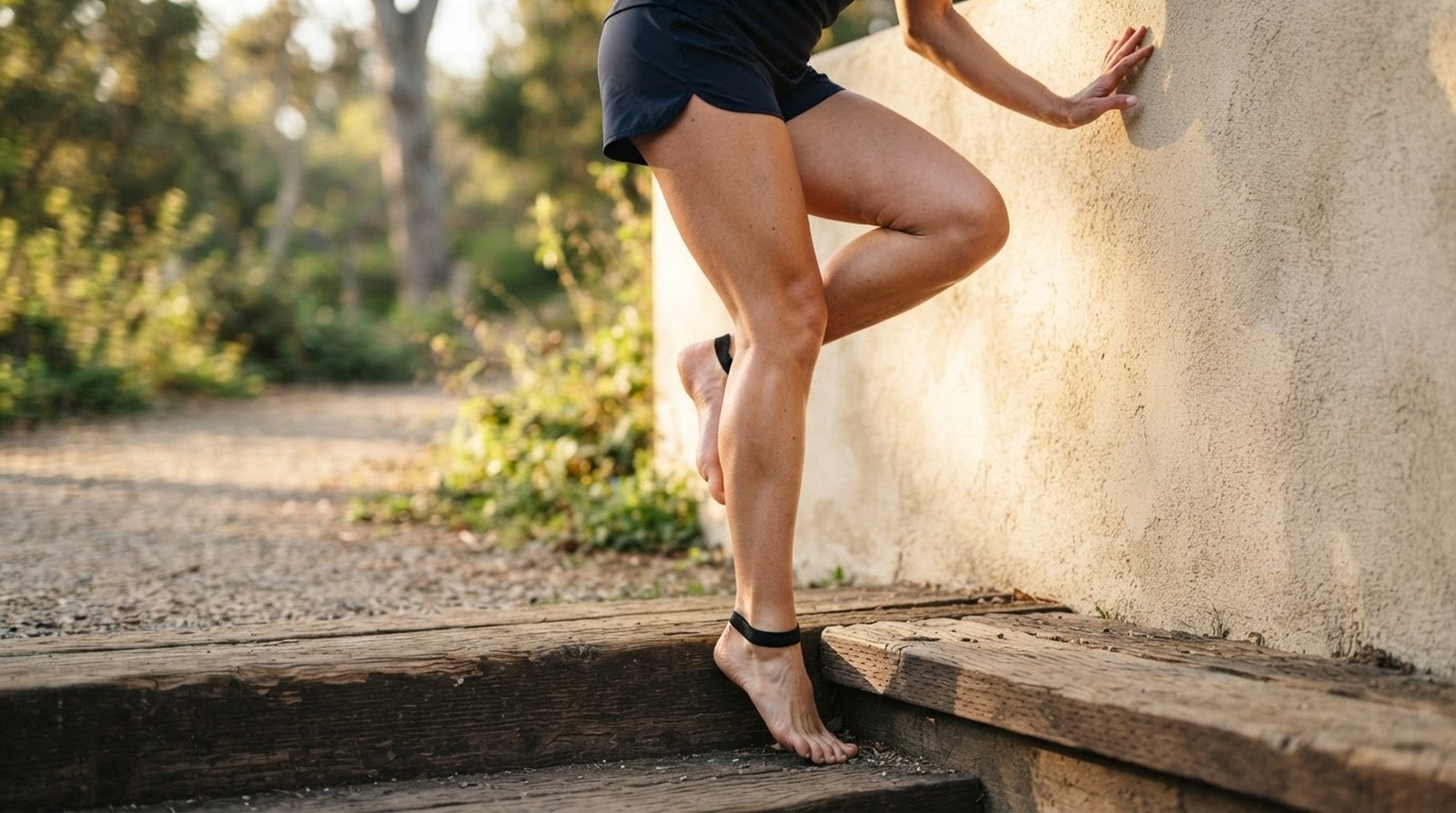
- Rise. Stand next to a stable support and rise onto the balls of both feet. Hold on with a hand for balance, without pulling yourself up.
- Weight shift. Shift your weight onto one leg, keeping the foot and knee position. Unload the other leg without a sharp drop of the heel.
- Lowering. Lower the heel over about 3 seconds, then use both legs again to rise. An initial version is possible on a flat floor: going below the support level with the heel isn't necessary.
For a pain-free introduction, a guideline of 1–2 sets of 6–8 lowerings per side is possible, rather than a large volume on top of all the calf raises. Further dosing depends on strength experience, running load, and next-day response. These exercises partially overlap: regular raises already include an eccentric phase, so a separate block isn't needed automatically.
The guideline "no higher than 3–4 out of 10" appears in rehabilitation protocols, but it does not give you permission to train an injured Achilles on your own. With tendinopathy, the dosage and acceptable pain are determined by a doctor, not by an article. If pain is above 3–4 out of 10, stop the exercise; sharp or unfamiliar pain is also a reason to stop, even if the rating is lower. If it worsens the next day, reduce the load, and the decision to continue with pain is made by a doctor.
Unfamiliar eccentric work causes delayed soreness. Don't start abruptly and don't put the first such block 2–3 days before a long run. Muscle soreness is not a measure of workout quality, and tendon pain should not automatically be considered soreness. Load on downhills is discussed separately in the article "Downhills break your legs: what eccentric load is".
Tibialis anterior: control the lowering of the foot
The tibialis anterior lifts the foot and helps control its position. When landing on the heel, it brakes the lowering of the forefoot so that it doesn't fall uncontrollably. Calf raises alone are not enough for this task: there the movement goes in the other direction. Unfamiliar work can become especially noticeable when changing shoes or increasing downhill volume. There is a separate breakdown on how to choose tread and when a membrane does harm.
A simple version is toe raises at the wall. Lean your back against it, move your feet slightly forward, keep your heels on the floor. Lift your toes toward your shin and slowly lower them, without rocking your torso or lifting your heels. The farther your feet are from the wall, the harder the exercise usually is; choose a position where the movement remains controlled.
A guideline for a runner without pain is 1–2 sets of 10–15 reps with a smooth lift and lower of about 2 seconds. The starting volume depends on experience, and in a busy running week it is wiser to reduce it than to add reps in jerks. Such strengthening can be part of dealing with overload of the front of the shin, but shin pain is not a reason to "work through the pain." Its causes vary; the need for examination and the acceptable load are determined by a doctor.
Knee to the wall: test the movement, don't force the joint
Dorsiflexion is the movement in which the shin approaches the foot. If the available range is not enough for a specific task, the body looks for it elsewhere: the heel lifts earlier, the foot turns out, or the knee path changes. This does not mean that any deviation is dangerous, and one test does not predict injury. It helps notice limitations and compare sides under the same conditions.
- Starting position. Stand facing the wall, place one foot in front of you. The heel and forefoot stay on the floor, the knee moves roughly in the direction of the toes.
- Test. Touch the wall with your knee without lifting the heel or turning the foot out just to gain extra distance. Gradually move the foot back until the movement stays clean.
- Comparison. Note the distance from the big toe to the wall and the sensations on the right and left. Test in the same shoes or barefoot; there is no universal number that every runner must show here.
For gentle work, you can use 1–2 sets of 6–10 slow knee approaches to the wall within a comfortable range. This is a guideline, not a task to move the foot farther every time. Light tension at the back and pinching at the front are different sensations: the front stop should not be forced with body weight. If there is pain, stop the exercise, and discuss the cause of the limitation and further actions with a doctor.
Mobility does not replace strength, and increasing range by itself does not make running more economical. The point is available movement under control: the foot holds the support, the shin moves without jerking, and the knee does not have to be moved aside just to touch the wall.
How to place the work in the week and not ruin your running
Short sessions of 10–15 minutes several times a week often fit in better than one long session. A starting option is two small blocks after an easy run or separately from key workouts. In one you can do straight-knee raises and tibialis anterior work, in the other bent-knee raises and gentle mobility. If needed, separate eccentric lowerings replace part of the raises rather than endlessly increasing total volume.
Before the mountain season it helps to set aside 8–12 weeks of mostly strength work: start with dosed eccentrics and basic single-leg movements, learn the technique, then gradually add resistance. This is a planning guideline, not a guaranteed adaptation timeline. Closer to the race the principle of specificity applies: exercises and running work increasingly mimic the real mechanics of the task. Moving to faster and more elastic work requires an already established base; readiness when in pain is assessed by a doctor.
The growth of a long workout illustrates the same principle well: load is built up gradually, leaving room for recovery. The scheme below applies to running and does not set the dosage of exercises for the Achilles.
Consider more than just kilometres. Moving to asphalt changes familiar conditions, new shoes can redistribute load, and downhills add unfamiliar braking work. When these factors change abruptly, the calf often reacts first. It is not worth simultaneously increasing the long run, adding elevation, and doubling the strength block. Change one significant parameter and track the response, including the next morning.
In regular sets, leave a reserve of clean reps: strength work to failure before a key running session steals running quality. In a heavy training phase or near a race, it is more important to maintain the usual tolerable load than to set a personal best in raises. Technique matters more than weight, and the onset of pain moves the question from choosing a training dose to a discussion with a doctor.
In 1trAIner the AI coach builds the plan as a cascade Season → Month → Week → Day. Data from Garmin and Apple Watch watches syncs automatically, and the week is recalculated after every workout. First 7 days free.
This material is for information only and does not replace a doctor's consultation. If there is pain or a suspected injury, the decision on permissible load and return to training is made by a doctor.