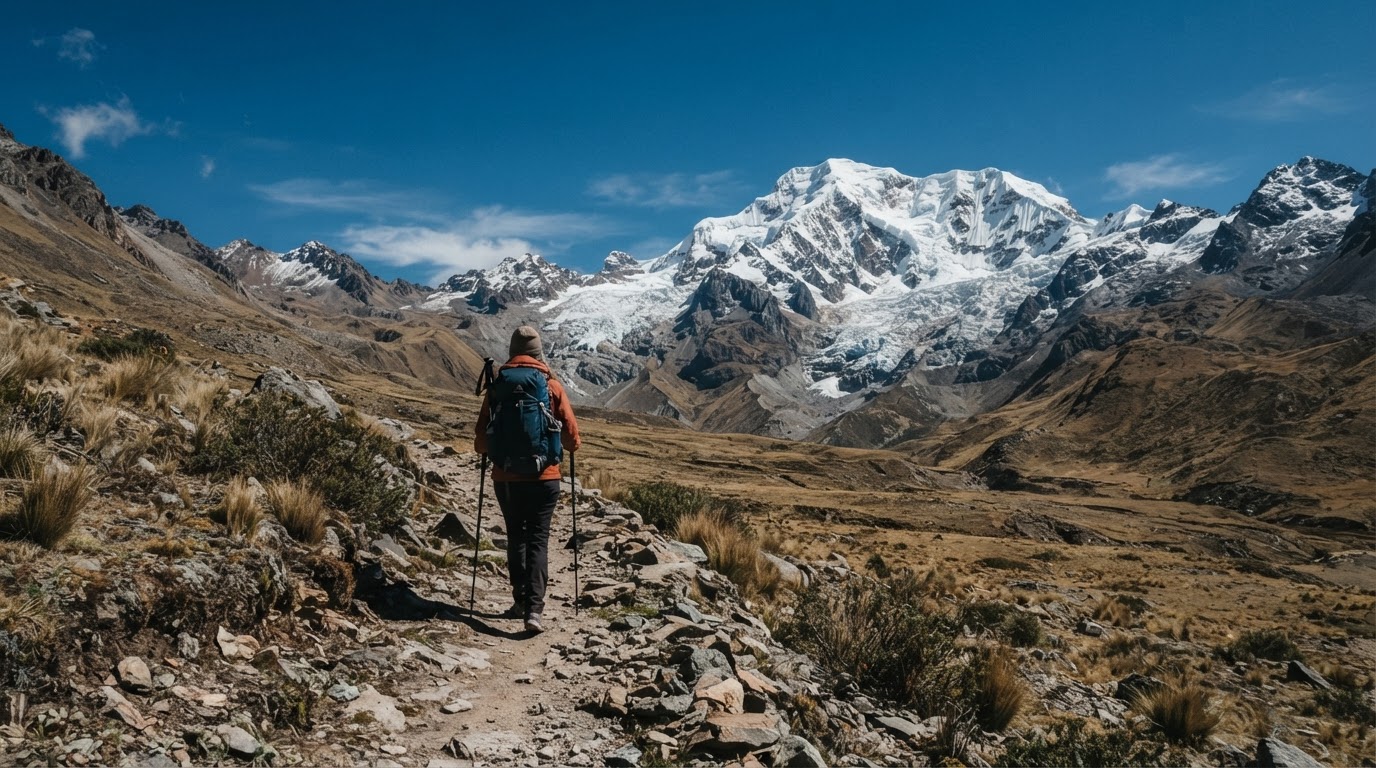
Preparation below ends the moment you step off the plane in La Paz or Cusco. After that, it's not fitness that matters but behaviour: the rate of ascent, sleep, water and readiness to turn back. There's a separate article on how to prepare for altitude while living in Moscow; this one is about the first days on site.
The main thing to accept in advance: being fit hardly protects you from altitude sickness. It develops roughly the same in strong and weak people, and good fitness can actually work against you: it lets you climb faster than your body can adapt.
The rule that decides almost everything
What matters is the altitude at which you sleep, not the day's maximum. Above 3000 metres, the increase in sleeping altitude should be no more than 500 metres per day, and every third or fourth day you should sleep at the same altitude as the night before.
During the day you can and should go higher: the 'climb high, sleep low' pattern speeds up adaptation. A walk to 4500 and returning to sleep at 3800 is useful; sleeping at 4500 after 3800 already breaks the rule.
A special case is flying straight to altitude, as in La Paz (about 3600 m) or Cusco (3400 m). You arrive at an altitude that would normally take several days to reach on foot, so the first two days are spent without exertion and without gaining altitude: walks around town, water, sleep. Trekking starts on the third day, not the next one.
How to tell adaptation from altitude sickness
The first days up high are hard for everyone: light sleep, shortness of breath on stairs, no appetite. That's a normal reaction. Altitude sickness begins where a headache appears.
In medicine the Lake Louise score is used: if a headache is present, points are counted across four items — the headache itself, nausea or loss of appetite, fatigue and weakness, and dizziness. Each item is scored from 0 (none) to 3 (severe).
| Total score | What it means | What to do |
|---|---|---|
| 0–2 | No altitude sickness | Continue as planned |
| 3–5 with a headache | Mild form | Don't go higher until it passes |
| 6–12 | Moderate or severe | Descend 300–1000 metres |
Two conditions require not observation but immediate descent and help. High-altitude cerebral edema: unsteady gait — the person cannot walk in a straight line — confusion, strange behaviour. High-altitude pulmonary edema: shortness of breath at rest, cough, a feeling of gurgling in the chest, a sharp drop in exercise tolerance. With pulmonary edema, the descent needs to be as deep as possible — from 1000 metres.
A rule worth learning word for word: if you get worse at altitude, you must not go up, and if symptoms persist for a day, you need to descend. Of all the ways to treat altitude sickness, exactly one works reliably — losing altitude.
What a pulse oximeter shows and what it doesn't
A finger device is a popular purchase before a trip, and it is genuinely useful, but not in the way people usually think. Blood oxygen saturation at altitude drops as expected: at 3500 metres, 88–92 % is considered normal; at 4500, 82–88 %. The absolute number alone is not a diagnosis: people with the same readings feel differently.
Two things are useful. Dynamics within the group: if everyone is at 87 % and one person is at 78 %, that's a reason to pay attention. And your own day-to-day dynamics: normal acclimatisation produces a slow rise in the reading at the same altitude, while a drop of 5–7 points in a day without a change in altitude is a bad sign.
A watch measures the same thing from the wrist and does it noticeably worse: an optical sensor in motion and cold is badly off. As with sleep, the trend is more useful than the absolute number, and the decision is made based on how you feel. No device replaces the simple question: does your head hurt, and is it going away.
Routine for the first days
- Exertion. The first two days are walks, not workouts. After that, only one pace works: one at which you can speak in full sentences. At altitude this is slower than seems decent, and that's right.
- Water. Dry air and faster breathing take more fluid than down below. A guideline is 3–4 litres a day, checked by urine colour. Drinking even more "just in case" is not necessary.
- Food. Appetite drops while the need for carbohydrates grows: at altitude the body prefers to run on them. Eat more often and in small amounts; don't count on three full meals.
- Alcohol and sleeping pills — no, especially in the first days: they suppress breathing during sleep, exactly when it's already in short supply.
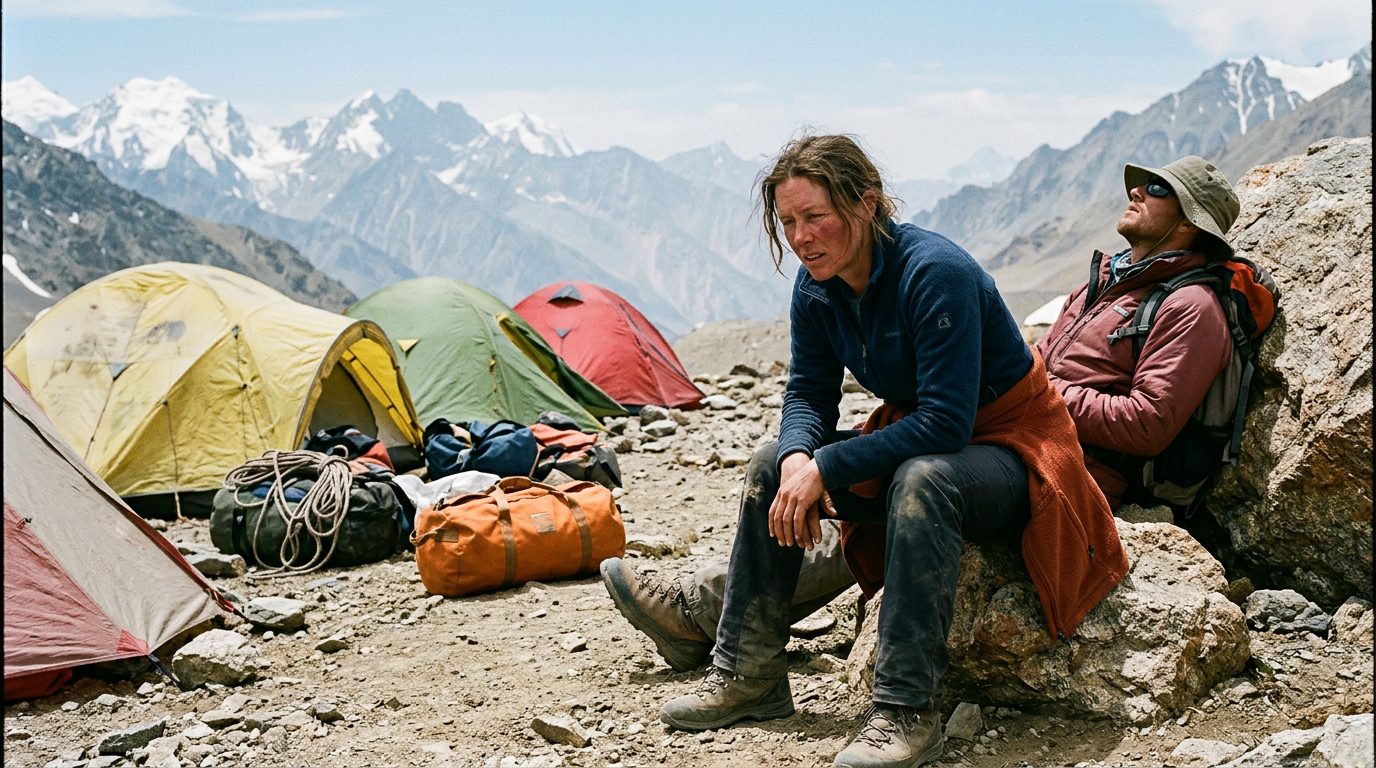
- Sleep. Periodic breathing with pauses is a normal occurrence at altitude and is not dangerous in itself, though it frightens your tentmate.
A separate note on medication. Acetazolamide speeds up acclimatisation and is used for prevention during rapid altitude gain; doses and whether it's appropriate are determined by a doctor, and that decision is made before the trip, not on the trail. Painkillers for a headache are acceptable, but they mask the main symptom — by taking them, you lose the signal on which decisions are based.
How to build a buffer into the route
The most common cause of trouble is a schedule. Tickets are bought, the group has a timeline, and a person heads up with a headache because "the pass is tomorrow". A spare day on the route costs less than an evacuation and is more reliable than any pill.
A practical minimum when planning: one spare day for each week of the route, overnight stops planned by the 500-metre rule, known points where you can descend quickly, and a decision made in advance about who decides to turn back. The last one is not a formality: in almost every group there is someone who will "make it at any cost".
As for fitness, it is still necessary — not for protection from altitude, but so that long days on the trail don't wear you out beyond measure. How to build such a base at home, including uphill walking technique and preparation for descents, is covered in the related articles.
In 1trAIner, the AI coach builds your preparation backward from the trip date and takes into account the acclimatization profile of the route: where the load will be, where the reserve days are, and what volume makes sense before departure. The first 7 days are free.
This material is for informational purposes and does not replace a doctor's consultation. The use of any medications for the prevention and treatment of altitude sickness is determined by a doctor. When symptoms of mountain sickness occur, the decision is made in favor of descending; cerebral edema and pulmonary edema are emergencies requiring immediate descent and medical care.