Trail running shoes are chosen not by how aggressive the outsole pattern looks, but by what will be underfoot and where water will go. On a dry forest path, deep lugs are often unnecessary; on wet clay, a smooth outsole quickly loses grip; and in a stream crossing, a waterproof upper turns into a water container. First determine the main conditions of your runs, then choose the design and try the shoes on.
Mountain trail running and regular trails: different priorities
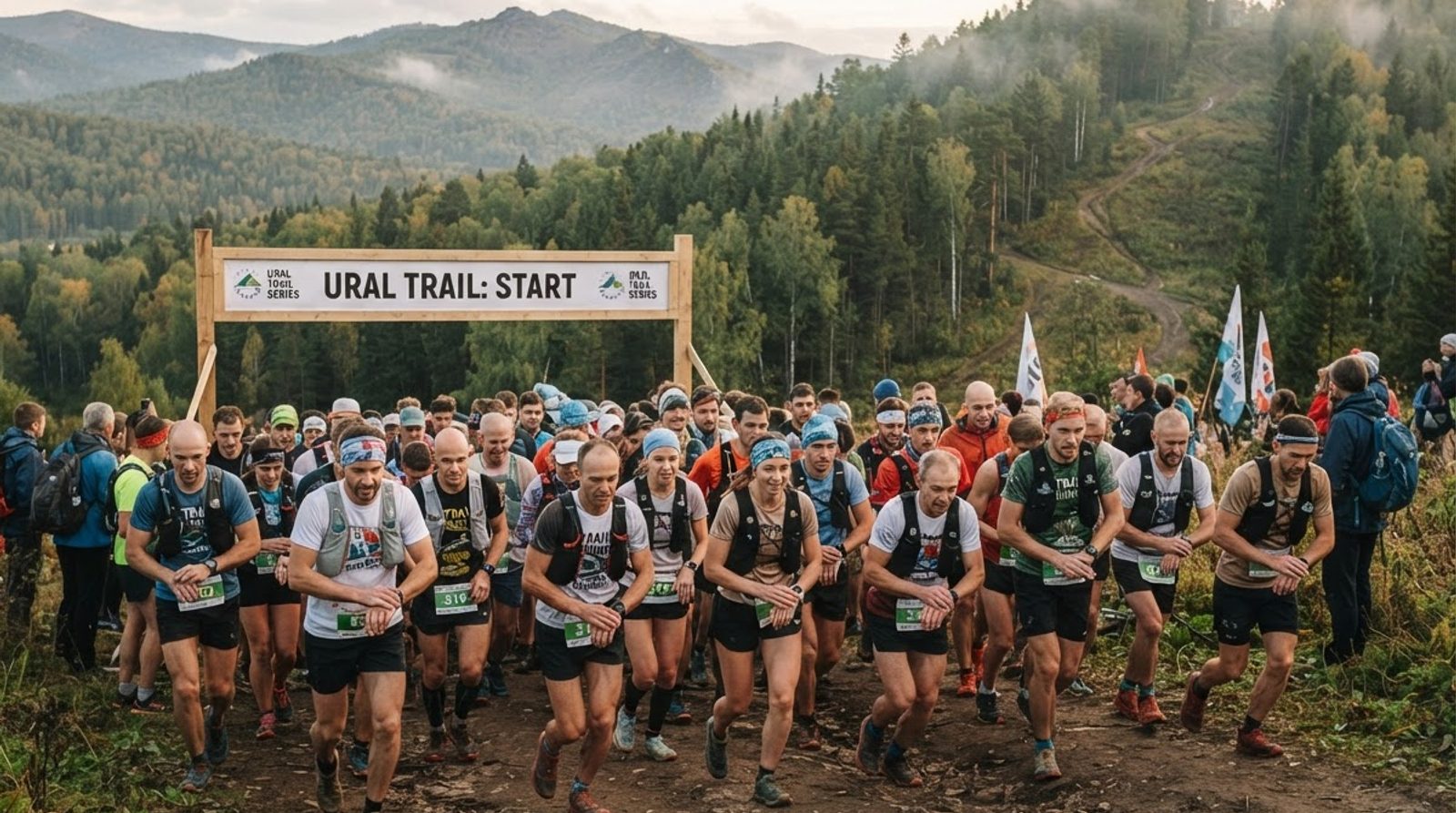
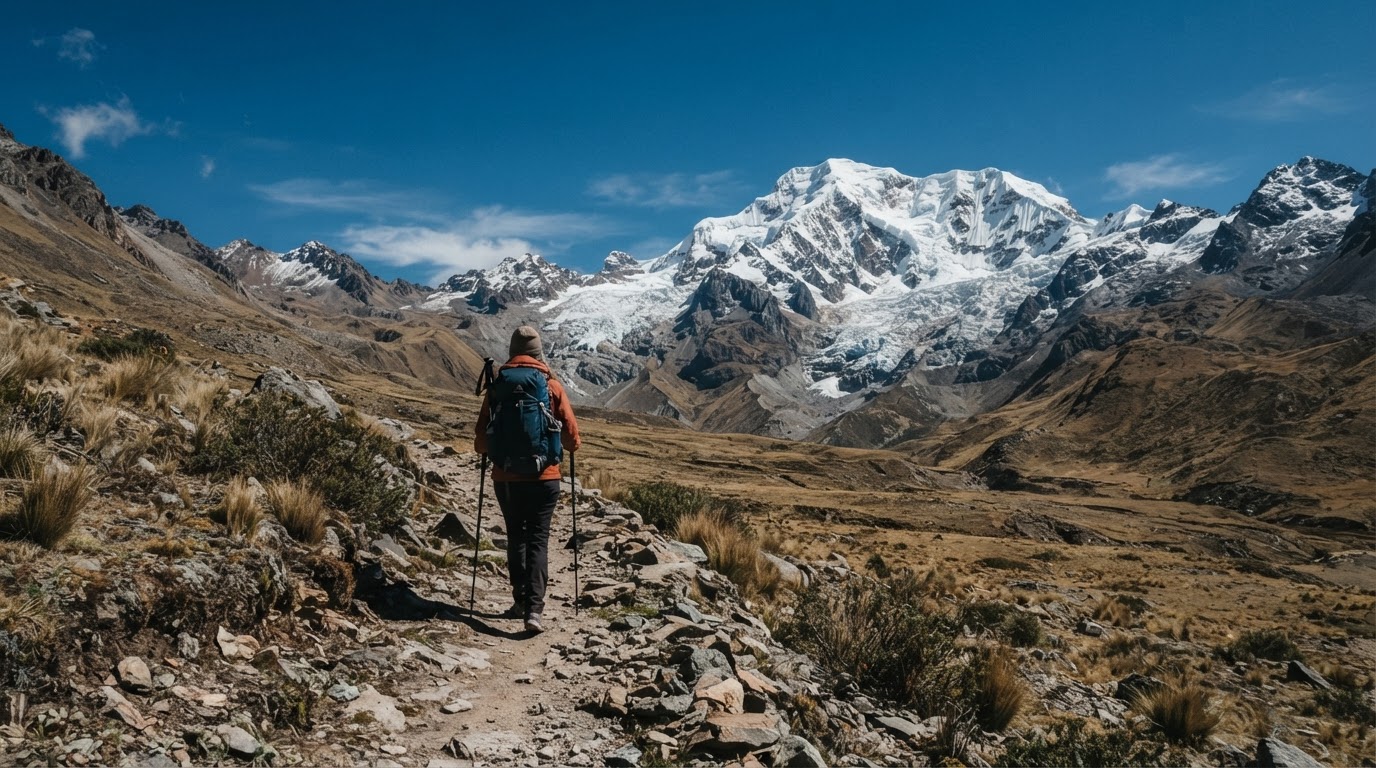
In the mountains, grip, protection, and foot stability come first. Cushioning is secondary: soft foam doesn't compensate for slipping on rock or a heel that moves around inside. On a long route, comfort still matters, but it should be assessed together with how the shoe controls your foot. For forest and park terrain, lightness, comfort, and the ability to run calmly to the trail on asphalt are usually more important.
- Outsole. In the mountains you need grippy rubber and stable contact with rocks; lug depth depends on the surface. For firm paths, more frequent and lower lugs work well. High mud lugs don't necessarily hold well on wet rock.
- Stack height. A thick foam layer provides cushioning reserve, but on angled rocks, platform width and lateral stability matter. A lower stack usually gives better ground feel, though it isolates less from impacts with rocks.
- Protection and lockdown. A reinforced toe cap, dense sidewalls, and a rock plate are useful on rocky routes. The heel and midfoot should be held without over-tightening the laces. In the park, heavy reinforcement is often unnecessary.
- Weight. Protection and a durable upper add mass. For mountains, this is a reasonable trade-off, but on smooth trails, extra weight doesn't give an automatic advantage.
As category examples: for mountains and ultra, people usually look at Hoka Speedgoat and La Sportiva Akasha; for technical dry terrain, La Sportiva Bushido; for park, Nike Pegasus Trail and Hoka Challenger. These are not buying recommendations: shoes are chosen for your foot and usual last, and the list of models and properties of specific versions change every season.
Lug depth: from park to deep mud
Millimetres are the first filter, not the final assessment of grip. Rubber compound, lug shape, their placement, and spacing matter. A sparse pattern with open channels sheds mud more easily; a dense one works better on hard ground.
- Up to 3 mm. Dry packed trail, park, routes with asphalt sections. Comfortable on firm surfaces, but little margin for loose mud.
- 4–5 mm. A versatile option for most mixed trail running: forest, dirt, small rocks and moderately wet sections.
- 6–8 mm. Mud, wet grass, loose technical descents. The lugs bite into the soft layer, but on smooth rock slabs their height alone doesn't help.
- 8 mm and more. Deep mud, including on an ultra in the rain. This is a specialised choice based on surface, not race distance: on hard sections the tall lugs can get in the way.
In the mud category, people usually look at Salomon Speedcross and Inov-8 Mudclaw. Compare the specific version, fit, and outsole pattern, not just the line name. Even aggressive lugs can clog with sticky clay if there's little space between them for it to escape.
Five weather scenarios
- Dry. Breathable mesh upper without a membrane and a 4–6 mm outsole for mixed trail. For a flat park, a finer tread pattern is enough. On dry rocks, contact area and predictable rubber matter.
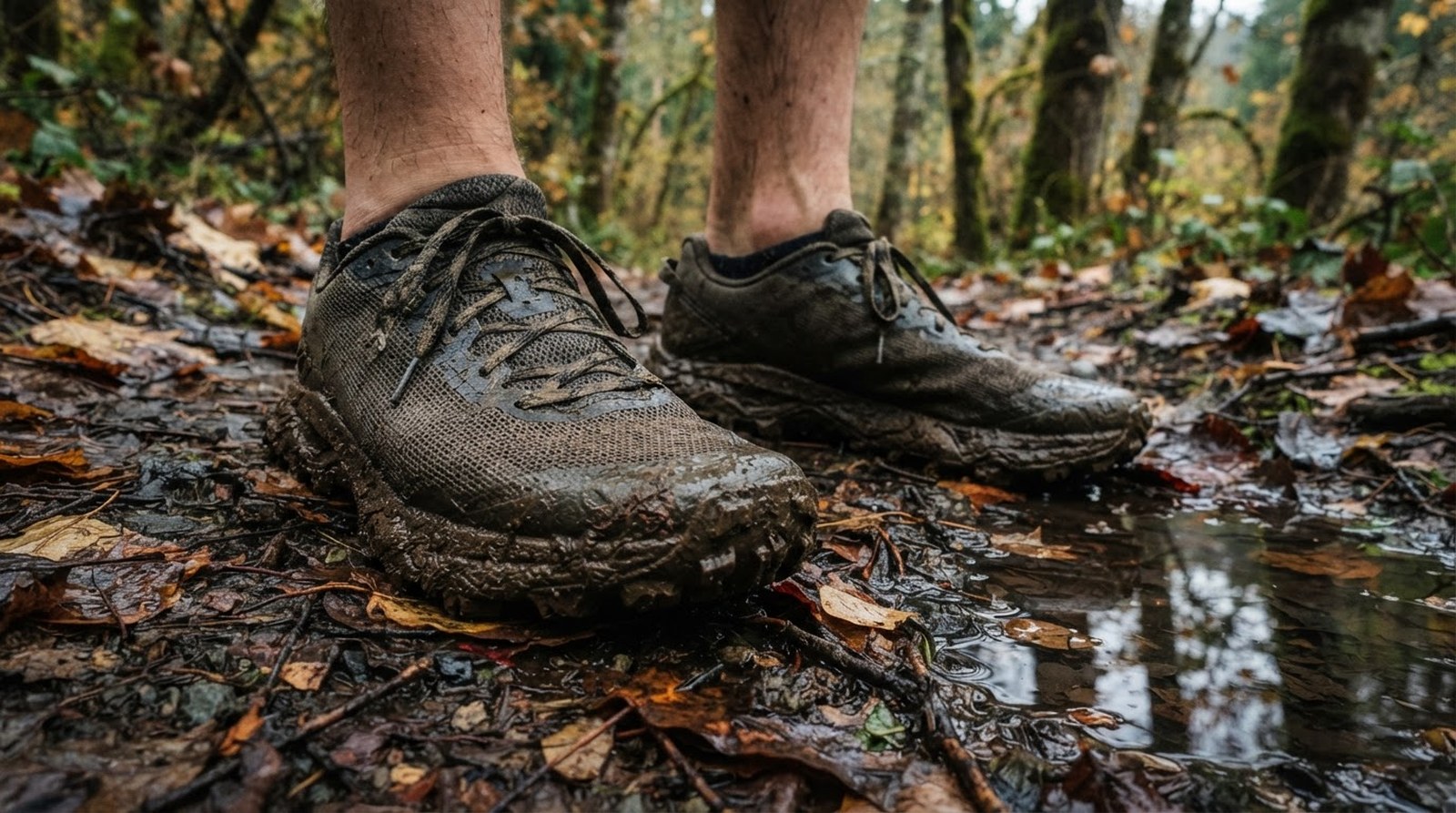
- Rain and wet ground. Grippy, conditionally "sticky" rubber, 6–8 mm lugs for soft surfaces, and deep open channels for self-cleaning. A membrane is usually unnecessary: it's more important that water drains out and the upper doesn't stay heavy. If the route is mostly on wet rocks, choose rock-specific rubber rather than maximum lug depth.
- Winter and slush. You need traction on snow and rubber designed for cold. Here a membrane is justified if water doesn't overflow the top of the shoe. On ice, metal spikes or suitable running attachments may be needed: regular lugs don't replace them.
- Fords and swamps. For such routes — categorically without a membrane. You need drainage, a minimum of water-absorbing parts, and quick drying. After a deep ford, any low-cut shoe will get wet inside; the question is how quickly it releases water.
- Heat. Maximum ventilation, lightweight mesh, and no membrane. Choose the outsole based on the terrain, not the temperature. A dense upper that's good in winter makes heat and moisture removal harder in summer.
Don't just look at the rain icon in the forecast. Consider the temperature, duration of your outing, depth of puddles, and the possibility of water getting in above the shoe's edge. An hour on cold wet grass and three hours with fords require different solutions, even if the forecast is the same.
When Gore-Tex is needed and when it hurts
Gore-Tex and other shoe membranes limit water penetration through the upper, but they don't close the opening around the ankle. They also create additional resistance to heat and moisture removal. So the promise of "feet always dry" for running shoes is incorrect: water can come from above, and moisture can accumulate inside.
- Cold with slush. A membrane is useful on short outings if puddles aren't deep and water doesn't pour in from the top.
- Frosty dry season. It can work as light wind protection, but it doesn't replace insulation and isn't essential on its own. Socks, a loose fit, and traction on winter surfaces matter.
- Short winter runs, wet grass, and dew. A reasonable scenario in cool weather when the main wetting comes from outside through the upper material.
- One pair for the shoulder season. An acceptable compromise for runs up to an hour and a half without fords or overheating, if your usual conditions are cold and wet grass.
In prolonged rain, especially on a run longer than half an hour, water can run down your leg inside and stay there: it doesn't drain through the membrane as freely as through open mesh. Half an hour isn't an exact leakage threshold, but a reason to think about how long you'll be getting wet. Fords, swamps, and deep mud make this drawback even more noticeable.
In heat and high humidity, a membrane hinders ventilation, and on a long race it makes drying after getting wet harder. On a technical descent after rain, a soaked pair stays heavy and wet, which can worsen comfort and the feel of the fit. The membrane itself doesn't determine outsole traction and doesn't make the descent safer. A practical rule: a membrane is for cold and slush, not for rain and water in general.
Checklist before buying
- Surface. Name the main one: packed dirt, rock, clay, sand, or snow. Choose for most of the route, taking the hardest sections into account separately.
- Terrain. On sidehills and rocks, check lateral stability, heel hold, and toe protection. For long descents you need a fit where the foot doesn't slide forward.
- Distance. The longer the run, the more important the absence of local pressure and sufficient comfort. Ultra doesn't automatically mean the softest and tallest sole.
- Weather. Decide what's more likely: overheating, surface dampness, or full immersion in water. A membrane and fast drainage solve different problems.
- Last. Salomon often has a narrow fit, Altra and Topo have a wide toe box, and Hoka and La Sportiva have a medium fit in many models. These are rough guidelines: individual lines differ noticeably, and a wide toe box doesn't mean a loose heel. Fitting matters more than the brand.
- Drop. This is the height difference between heel and toe, not the overall sole thickness. In the low-drop group of 0–4 mm there's Altra and some Inov-8; in the 6–10 mm range — many Salomon and Asics. Check the model's specs: brands have other values too.
- Winter spikes. If there's ice on the route, decide in advance about spiked footwear or compatible attachments. Deep lugs are primarily for soft surfaces.
- Ultra allowance. The foot can swell, and on descents the toes press against the front wall. A common guideline is about a centimeter of free space in front of the longest toe, but without heel slipping. Check the fit on an incline and in running socks.
A sharp transition to a lower drop can increase demands on the calf muscles and Achilles, so a new pair is introduced gradually. More on this in the article "Calf, Achilles, and foot". Footwear changes traction and protection, but doesn't promise injury prevention and doesn't replace technique and gradual progression. We cover the load on descents separately in "Descents break your legs".
Practical takeaway: start with two pairs
Two pairs cover about ninety percent of everyday scenarios: a breathable pair for dry conditions with 3–5 mm lugs, and a mud or winter pair with 6–8 mm, optionally with a membrane. This is a household guideline, not statistics. The mud and winter pairs aren't always interchangeable: warm mud needs drainage, cold slush may benefit from a membrane, and ice needs spikes.
Don't buy a second pair for a rare hypothetical route. First look at your week: where the easy runs are, where the intervals are, where the long run is, and what surfaces those outings cover. Below is an example of how to distribute your sessions, not a mandatory plan. Test new shoes on a short easy run first, not on a key workout or a race.
In 1trAIner, the AI coach builds your plan as a planning cascade: Season → Month → Week → Day. Data from Garmin and Apple Watch syncs automatically, and the week is recalculated after every workout. In the daily plan, the coach takes the weather forecast into account and suggests which pair suits the conditions. The first 7 days are free.
This material is for informational purposes only and does not replace a doctor's consultation.