Strength training for mountain trail, forest race, and road run shouldn't look the same. In the mountains, you need to brake repeatedly on descents and lift your body on climbs; in the forest, you hold effort on changing footing; on asphalt, you repeat thousands of elastic contacts. General strength is needed everywhere, but the same 'leg day' only covers part of the task: muscles may get stronger, but the mechanics specific to your course will remain unfamiliar.
Course mechanics first, exercises second
It's more convenient to choose strength work not by the name of the race, but by what your legs will do for most of the distance. How long are the descents, are there steep climbs where you switch to walking, how many roots and turns, will you be able to hold a steady rhythm? Even two trails of the same length can require different focuses. The discipline name is a starting point, while the profile and surface refine the choice.
- Descent. The quadriceps works eccentrically: it produces force while lengthening and controls knee flexion during braking. Regular weight lifting doesn't replace the habit of this kind of work.
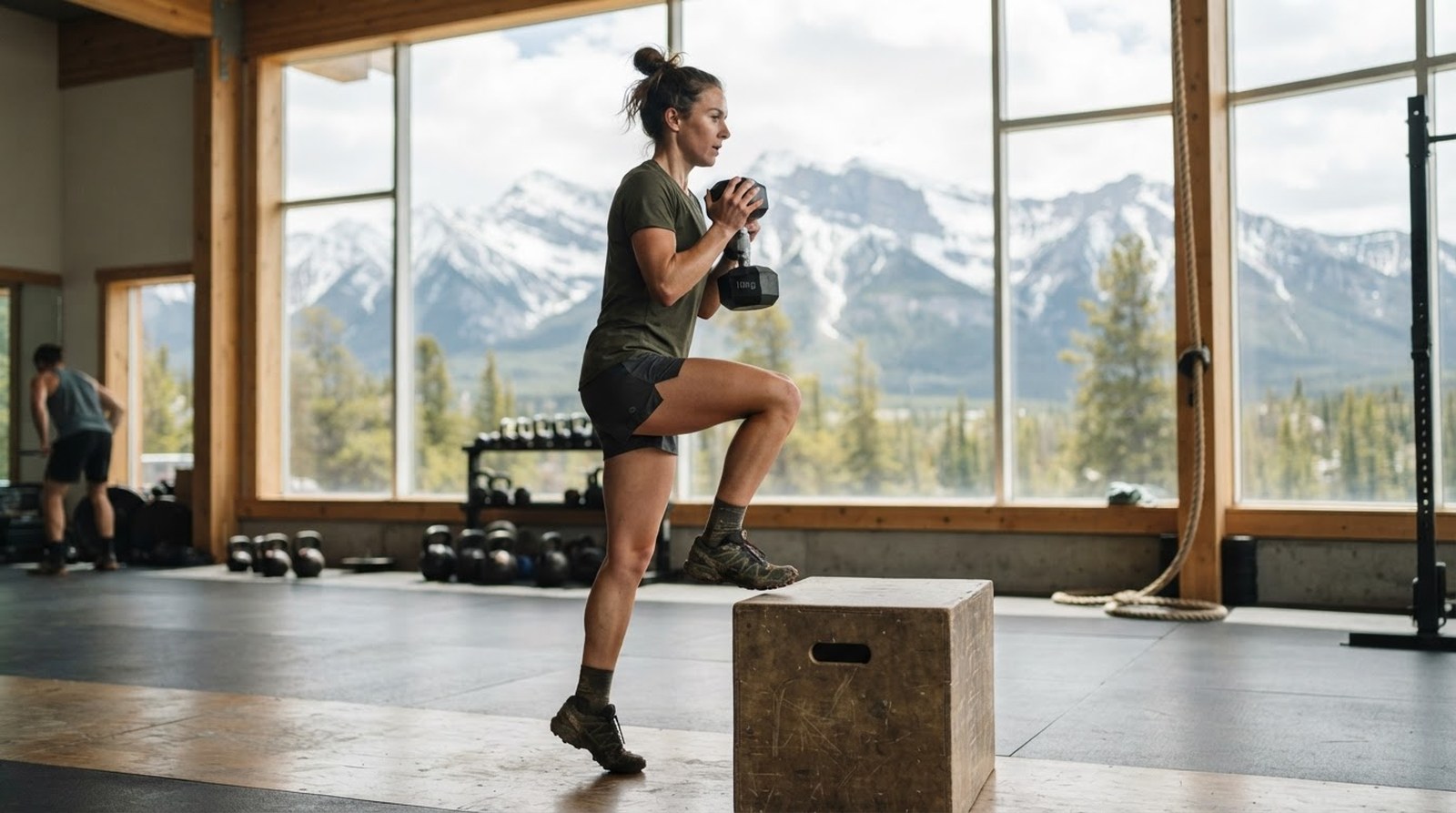
- Climb. You need to repeatedly lift your body upward on one leg. That's why step-ups, hip extension, and power hiking in steep climbs matter—if it's expected in the race.
- Flat road. The main feature is thousands of similar contacts with asphalt. Here the priority is higher for calf strength and the ability of the muscle-tendon complex to absorb and return energy in a short stance.
When it says 'almost not needed' below, it means low priority when time is limited, not a ban. An exercise can stay in the program for variety or a specific task. But if you have an hour a week for strength, first cover the demands of your course instead of piecing together a bit from every discipline.
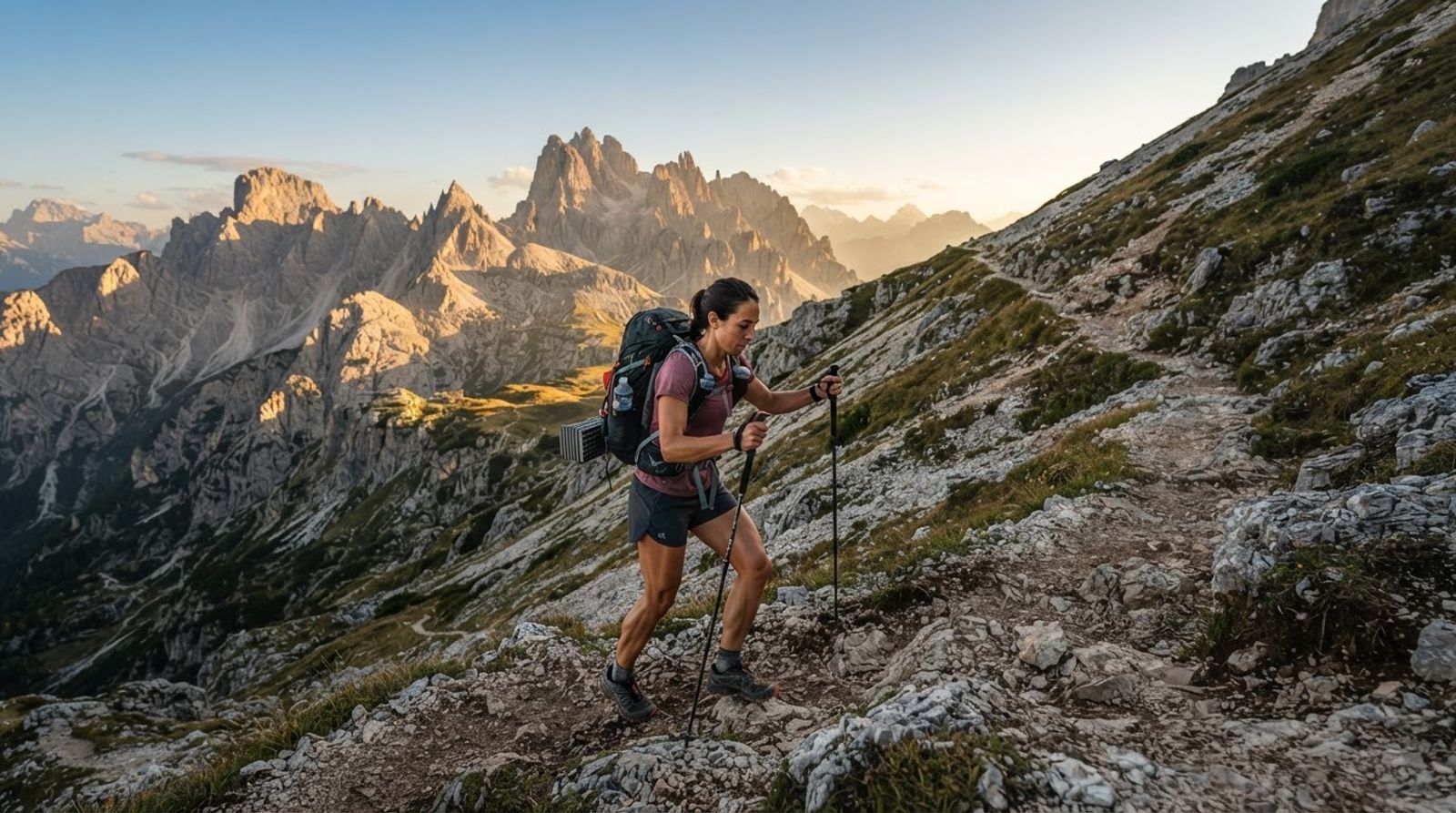
Mountain trail running: braking, support and a stable core
In the mountains, it's not enough to push off hard. You need to maintain control after a series of descents, place your foot on uneven ground, and keep your torso from twisting with every step. This direction has three strength focuses.
- Eccentric quadriceps and descents. Controlled lowering in single-leg exercises prepares you for braking work, while dosed descents add real mechanics. You don't need to make them long and fast right away. Exercise selection is already covered in the article 'Strength for trail: six exercises for descents'.
- Balance and ankle proprioception. This is the ability to sense joint position and control your footing. Single-leg stands with free-leg movement, controlled reaches, and work on different surfaces are more useful than trying to stay on the most unstable platform at any cost.
- Anti-rotation of the torso. The torso resists excess rotation while the legs work alternately. Holds with a band pulling from the side and carrying weight in one hand work well: the task is to maintain pelvis and ribcage position, not to move maximum load.
Climbs also can't be left to running alone. Step-ups onto a stable platform and power hiking practice connect basic strength to upward movement. Choose step height so you can rise with the working leg without a strong push from the lower leg and without the pelvis collapsing. Closer to the race, similarity to the expected incline and duration of effort matters more than a record box height.
A typical mistake is copying a road program with jumps and fast contacts while skipping eccentrics. Pure plyometrics in large volume is not the main priority here. It can supplement preparation, but it doesn't replace braking, step-ups, and stability on uneven footing.
Non-mountain trail running: one leg, posterior chain and calves
Forest trail running without big elevation changes is not just road running on a soft surface. Roots, ruts, short bumps and turns change stride length and the direction of effort. Strength training should help you hold your body position and keep moving after such changes in footing, not just lift weight with both legs.
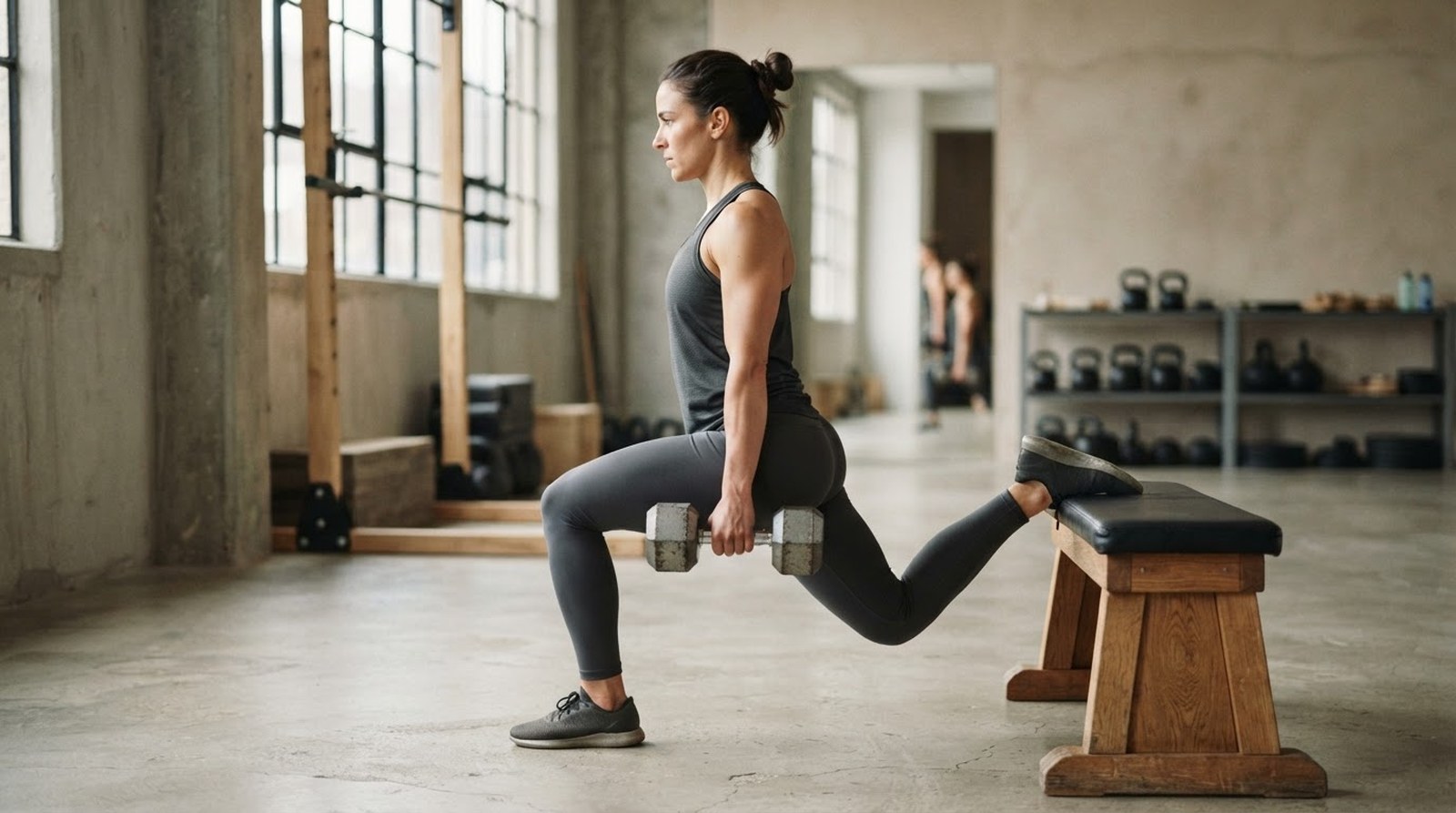
- Single-leg strength exercises. Bulgarian split squats, single-leg Romanian deadlifts and step-ups build the base for alternating leg work. Watch for controlled movement of the knee, foot and pelvis. Using a hand for support is acceptable if balance without it prevents you from loading the muscles properly.
- Posterior chain and Achilles. Glutes and hamstrings are involved in hip extension and stride control. Pulling movements are complemented by calf work, gradually accustoming the entire lower leg and Achilles tendon complex to load.
- Calves as a separate task. Calf raises with a straight and bent knee, as well as controlled toe raises, cover different movements. The Achilles is a tendon, not a separate muscle: its load is considered together with running, jumping and calf strength work.
A typical mistake is to assume that the calves and Achilles already get everything they need from running. Running volume is not the same as dosed strength work. At the same time, a large volume of special downhill workouts on a flat course usually has low priority: short uneven sections do not create the same task as a long mountain descent. If the profile is still hilly, the emphasis is adjusted according to the course.
Road: elastic contact and push-off strength
A flat surface reduces the demands of constantly readjusting your footing, but repeats the same cycle many times over. Here strength work is linked to the quality of short contact, the work of the hip extensors and the ability of the calves to withstand repeated efforts. This does not mean that all gym work should be replaced by jumping.
- Plyometrics and running drills. Low springy hops, short jump series and running drills help develop rhythm and elastic support. Start with simple variations and a small number of quality contacts. If you lose control of the landing, end the set rather than forcing out repetitions at any cost.
- Glute group. Hip thrust — lifting the pelvis with the upper back supported — allows you to load hip extension. This is an addition to split squats and pulls, not a replacement for the entire posterior chain. Finish the movement with hip extension, without overextending the lower back.
- Gastrocnemius, soleus and Achilles. Calf raises with a straight and bent knee shift the emphasis between the lower leg muscles. Strength and jumping loads are increased in a coordinated way: adding a lot of running, heavy calf raises and hops at the same time is not advisable.
A typical mistake is to neglect the jumping progression, leaving only slow weighted exercises. But the opposite extreme is not needed either: jumps are introduced after mastering the basics, taking into account experience and tolerance. Balance on an unstable surface and special downhill work have almost no effect on the main task of flat road running compared to more specific work. If time is limited, they are left on the back burner, not declared useless.
The general base remains for everyone
Bulgarian split squats, single-leg Romanian deadlifts and ankle and hip mobility are needed by all three directions without exception. This is a common foundation, but not a requirement to perform one version of a movement under all circumstances. Range of motion, support and load are selected for the individual. Mobility here means an accessible and controlled range, not striving to stretch the joint as far as possible.
The posterior chain cannot be skipped in any discipline. For mountains it is involved in climbing and controlling body position, for forest — in working on changing footing, for road — in repeated hip extension. Therefore, even with a strong emphasis on the quadriceps or calves, the program retains a movement with a hinge and hip extension.
For basic exercises, a guideline can be 2–3 sets of 6–10 reps per side with a few reps in reserve. At the start of an eccentric block, the lowering is sometimes done over 2–3 seconds, but that pace already increases the load. This is not a ready-made prescription: sets, reps and speed depend on experience, training phase, running volume and whether there is pain. A beginner is better off starting with less volume and stable support.
Technique matters more than weight. If the movement falls apart, reduce the load or complexity. If pain is above 3–4 out of 10, stop the exercise; lesser pain also doesn't mean it's safe to continue. The decision about training with pain or an injury is made by a doctor, not by a rep table or the desire to finish the set.
Season and week: strength first, then specificity
Before the season, an 8–12 week block of pure strength is allocated, especially before mountain races: they start with basic single-leg movements and gradually introduce eccentric work. "Pure strength" means the main focus of strength sessions, not giving up running. Then gym volume is reduced to support and the work shifts toward race mechanics: descents and power hiking in the mountains, changing footing in the forest, springy contacts on the road.
Eccentric work can cause delayed soreness, so it is not started abruptly and is not placed 2–3 days before a long workout. After unfamiliar load, recovery sometimes takes longer. 2–3 weeks before a race, heavy eccentric work is removed: during this period, they do not try to make up for missed strength and do not introduce new exercises that could leave pronounced muscle soreness.
In a running week, usually 1–2 strength sessions are placed on days separate from the key run. First mark the intervals, tempo, and long run, then look for a place for the gym with room for recovery. For example, with key runs on Tuesday and Saturday, one session can go on Wednesday if your condition after Tuesday allows. The second is added only when it doesn't worsen the next important run.
The weekly scheme is a guide for distributing load, not a mandatory calendar. It's better not to leave a heavy strength session on the eve of a key run, and work to failure even more so: it steals the quality of the running session. If there's only one free window, a short session with reserve or moving the workout is preferable to trying to fit in the whole complex. Closer to the race, maintain familiar movements and cut tiring volume.
In 1trAIner, the AI coach builds the plan as a cascade Season → Month → Week → Day. Data from Garmin and Apple Watch watches syncs automatically, and the week is recalculated after every workout. First 7 days free.
This material is for informational purposes and does not replace a doctor's consultation. Decisions about load with pain and injuries are made by a doctor.