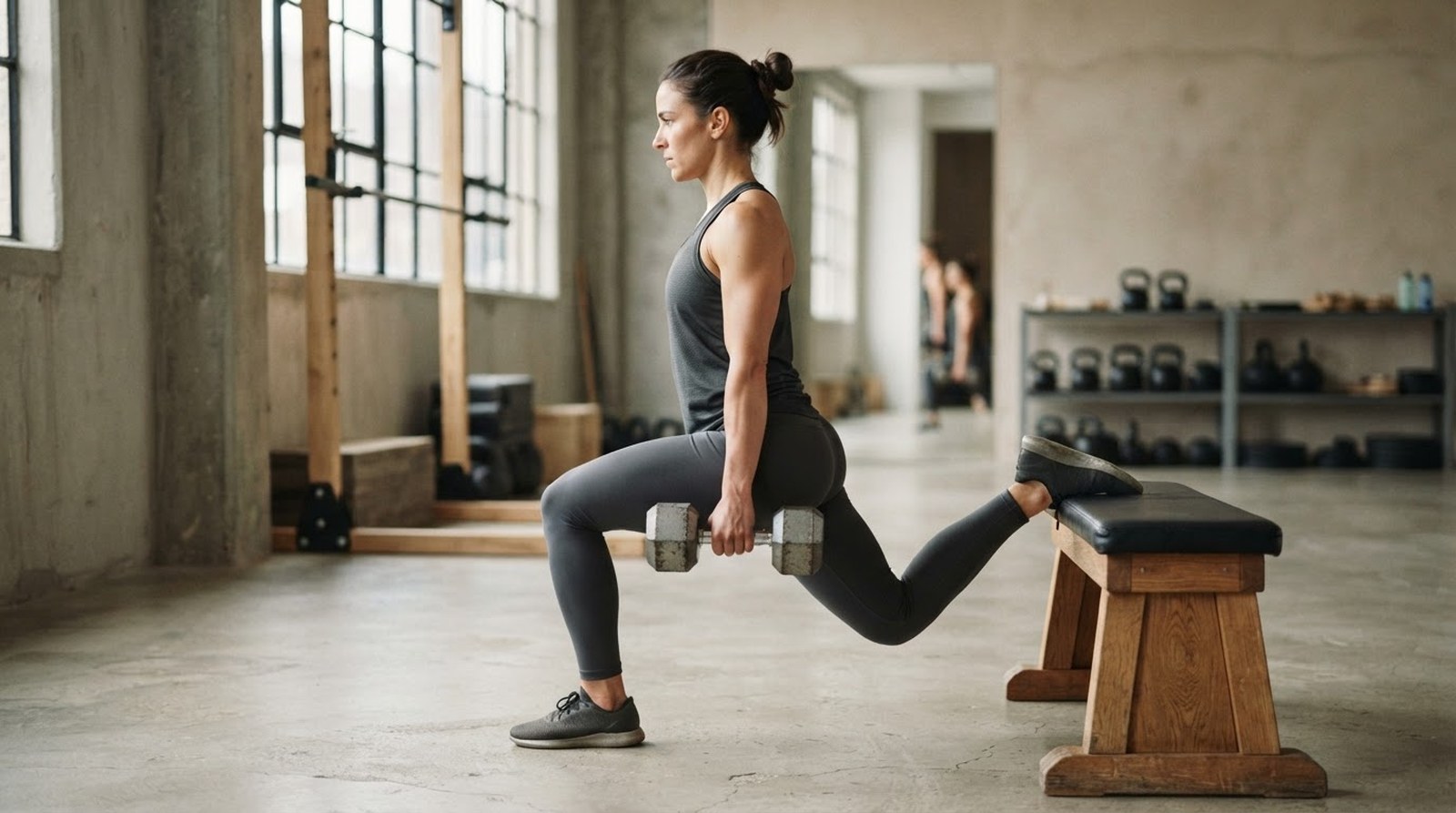

Plyometrics are needed by a runner not for a high jump, but for springy and controlled contact with the ground. Running drills solve a neighbouring task: they help set up rhythm and coordination before running. Both tools complement strength training and running volume, but don't replace them. A few precise repetitions on fresh legs matter more here than a long set after which it's hard to maintain your normal stride.
Springiness: what makes a stride more economical
On landing, the muscle-tendon system takes the load, and elastic tissues deform. Tendons and ligaments can store and return part of the mechanical energy; in running, the work of tendons, including the Achilles, is especially important. This isn't a separate spring that acts without muscles: muscles control joint position and tissue tension, while the nervous system coordinates the entire contact.
When stretching quickly gives way to push-off, part of the stored energy helps the next movement. The better this work is coordinated, the cheaper a stride can be at the same pace. This is one component of running economy, not a promise to automatically run faster. It's also influenced by running fitness, fatigue, habitual rhythm, and movement conditions.
- Plyometrics. Exercises with a fast transition from taking load to push-off. Their task is to train this transition, not just tire out the legs with jumps.
- Springy contact. The support stays controlled: the body doesn't collapse, and the next movement happens without an extra pause. There's no need to deliberately shorten contact at any cost.
- Strength base. The ability to take and control load precedes attempts to return it faster. Jumps don't let you bypass this stage.
Why priority is higher on the road than in the mountains
For a trained road runner, springiness is focus number one among special strength tools. Even surface and relatively constant rhythm create thousands of similar elastic contacts. The skill of quickly and steadily transitioning from support to push-off is close to the actual race task here. But this priority appears after basic strength, not instead of it: a beginner is too early to choose complex jumps just because they're preparing for the road.
In the mountains, the stride constantly changes. Stones, slope, turns, and loose surface require either shortening support, lingering on it, or switching to a walk. On technical terrain, the risk of a bad landing is higher, so plyometrics usually yields in priority to single-leg strength, stability, and the ability to handle downhill load. At the same time, on flat running sections, elastic work doesn't disappear.
The principle of specificity works: closer to the race, exercises should more accurately reflect its mechanics. For the road, this might be an emphasis on rhythmic contacts on a flat surface; for the mountains, more attention to support control and strength. This isn't a reason to jump on stones for the sake of resembling the course. The posterior chain — glutes and hamstrings — can't be skipped in any discipline. Preparation for downhills is covered separately in the article "Strength for trail: six exercises for downhills".
Order of entry: strength, low box, complex contacts
Start with basic single-leg movements and a controlled eccentric phase — the part of the exercise where the muscles work while lengthening. Before the mountain season, 8–12 weeks of pure strength can serve as a guideline. This is a timeframe for planning, not an automatic clearance for jumps: the transition depends on experience, movement control, the phase of preparation, and the absence of pain. Eccentric work causes delayed soreness, so it is not introduced abruptly and unfamiliar heavy work is not placed 2–3 days before a long workout.
- The first stage is a strength base. Single-leg squats through an accessible range of motion, hip-hinge movements, and calf raises teach you to hold your support. Technique matters more than weight: the pelvis, knee, and foot should remain controlled, without trying to finish a rep at any cost.
- The second stage is a jump onto a low box. You start with a small height, jumping onto a stable platform. You need to hold the landing, then be sure to step down. Jumping back down adds a separate impact load and is not required at this stage. This jump is an introductory exercise, not a test of maximum height.
- The third stage is drop jumps and bounding. A drop jump is stepping off a low platform followed by a quick push off the floor. Bounding is a series of springy jumping steps with forward movement. You move on to these only after confidently mastering the simpler variations, not just because another week has passed.
For a short block, the guideline is 2–3 sets of 4–6 quality contacts with 1–2 minutes of rest. In consecutive jumps, each contact with the ground counts separately; this is not 4–6 long runs. The volume depends on experience, the difficulty of the exercise, and where you are in the season. A beginner may need less, and if there is pain, the guideline is not mechanically reduced: stop the work and discuss further loading with a doctor.
You don't need to increase height, speed, and the number of contacts at the same time. First maintain the quality of the current variation, then change one parameter. In a dense running week, it's wiser to keep a short, familiar block than to add a new complex exercise. Plyometrics shouldn't turn into yet another hard workout that you have to recover from at the expense of running.
Quality is a quiet landing, not a height record
The main guideline is a quiet and controlled landing. The foot doesn't slap, the knee doesn't go into an uncontrolled position, and the body doesn't need an extra step to catch itself. At the same time, quiet doesn't mean squatting as deep as possible: excessive sinking lengthens the contact and changes the task. You also shouldn't deliberately land on stiff legs just for a short touch.
Sound is a convenient cue, but not the only test: on a soft surface, a poorly controlled contact can also be quiet. Look at the repeatability of the movement and the ability to maintain balance. In a box jump, a stable final position matters, and in consecutive contacts, an even rhythm matters too. The height of the platform by itself says nothing about quality: you can "cheat" it by simply tucking your knees more.
- You can continue as long as the movement repeats. The contacts stay collected, the landing is predictable, and the push-off doesn't require more and more effort.
- End the set when you lose springiness. Loud landings, a drawn-out support, a broken rhythm, and attempts to hold on are reasons to stop earlier than the planned number.
- Rest is needed for quality. If control hasn't returned after a pause, end the block. The goal is not to wait for complete leg exhaustion.
Jumps are performed after the warm-up, while you still have coordination reserves, not after a hard run to fatigue. A small, mastered block is sometimes included before a quality session, but it shouldn't take away from its freshness. Strength work to failure before key running work steals its quality; the same happens with a fatiguing jump set.
Running drills: movement tuning, not cardio
A-skip, B-skip, and high knees are neuromuscular work. Here you train the coordination of arms and legs, rhythm, and support control, not the ability to tolerate a high heart rate. The guideline is short runs of 20–30 meters after the warm-up, walking back. The number of runs and the speed depend on experience and the goal of the day: for familiarization, a shorter distance is enough if the movement falls apart beyond that.
- A-skip. Rhythmic forward movement with a hop and knee lift. A collected torso, coordinated arm work, and foot placement without reaching far forward matter. Knee height shouldn't be achieved by leaning the torso back.
- B-skip. A more complex variation with shin extension after the knee lift and the foot returning down. It is mastered after A-skip. Don't try to hit the heel harder in front of you: first you need calm control of the sequence.
- High knees. A short rhythmic run without racing for frequency at any cost. The range of motion stays such that the pelvis and torso are stable, and breathing doesn't become the main limiter.
SBU (special running exercises) do not "fix technique" on their own and do not replace running volume. They give you a chance to remind the body of the right movement pattern before quality work, but the transfer to normal stride does not happen automatically. You don't need to artificially pull your knees up during the entire next run or copy the exaggerated range of the exercise. It's more useful to keep a sense of rhythm and free coordination.
Heart rate zones help distinguish the intensity of running work, but short SBU and jumps are not dosed by them: heart rate lags and does not reflect the impact load on tissues. The scheme below applies to the running part of the session. Here the criteria are different — movement precision, sufficient rest, and absence of accumulated fatigue.
When it's better to cancel jumps
The jump block is not mandatory at any cost. If your legs can't hold their usual support, moving it to another day is more useful than trying to complete the plan formally. This is especially true during periods of dense training and returning after a break: past experience does not mean that your current load tolerance has remained the same.
- Pronounced fatigue. Heavy legs, worsening coordination, and loss of control already during the warm-up are reasons to drop the jumps, not to push through by force.
- Pain in the Achilles or the area above the periosteum. Jump work is cancelled without trying to "run out" the unpleasant sensations. The cause of the pain and the admissibility of further load are determined by a doctor.
- Slippery or unstable surface. Wet tiles, ice, loose soil, and a wobbling box are not suitable for training fast contacts.
- The day after a long descent. Residual fatigue after eccentric load can worsen control, even if walking already feels easy. It's better to skip the jump block on such a day.
If pain is above 3–4 out of 10, the exercise is stopped, but a lower score does not mean permission to continue. For pain in the Achilles or shin, you don't need to wait for this threshold. The decision to return to jumps after an injury is made by a doctor, not by the calendar or the result of a trial set. The plan can be rebuilt; testing tissue readiness through pain is not worth it.
In 1trAIner, the AI coach builds the plan as a cascade Season → Month → Week → Day. Data from Garmin and Apple Watch watches is pulled in automatically, and after each workout the week is recalculated. The first 7 days are free.
This material is for informational purposes and does not replace a doctor's consultation.