Push-ups need nothing but a floor and ten minutes. That is why they are so often done “however it goes”: some number of reps to failure, every other day or once a week — and a month later the result is the same. For your reps to grow you need a program: a starting variation for your level, a clear volume, rest and a rule for when to make it harder. Below — a test, technique, weekly stages and what to do if progress stalls.
In short: where to start and how often to train
- Start with a test: how many push-ups in a row you can do with good technique. That number decides your starting variation — incline, knee or floor push-ups.
- Three sessions a week with a rest day between them is a working guideline for most people. There is no need to do hard push-ups every day.
- Sets not to failure: leave one or two reps in reserve in each. Progress comes from regular volume, not from fighting for the last rep.
- Progress is a guideline, not a promise: beginners usually improve noticeably in the first 6–8 weeks, after that growth is slower.
What push-ups train
The main work is done by the chest, triceps and front of the shoulders. At the same time the abs, back and glutes keep the body straight, so push-ups are also a stability exercise, like a moving plank. That is useful for runners: a strong core helps hold your posture at the end of a long run, and a strong upper body helps you drive with your arms on climbs.
Level test: how many clean push-ups you can do
Warm up for five minutes, rest and do one set of standard floor push-ups until your technique starts to break: the lower back sags, the range of motion shortens or the elbows flare out. Only clean reps count — the chest almost touches the floor, the arms fully straighten. If you can’t do a single one from the floor, test knee push-ups, and then push-ups against a table-height support.
Repeat the test in the same conditions: the same warm-up, the same time of day, not after a hard workout. Otherwise the difference in the result will show tiredness or freshness rather than progress.
| Test result | Where to start |
|---|---|
| Fewer than 5 incline | Stage 1 with a high support — a windowsill or a wall; two weeks to get used to the movement |
| 0 from the floor, 5+ from the knees or a table | Stage 1 — push-ups against a table-height support |
| 1–5 from the floor | Stage 2 — knee or low-incline push-ups, plus negative reps |
| 6–15 from the floor | Stage 3 — standard push-ups in sets |
| More than 15 from the floor | Stage 4 — volume, narrow hand position and paused push-ups |
Technique: how to do push-ups properly
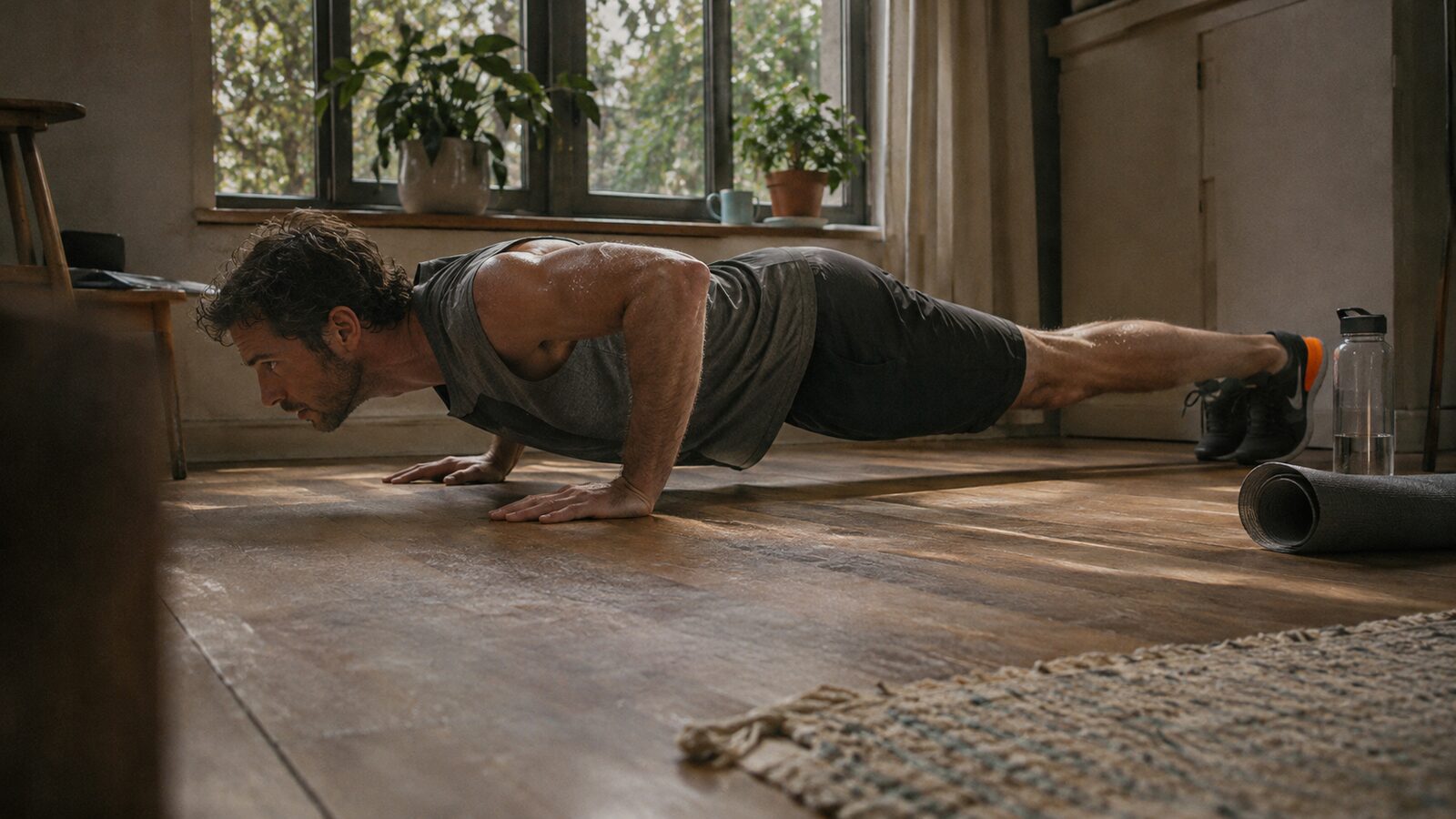
- Hands slightly wider than the shoulders, palms under the shoulders or a little lower, fingers pointing forward.
- Body — a straight line from the crown of the head to the heels: glutes and abs engaged, the hips neither sagging nor lifting up.
- Elbows go back at roughly 30–45° to the body, not out to the sides in a “T”.
- Range of motion is full: at the bottom the chest is a few centimetres from the floor, at the top the arms are straight.
- Tempo is steady: two counts down, one count up. Breathe in on the way down and out on the way up, without holding your breath.
The most common mistakes are “half push-ups” with a short range of motion, a sagging lower back, the head reaching for the floor before the chest, and elbows flared out to the sides: the shoulders tire faster this way, and reps get counted even though the muscles are underworked. If your technique falls apart towards the end of a set, it is better to end the set earlier.
Push-up variations: from easy to hard
- Incline — a wall, windowsill, table, bench. The lower the support, the harder it is. The best start from zero: the movement is the same as a standard push-up, but the load is lower.
- Knee push-ups. Another easier variation, as long as you keep a straight line from knees to head. Works as a step from incline to the floor.
- Negatives. From the top of a push-up, lower yourself to the floor slowly over 3–4 seconds, then return to the top from your knees. They teach you to hold your body in the hardest part of the movement.
- Standard — the main variation of the program and the measure of your result.
- Narrow — palms shoulder-width or closer, elbows along the body. They load the triceps more; good when standard push-ups have stopped improving.
- Paused — a 1–2 second hold at the bottom without touching the floor. They remove momentum and strengthen the weakest point of the movement.
- Feet elevated — feet on a bench or a step. More of your weight goes onto the arms and shoulders; this variation is for those who confidently do 25–30 standard push-ups.
Difficulty is easy to change in two ways: the height of the support and the tempo. If standard push-ups don’t work yet, there is no need to wait until “the strength appears” — lower the support by one step and continue the program.
Week-by-week program
Three sessions a week, for example Monday, Wednesday and Friday. The stage durations are a guideline for those starting from zero: if your test showed more, start from your own stage. “Max” is the result of your latest test in standard push-ups.
| Stage | Session |
|---|---|
| 1. Weeks 1–2 Incline | 3 sets of 8–12 push-ups against a table or bench, rest 60–90 seconds |
| 2. Weeks 3–4 Knees and negatives | 4 sets of 6–10 from the knees or a low support, rest 90 seconds; finish with 3 negative reps |
| 3. Weeks 5–6 Standard | 4–5 sets of half your max, rest 90–120 seconds; if your max is under 6 — a 1-2-3-2-1 “ladder” |
| 4. Weeks 7–8 Volume | 5 sets of 60–70% of your max, rest 90–120 seconds; on Friday one set of narrow or paused push-ups |
| Every 2 weeks Test | Instead of one session — a new max after a warm-up; the next sets are calculated from it |
Progression rule. Move to the next stage or add one rep per set when all sets in two sessions in a row were done cleanly with something left in reserve on the last one. If not — stay on the current stage for another week; that is a normal part of the program.
After week eight. From here it is convenient to work in cycles: for three weeks you gradually add reps or sets, the fourth is light, with a test at its end. Once your max passes 20–25, add narrow or paused push-ups to one of your three sessions, and one long set at 80–90% of your max to another: this specifically trains endurance for a long set.
One session takes 15–25 minutes: a five-minute warm-up (arm and shoulder circles, wrist rotations, easy incline push-ups, a 20–30 second plank), the working sets, and a plank or “superman” for the back at the end. Between sessions — at least a day of rest for the chest, shoulders and triceps.
At home: which support to choose
Anything stable will do for incline push-ups: a wall, a windowsill, a kitchen table pushed against a wall, a sofa with a back, the steps of a staircase. Steps are especially handy — each next one is lower, so difficulty changes by one step without new equipment. Stools and chairs on wheels won’t do: they can slide away at the worst moment. Push-up handles are inexpensive and take load off the wrists, but they are not required for the program.
How to keep a log
The program works when you can see what you did last session. Write down the date, the variation (incline, knees, standard), sets and reps, and how it felt: “easy”, “at the limit”, “last set with reps in reserve”. With such notes the progression rule applies itself: two “easy” sessions in a row — time to make it harder. Without notes it is easy to undertrain or, on the contrary, to test your max for weeks.
If you are heavy or haven’t trained for a long time
Standard push-ups lift about two thirds of your body weight, so with a high body weight or after a long break, starting from the floor often means fighting for every rep and loading the wrists and shoulders. It makes more sense to start with wall or windowsill push-ups and lower the support gradually, once every one or two weeks. Do the same if your shoulders have hurt before: the first weeks — a high support, a slow tempo, no sets to failure.
Goals: 20, 30, 50 and 100 push-ups
Once standard push-ups go confidently in sets, it is easier to think about a specific goal — it determines volume and timelines. For each goal we have a separate plan with an AI coach: 20 push-ups in a row, 30 push-ups, 50 floor push-ups and the path from 20 to 100 push-ups. If you also want to do pull-ups, there is a combined goal — 10 pull-ups and 50 push-ups.
The timelines in such plans are guidelines: some people get from 20 to 30 push-ups in a month, others need twice as long. Your starting level, consistency and recovery decide it, so it is worth revising the plan based on test results rather than the calendar.
Plateau: what to change if your result isn’t growing
- Volume. Add one set or extend the “ladder”: 1-2-3-4-5-4-3-2-1 gives a lot of clean reps without failure.
- Pauses and tempo. Push-ups with a hold at the bottom and a slow 3–4 second descent load the muscles more with the same number of reps.
- Variation. Two weeks of narrow or paused push-ups often move your standard max.
- Hand position. Check whether your hands are too wide: with a wide position the shoulders tire faster, and the set ends before the chest and triceps do.
- Rest. If your max drops and your muscles ache, the load is more than your recovery can handle. Take a light week: the same sessions but half the sets.
- Sleep and overall load. Lack of sleep and a hard week of running or work affect strength training. That is not a reason to quit, but a reason not to test your max right now.
How to combine with running, other sports and pull-ups
Push-ups barely interfere with running: they load the upper body while the legs stay fresh. The most convenient time is on an easy run day — after the run — or on a day without running. Don’t do push-ups to fatigue before intervals or a long run: you need your energy and focus for the main session. If you are preparing for a race, it is better to reduce push-up volume in the last week before it.
With cycling and swimming the logic is the same: push-ups go after an easy session or on a free day. Swimmers should remember that their shoulders already work a lot — they had better build push-up volume more slowly.
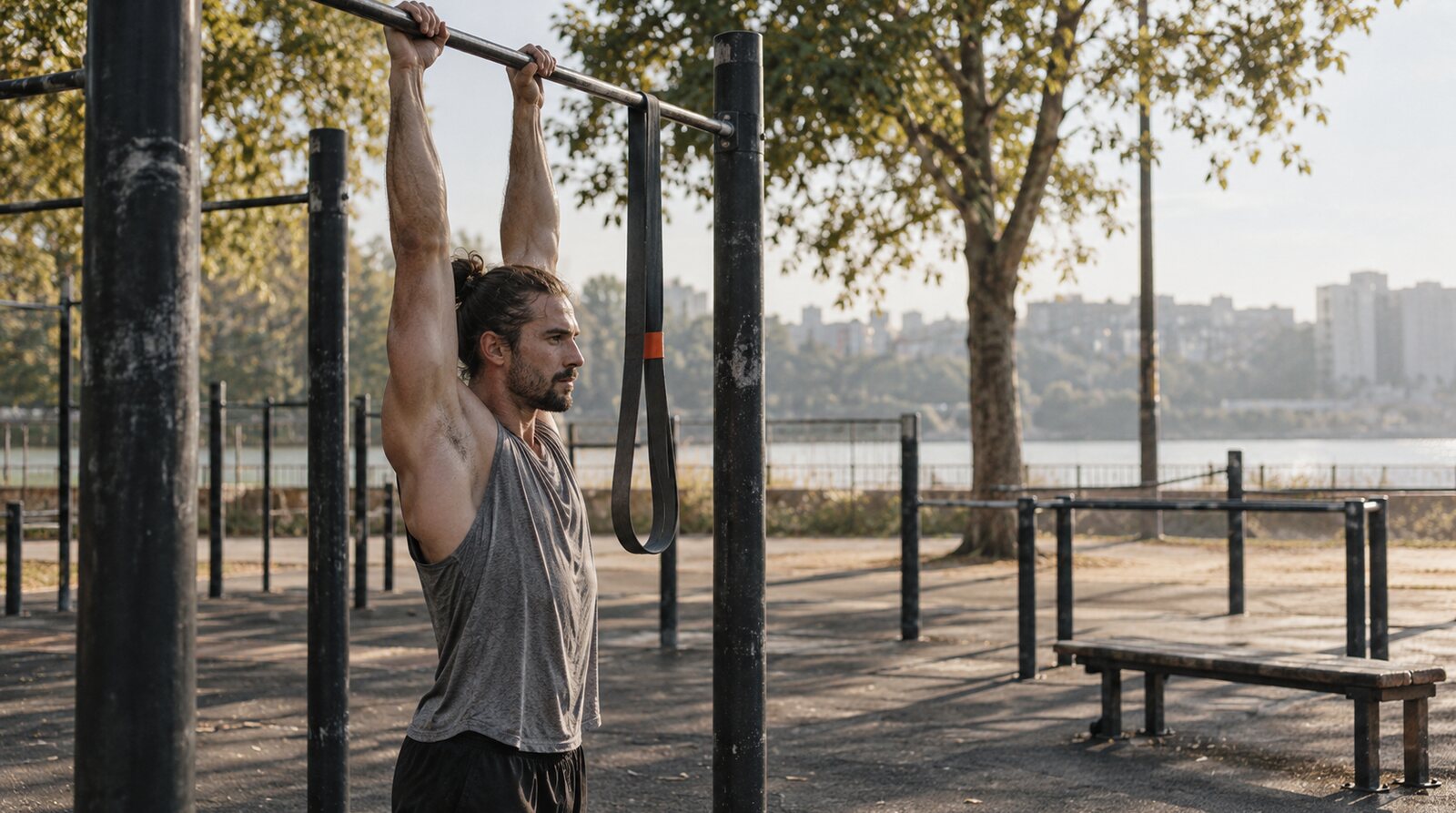
Push-ups combine well with pull-ups: one movement is a push, the other a pull. You can do them in one session, alternating sets, or on different days. How to learn to do pull-ups from zero and which stage to start from is covered in the article on a pull-up program.
If you go to the gym and do the bench press or dumbbell press, push-ups load the same muscles. Put them on a different day or do light sets after pressing, otherwise your chest and triceps won’t recover by the next session.
When to stop
A burning sensation in the muscles and fatigue towards the end of a set are a normal response to the load, and mild soreness the next day goes away on its own. If your wrists hurt, try doing push-ups on your fists or with push-up handles. Sharp pain in the shoulder, elbow or wrist, numbness in the arm or chest pain are a reason to stop training immediately and see a doctor.
Frequently asked questions
How many times a week should you do push-ups?
Usually three sessions a week with a rest day between them are enough for steady progress. A fourth can be added when three feel easy — a light one, without testing your max.
Can you do push-ups every day?
Yes, if the daily sets are light and far from failure — for example, a few sets of half your max. Hard sessions at your limit every day don’t let the muscles recover, and the result is more likely to stall.
What do 50 push-ups a day give you?
A habit of moving and decent muscular endurance, especially if you didn’t do push-ups at all before. But the same 50 reps every day eventually stop developing you — for progress, volume, variations and rest need to change, as in the program above.
Why isn’t my push-up count improving?
Most often because of sets to failure without rest, the same load for weeks or insufficient recovery. A light week, a “ladder”, paused push-ups and a narrow hand position help.
Do knee push-ups count?
As training — yes: it is a full-fledged easier variation if you keep a straight line from knees to head. As a result in tests and standards, standard floor push-ups count, so knee push-ups are a step towards them, not a replacement.
Want a program for your level, schedule and equipment? Get a personal plan from the AI strength coach 1trAIner. Tell it about your goal, experience and free days — the AI will build a program for home or the gym, including bodyweight only. The plan for the day arrives in the chat, and you can report completed sets and reps in words — the coach will adjust the following week. Strength and running are kept in one plan, a watch is not required. The first 7 days are free.