An easy jog doesn't have to be preserved at any cost. If your breathing is calm and your feet and shins are already tired from the weekly volume, part of the aerobic work can be moved to an indoor bike, elliptical or water. The goal is to reduce impact load, not to quietly add another hard workout. These activities support different aspects of endurance, but they don't replicate all the demands of running: tendon work, landing and running economy.
When to replace an easy run
The first reason is accumulated fatigue in your feet and shins at a usually easy effort. The second is an increase in overall volume: the cardiovascular system may tolerate prolonged work better than tissues tolerate thousands of repeated landings. In both cases, cross-training is useful specifically as a replacement for part of the load. If you keep all your runs and add cycling on top, you won't get recovery.
- Fatigue after a running block. Instead of another easy outing, you can choose a familiar type of cross-training if it feels comfortable. With pronounced general fatigue, rest may be more appropriate than any workout.
- Accumulated volume. Replacing part of your easy kilometres allows you to separate aerobic and impact load. But your muscles are still working, so time on the machine counts toward the overall weekly load.
- Return after illness. Cross-training can be a convenient format for a gradual return after recovery, but not a way to train during illness. If in doubt, a doctor determines the timing and permissible load.
Pain, a change in gait or a suspected injury is not a task for independently choosing a "safe" machine. A doctor makes the decision about training. The absence of impact doesn't yet mean that a specific tissue isn't loaded. In normal preparation, cross-training complements running and replaces primarily easy sessions; with medical restrictions, priorities change as decided by a specialist.
Cycling and indoor bike: controlled aerobic volume
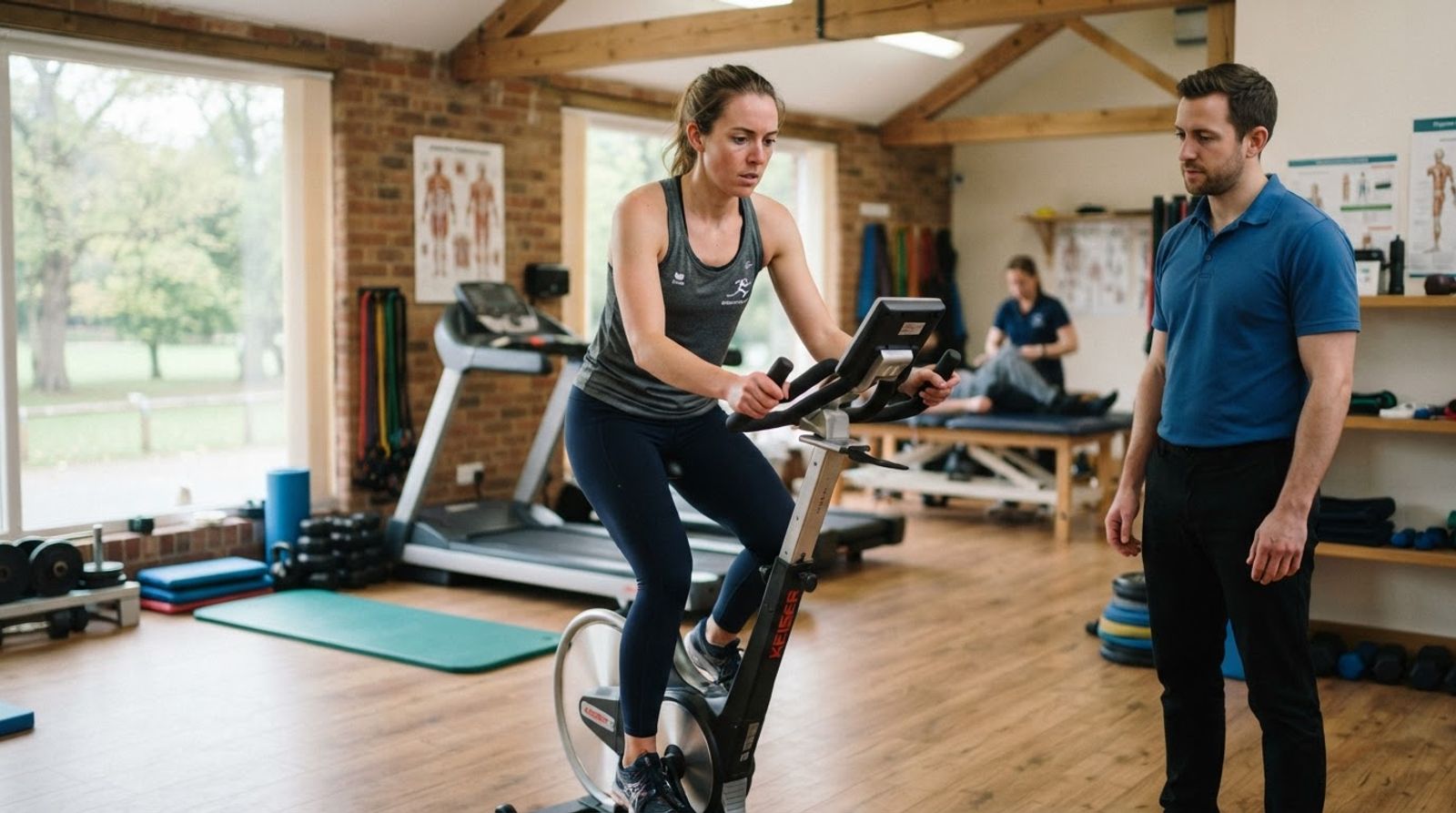
Cycling is convenient for prolonged steady work without running landings. Outdoors, effort is changed by terrain, wind and stops, while an indoor bike lets you hold a target power without these interferences. This is a good way to build aerobic volume if your position is familiar and local leg fatigue doesn't limit the session before your breathing does.
The main mode is zone 2: a calm, steady effort at which you can speak in full sentences. Zone numbering differs between systems, so a label on your watch alone isn't enough. For a runner already adapted to cycling, 60–90 minutes can easily be a guideline, but not a mandatory minimum. Duration depends on experience, weekly load, position and response to previous sessions; for a first introduction, a shorter session is more reasonable.
The scheme helps distinguish intensity, but it doesn't transfer running heart rate boundaries to any machine. On a bike, heart rate at a comparable effort may differ from running; indoors it is also affected by heat and ventilation. You can accurately control zones by power if their boundaries are defined for cycling and the meter is set up. The number of watts alone says little without individual context.
- Easy session. Steady effort without fighting a heavy gear. Assess not only heart rate but also breathing, leg tension and how freely the movement is maintained.
- Quality work. Intervals are more convenient to set by power: it reflects changes in effort immediately, while heart rate lags. For example, several 3–5 minute segments with easy recoveries are just one structure option, not a universal prescription.
- Position. Saddle height, foot position and handlebar reach affect the load. An unfamiliar bike with an uncomfortable position doesn't become recovery just because there's no impact.
Not every runner needs intervals. If the week already has enough quality in running, it's better to keep the bike trainer easy. Even when there's room for an intense cross-training session, it's done no more than once a week and not on the eve of a key running workout. Power and the number of repeats are chosen based on experience and the goal, not for the sake of a maximum number in the app.
Elliptical: looks like running, but effort needs to be controlled
Among common land-based machines, the elliptical is closest to running in overall movement structure: upright body position, alternating leg work, involvement of the arms. The feet stay on the platforms, so there's almost no impact on landing. At the same time, the trajectory is set by the mechanism, there's no flight phase, and joint work is different. The elliptical doesn't replace running technique and adaptation to ground contact.
It's easy to slack off on it: shift your weight onto the handles, move by inertia, and mistake the fast rotation of the platforms for a full workout. The opposite happens too — too much resistance turns a calm session into a strength grind. Speed and the conventional kilometres on the display aren't comparable between models; it's more useful to track time, breathing, and how steady the effort is.
- Body position. The torso is stable, shoulders relaxed, the handles don't serve as support for your entire body weight. Movement stays controlled, without swaying or jerking.
- Resistance. Enough to work actively, but not so much that it breaks the trajectory. The setting depends on the machine's design and your familiarity with it.
- Duration. A rough range of 30–50 minutes works as a guideline for a familiar machine, not as a norm for the first time. Keeping clean movement matters more than filling the planned time.
The elliptical is especially handy when you want rhythmic full-body work without running landings. But almost zero impact doesn't cancel the load on your feet, knees, and hip joints. If movement causes pain, discuss further activity with a doctor rather than trying to fix it by increasing resistance or randomly changing foot position.
Swimming: a change of load, not a copy of a run
Swimming shifts a significant part of the work to the upper body and requires coordinating breathing with movement. The water's support reduces axial load on the spine compared to vertical work on land. This can give a feeling of relief, but doesn't make any stroke therapeutic: head position, arching, and stroke technique matter.
Transfer to running is limited. General aerobic work remains, but swimming hardly reproduces running's ground contact, elastic leg work, and running economy. In a runner's week, the pool is more often useful as a recovery format and a change of load, not as a direct trainer of running fitness. And it will only be recovery at a genuinely easy effort.
If technique is weak, even a slow lane can feel hard: breathing gets thrown off, shoulders tire, pauses become forced. A guideline of 20–40 minutes of easy work with rest depends on your swimming skill and tolerance to the load. There's no goal to swim without stopping at any cost. Short, technically careful segments are better than a long struggle with the water to replace running kilometres.
Aqua jogging: running movement without contact with the bottom
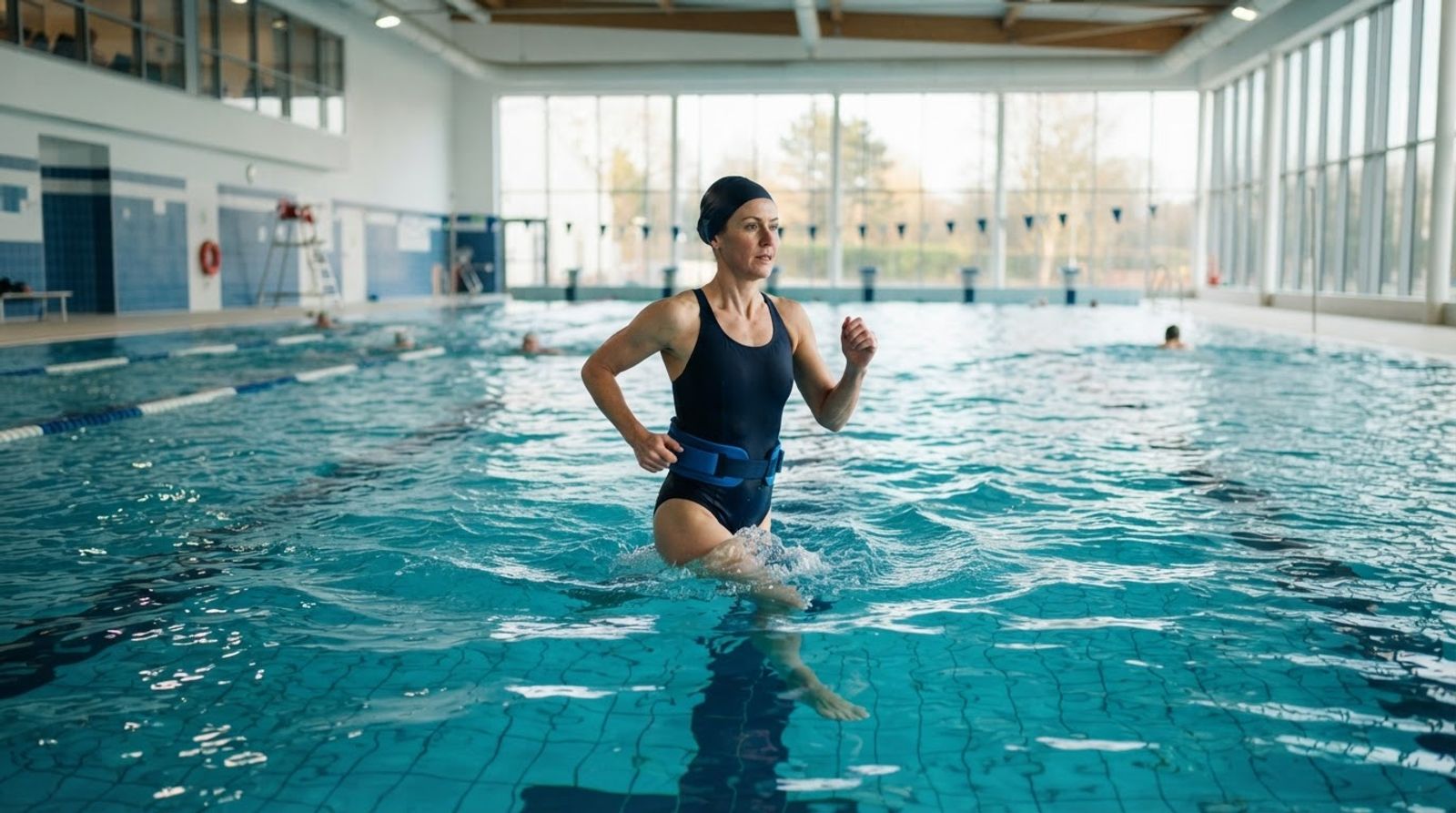
Aqua jogging is an imitation of running movement in deep water, usually with a flotation belt. The feet don't touch the bottom, arms and legs work alternately, the torso stays stable. This isn't running in shallow water: there, contact with support remains and the load is structured differently. Water resistance also changes the mechanics, so a literal copy of a land stride won't happen.
After a stress fracture, aqua jogging is often considered one of the main tools for maintaining aerobic work during the return phase. But whether it is allowed, when to include it, and which movements are permitted is decided by a doctor, taking into account the location and stage of recovery. The absence of impact does not prove safety for any injury, and a water workout does not automatically speed up clearance to run.
- Technique. You don't need to try to stand on the water, lift your knees excessively, or turn the movement into pedaling. A belt helps you stay afloat, but coordination still has to be learned.
- Easy work. The benchmarks are even breathing and a controlled rhythm. The first sessions can be short: mastering the movement matters more than duration.
- Heart rate intervals. Over sufficiently long segments, heart rate helps control intensity if the sensor works reliably in water. Over short ones, it lags, so movement pace and perceived effort remain important benchmarks.
Heart rate boundaries for water cannot be mechanically copied from running: immersion, temperature, and body position change how the body responds. Don't speed up just to match a familiar running number on your watch. Intervals in rehabilitation are possible only within the agreed load; their purpose is not necessarily high intensity.
How to fit cross-training into the week
A practical 3:1 rule — for three running days, one cross-training day; with four to five running days, two are possible. This is a frequency guideline, not a mandatory quota and not a requirement to fill every free day. If cross-training means removing necessary rest, cut back on sessions. In normal preparation, key running sessions are kept, and cross-training replaces part of the easy work.
The main mode is zone 2, quality — no more than once a week and only if you have the resources. Don't schedule two hard days in a row: intense cycling also counts as a hard day. On the eve of a key run, cross-training should not leave your legs fatigued; if in doubt, it's better to reduce its duration or choose rest. There is no conversion of "one hour of cycling equals so many kilometres": time, effort, and subsequent recovery are taken into account.
Cross-training technique itself can become a source of injury. Better 30 minutes of clean movement than 90 minutes of sloppy work: these numbers emphasize the priority of quality, not set a dose. Start with a familiar format and evaluate not only how you feel during the session but also your readiness for the next running day. A successful substitution removes excess load rather than creating a competition for volume on a new machine.
In 1trAIner, the AI coach builds a plan as a cascade Season → Month → Week → Day. Data from Garmin and Apple Watch watches sync automatically, and after each workout the week is recalculated. First 7 days free.
This material is for informational purposes and does not replace a doctor's consultation. Decisions about training with injuries and returning after illness are made by a doctor.