When you can't run, the goal isn't to reproduce your previous mileage at any cost, but to preserve the fitness you can and not hinder recovery. Cross-training can support aerobic work and your usual weekly rhythm, but only if the chosen activity is approved by a doctor. The absence of impact with the ground doesn't yet make the load suitable for any injury: movement, resistance, and how your body responds after the session matter.
What you lose without running, and what you can maintain
Fitness consists of several components. The heart and respiratory system support muscle work, while running economy also depends on coordination, tissue elasticity, and the habit of handling repeated landings. Water and cycling can maintain aerobic capacity, but they don't reproduce that entire set. So feeling good on the bike doesn't mean you're ready to immediately return to your previous running volume.
Changes may be felt in the first weeks without your usual load, but there's no single timeline for losing fitness. It depends on the length of the break, your baseline training, available activity, sleep, and overall condition. The feeling that "everything is lost" sometimes comes before a noticeable drop in endurance. The opposite can also happen: breathing feels easy, but your tolerance for running load hasn't recovered yet.
Complete rest is rarely the automatic choice just because running is temporarily off-limits. If your doctor allows movement, suitable activity helps maintain the training habit and some adaptations. But sometimes limiting the load is a necessary part of recovery. The question isn't how to get around the restriction, but which types of movement, duration, and effort are currently acceptable.
- In normal training. Cross-training complements running rather than replacing key running sessions. A practical guideline is 3:1 — one cross-training session per three running days; with four to five running days, two are sometimes appropriate if recovery is sufficient.
- During a forced break. The role changes: approved cross-training temporarily becomes the main load. This is an exception to the usual scheme, not proof that sports are fully interchangeable.
- When planning. It's more convenient to track minutes, perceived effort, and recovery rather than converting pool or bike work into conditional running kilometres.
Aqua jogging: running movement without landing
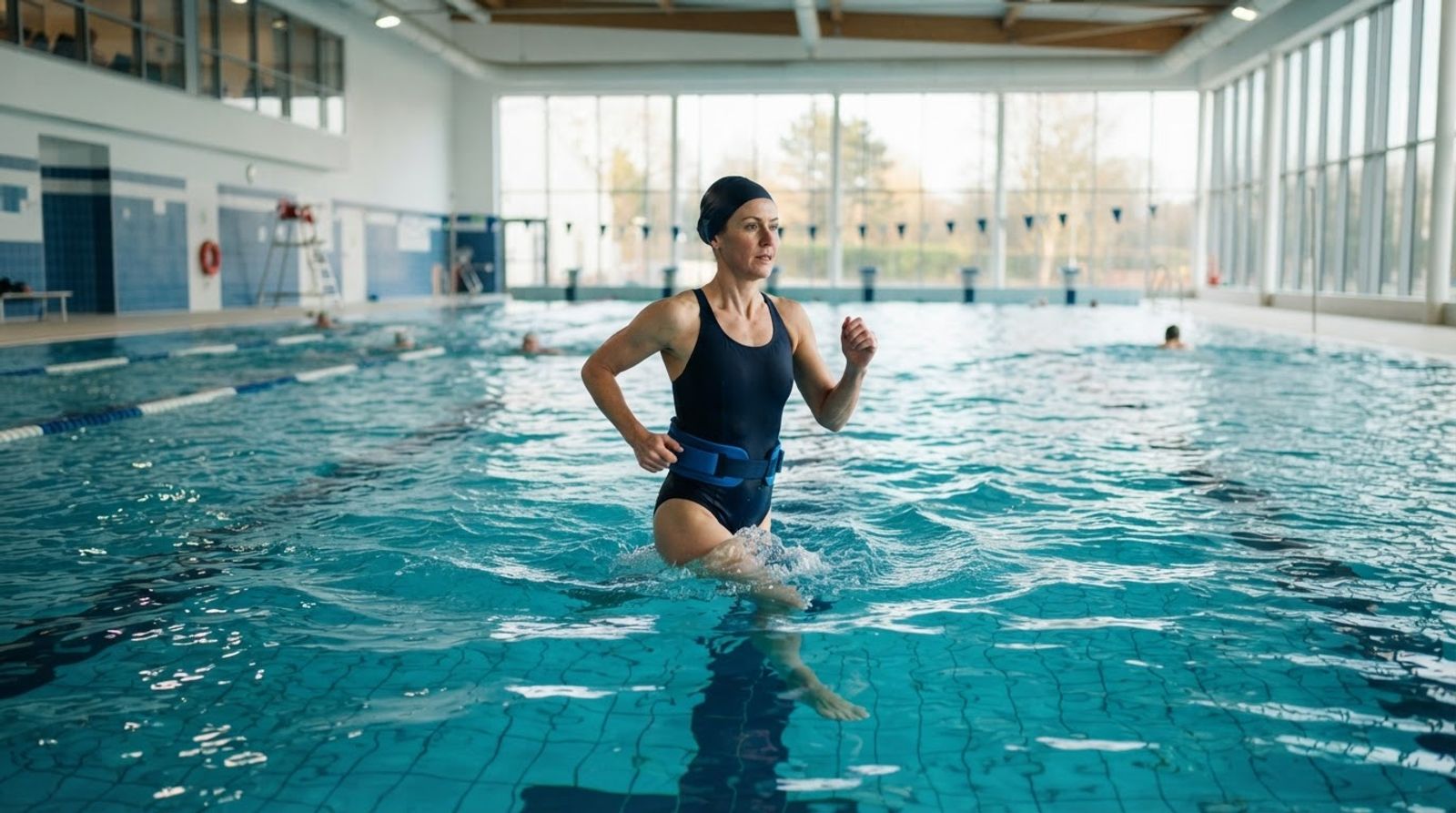
Deep-water aqua jogging is one of the closest cross-training options to running in terms of combining movement pattern and cardiorespiratory response. You can create prolonged aerobic load and vary intensity without pushing off the bottom. However, the overall stress response isn't identical to running: water, temperature, and the lack of support change the working conditions. Choosing this tool still depends on your doctor's restrictions.
A flotation belt helps you stay on the surface and focus on movement. Your torso stays engaged with a slight natural lean, arms work along the body. Legs mimic the running cycle without exaggerated swings or attempts to "pedal." The goal is repeatable movement, not speed along the lane. A first session with an instructor is more useful than trying to do a long session right away.
Heart rate here requires separate calibration. At comparable effort, it's often lower than on land, and an optical sensor in water may give unstable readings. You can't simply transfer running zones or subtract a universal number of beats from them. Reference points are reliable measurement, individual response in water, breathing, and perceived exertion. If readings jump around, don't chase the target heart rate by speeding up.
- Easy work. An approximate range is 20–40 minutes at a calm rhythm where you can speak in sentences. This is a guideline for activity you are already cleared for, not a mandatory starting dose: duration depends on experience, restrictions, and how you respond after the session.
- Heart rate intervals. For an athlete familiar with the water who is cleared for intense work, an example structure is a warm-up, 4–6 repeats of 2–3 minutes with about 2 minutes easy between them. The working range is chosen for the water, without going to maximum.
- Allow for the lag. Heart rate does not rise immediately. At the start of a repeat, even effort and technique matter more than trying to see the target number right away. If your movement falls apart, the task is no longer being done, even with a nice-looking graph.
Aqua jogging is convenient as a primary tool precisely because the load is manageable. But it does not have to be hard to count as a workout. During a break from running, 30 minutes of technically clean work is better than 90 minutes of chaotic movement: unfamiliar technique can itself become a source of overload.
Indoor trainer: volume and manageable zones
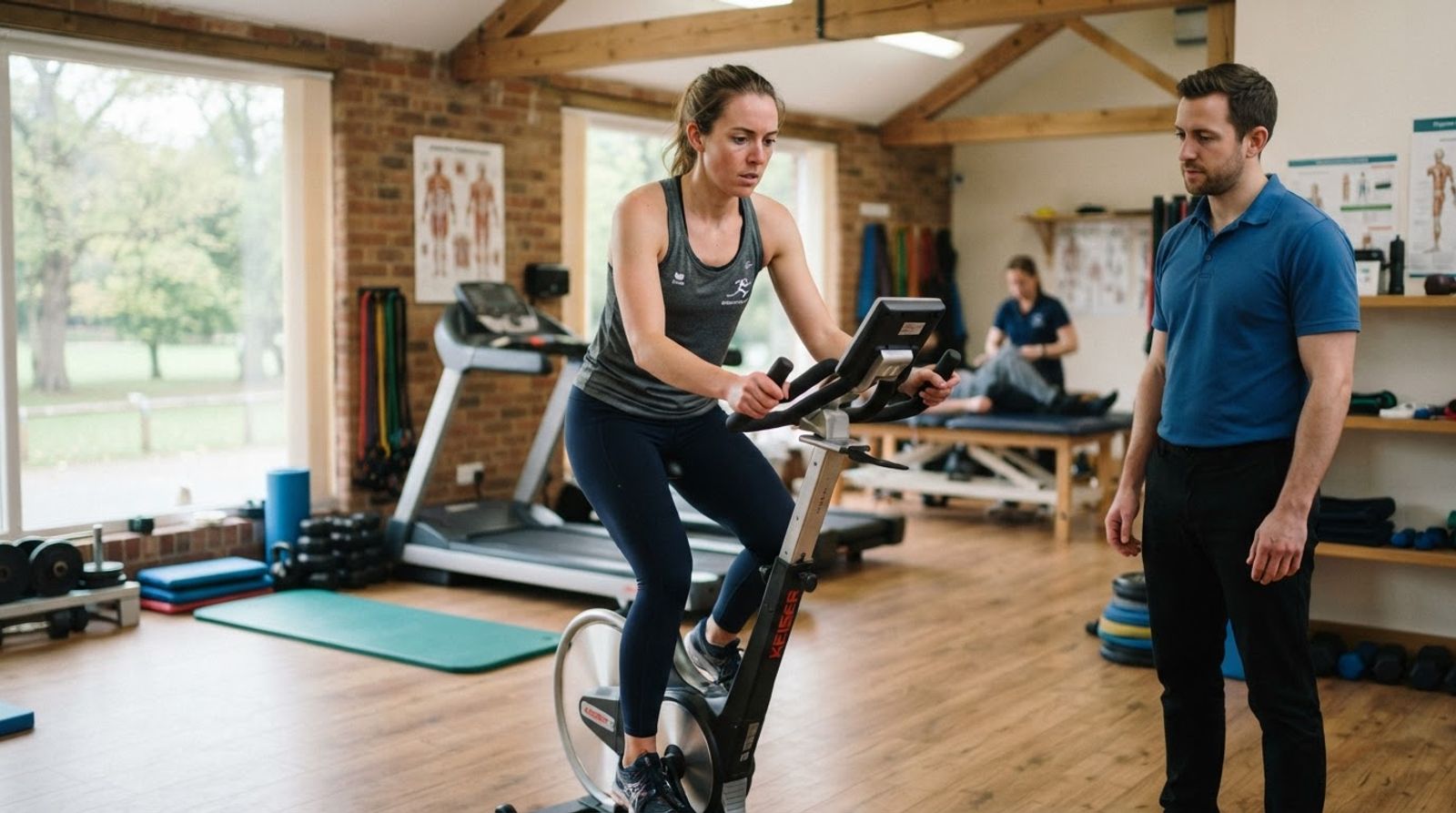
The indoor trainer is the second pillar when cycling is allowed: there are no descents, traffic lights, or need to constantly change effort. Resistance can be dosed, and power helps maintain even load. At the same time, the phrase "no load on the foot" should be understood carefully. There is no impact load from landings, but the foot presses on the pedal and transmits force. For some restrictions this is fundamental, so whether cycling is allowed is determined by a doctor.
The main mode is zone 2 in the familiar five-zone scale: calm aerobic work with controlled breathing and the ability to talk. In different systems, zone boundaries differ. Running heart rate values should not be automatically transferred to cycling, and an accurate power meter does not guarantee correctly set zones. Their purpose is to maintain a suitable effort, not to achieve a given number at any cost.
- Duration. For someone used to cycling, 30–60 minutes can be a convenient guideline for an easy session. This is not the equivalent of an hour of running and not a minimum you must complete. The novelty of the load and allowed restrictions matter more than previous running endurance.
- Position and pedaling. Saddle height, body position, and resistance affect how the load is distributed. Too heavy a gear to reach the desired heart rate can make the session locally hard even though breathing remains calm.
- Conditions. A fan and your usual drinking routine help avoid excessive overheating. A rise in heart rate in a stuffy room does not necessarily mean a useful increase in training stimulus.
The trainer is good for even volume, but boredom is not a reason to turn every ride into a power test. Technique is also a limiter here: a stable position and smooth movement matter more than duration. The onset of pain or its worsening is not a task for finding a better gear but a reason to stop the session and discuss the allowed load with a doctor.
How to put together a week when cross-training becomes the main thing
Four to six sessions per week is a possible guideline for someone who trained regularly before the injury and has been cleared for such a regimen. This is not a universal prescription and not a goal for the first week. Sometimes less is available, sometimes very short sessions are needed. Frequency is determined by previous fitness, tolerance of the new type of movement, and restrictions, not by the desire to fill all the freed-up running days.
Most of the work remains easy, predominantly in zone 2. A quality session is no more than once a week and only if intensity is allowed and well tolerated. It is optional: a week without intervals does not become useless. When alternating water and cycling, the load on the cardiovascular system still adds up. No two hard days in a row is a rule for the whole week, not separately for each sport.
- Example of five sessions. Monday — easy water, Tuesday — easy trainer, Wednesday — rest. On Thursday, one quality session in the water is possible, Friday — rest, on the weekend — one easy session each, taking accumulated fatigue into account.
- If intensity is not suitable. Thursday becomes easy or free. There is no need to move intervals to another sport just to complete the plan.
- If you want to add a sixth session. First assess sleep, overall fatigue, and your response to the current regimen. An extra day should not simultaneously mean an increase in duration and intensity.
The watch helps you see the overall recovery picture, but its metrics do not describe the state of damaged tissue. A low charge on the conventional battery can remind you of accumulated fatigue; a high one does not remove limitations. The diagram below illustrates the idea of balancing training load and rest, not a threshold for being cleared for a workout.
It helps to compare the duration of a session, effort, sleep, and how you feel afterward and the next day. This makes it easier to notice when a formally easy week is harder to handle than expected. These observations can help you discuss your routine with a specialist, but they are not a standalone way to determine that an injury has healed.
Returning to running: endurance is not the same as readiness
The decision to return is made by a doctor, not by a watch, training status, or a good streak on the machine. Cross-training may preserve the feeling of easy breathing better than the ability to tolerate landings. That is why the temptation to immediately run your usual distance is especially strong: your heart handles it easily, but that is not yet a test of whether all tissues are ready for running.
After clearance, the return is built gradually, according to an agreed plan. Short running bouts, sometimes alternating with walking, may be one option, but the specific order depends on the situation. A universal percentage increase does not replace individual restrictions. You should not simultaneously increase frequency, duration, and speed, or keep all your previous cross-training volume on top.
Pain during running, its increase after a session, swelling, a change in gait, or worsening of normal movements the next day are signs that require stopping the load and discussing with a doctor. They do not allow a diagnosis based on a training diary. The absence of such signs also does not automatically permit speeding up the program.
As recovery progresses, running becomes the foundation again, and cross-training becomes a supplement. Then you can return to the 3:1 guideline: one cross-training session for three running days, two for four to five, if the total volume is handled calmly. A quality cross-training session is not placed the day before a key running workout and is not automatically added on top of running intensity. Its job is to support the plan, not compete with it for recovery.
In 1trAIner, the AI coach builds a plan using the Season → Month → Week → Day cascade. Data from Garmin and Apple Watch watches syncs automatically, and the week is recalculated after each workout; the first 7 days are free. Planning does not replace a doctor's decision about permissible load.
This material is for informational purposes and does not replace a doctor's consultation. Permissible loads for an injury and the timing of returning to running are determined by a doctor.