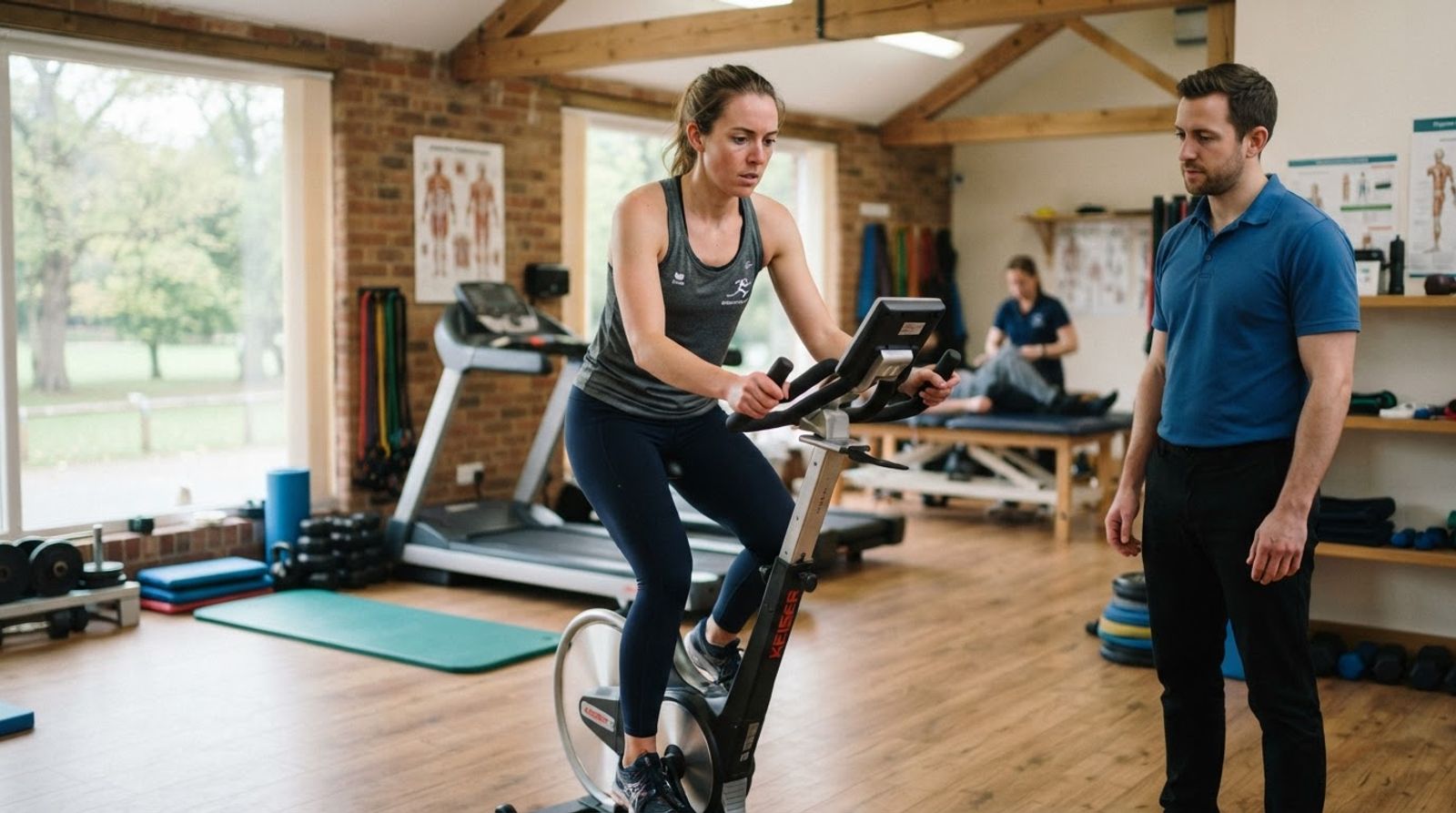

After a long descent, your breathing is already calm, but your legs are not yet ready to work. On a flat path, this is easy to miss: the real heaviness shows up the next morning when you need to go down the stairs. The task of recovery is not to remove any unpleasant sensations by evening, but to restore the ability to move freely and control your step. For this, sleep, enough food, and a reasonable interval between workouts matter more than a complex set of procedures.
Why one evening of rest is sometimes not enough
On a descent, muscles not only create movement but also brake it. The front of the thigh takes the load while the muscle lengthens under tension: this is eccentric work. It can feel relatively easy by breathing, but an unusual volume causes microdamage to muscle structures and a temporary decrease in strength. Therefore, a low average heart rate does not make a downhill session easy for the legs.
The 24–72 hour guideline describes the typical window of onset and peak of delayed muscle soreness, not a guaranteed period of full recovery. During this period, recovery processes are underway, but after an unusual or large volume, the decrease in strength may persist longer. The duration depends on the length and steepness of the descent, speed, surface, familiarity with such work, and overall fatigue. Readiness cannot be determined by a single number in the calendar.
Ordinary rest is not useless: without it, recovery is actually difficult. What does not work is the expectation that a few hours on the couch will completely cancel the effects of the workout. Breathing calms down faster than the ability to confidently brake on every step returns. Moreover, the absence of severe pain does not yet prove that strength and coordination have already returned.
- Look not only at kilometres. Consider the total elevation loss, technical difficulty, and continuity of the descent. A short steep session can noticeably load the legs.
- Remember novelty. After a break, a familiar route can feel like a new load. The previous pace does not have to suit your current fitness.
- Do not test recovery with another hard descent. Such a test itself becomes training stress and prevents you from understanding your initial state.
What helps: movement, sleep, and enough food
The basic order is simple: reduce the load, eat properly, and leave time for sleep. Active recovery can reduce the feeling of stiffness, but it does not have to accelerate the recovery of muscle structures. A calm walk or easy pedalling is suitable only when movement remains comfortable. If you have to favour one leg or endure increasing sensations, this is no longer recovery activity.
- Light movement. A rough guideline is 10–30 minutes at a conversational pace, without hills or forceful pedalling. The duration depends on fatigue: a short outing may be more appropriate than a full walk. The goal is to move gently, not to hit a step count.
- Legs up. A few minutes in a comfortable position sometimes reduce the feeling of heaviness after a long time on your feet. This is a way to rest, not a proven way to recover damaged muscles faster. No special angle or stopwatch is needed.
- Compression. For some runners, it slightly reduces subjective soreness. There is no convincing universal effect on the return of strength. Properly fitted clothing should not cause numbness, pain, or marked discomfort; stronger compression does not mean a greater effect.
- Sleep. For many adults, the guideline is 7–9 hours per night, but the need is individual and may be higher after hard days. It is more useful to free up the evening and keep your usual bedtime than to add procedures at the expense of sleep.
Protein after a session is part of supporting muscle recovery. A practical guideline for one meal is 20–40 grams of protein: the right portion depends on body weight, age, food composition, and the rest of your diet. This can be ordinary food, not necessarily a shake. There is no strict window of a few minutes: if you had a full meal shortly before running, there is usually no need to rush with a supplement.
Not only the post-workout serving matters, but also adequate nutrition throughout the day. Protein does not compensate for a lack of overall energy, and carbohydrates help replenish spent fuel stores. After a long trail run, it helps to plan accessible food and drink in advance so the journey home doesn't turn into several hours without nutrition. No single product guarantees that your legs will feel fresh tomorrow.
Cold, contrast and foam roller: relief is not the same as readiness
Cold procedures can reduce subjective soreness after hard work. This can be convenient when there is little time between sessions, but the effect on how pain feels cannot automatically be considered recovery of strength. Cold tolerance and reactions to it vary; colder and longer is better — that's flawed logic. Extreme procedures are not a mandatory part of recovery.
There is also the question of training adaptation. Regular cold immersion immediately after strength work may blunt some of the expected adaptations. How much this effect carries over to a specific trail workout depends on its content and the regimen of procedures. So turning cold into a mandatory ritual after every descent without a clear purpose isn't worth it. Short-term relief and long-term fitness development are different tasks.
With contrast procedures the picture is less clear: some people feel more alert, but there is no consistent superiority over simple rest across all recovery markers. Promises to "flush out toxins" or "wash out lactic acid" don't explain next-day soreness. Lactate doesn't stay in the muscles for several days and isn't the cause of that pain.
A foam roller can briefly reduce stiffness and improve available range of motion. It doesn't glue micro-damage back together and doesn't require painful digging into the muscles. If the roller feels good, you can keep it as an optional relaxation ritual; if you feel worse afterward, there's no benefit in persistence. A few calm passes shouldn't turn into a separate hard session.
- What is known. For some procedures, the effect on subjective soreness is more noticeable than on the return of strength or athletic performance.
- What remains unclear. Optimal conditions and the size of the effect vary between people and types of load. There is no universal protocol for all descents.
- Where marketing begins. The promise to fully restore muscles in one procedure substitutes a complex process with a short-term change in sensations.
How to check recovery in the morning
It helps to combine three sources of information: trends on your watch, sleep quality and everyday movements. Morning heart rate and heart rate variability, or HRV, make sense relative to your personal baseline, not someone else's "good" value. Compare measurements from the same device under similar conditions. Lack of sleep, stress, alcohol, heat and a change in routine can shift the numbers regardless of muscle condition.
A heart rate above your usual and HRV below your personal range for several mornings in a row is a reason to take a closer look at your overall load, but it's not a diagnosis and not an automatic ban on movement. The opposite is also true: normal numbers don't rule out local fatigue after descents. The watch doesn't directly measure the readiness of your quadriceps to brake on a rocky trail.
The chart shows the general idea of resource expenditure and replenishment over the course of a day, not a mandatory recovery curve after a descent. Indicators like Body Battery are calculated estimates by the device, not a percentage of restored muscle fibers. They're more useful as context for a decision, not as permission for intense work.
- Stairs. On a normal descent, notice whether your legs bend freely, whether you have to turn sideways or lean unusually hard on the handrail. There's no need to deliberately walk up and down the steps many times as a test.
- Everyday movement. Compare walking and standing up from a chair with your usual state. Symmetry, control and not having to change the movement because of pain are what matter.
- Overall readiness. Assess sleep, alertness and how your sensations have changed since yesterday. It's useful to distinguish the desire to complete the plan from the actual ability to handle it calmly.
If normal movements are comfortable, the start of the next easy session is still a test. Do not increase your pace just because things feel less painful after the warm-up: warming up can temporarily change how you feel. Also assess your form, the effort at your usual pace, and how you feel after the session. Returning to challenging descents does not have to coincide with returning to easy running on flat ground.
Three honest signs that you should skip a workout
You cannot prove in advance that any next session will definitely cause harm. But there are signs where additional running load is more likely to add risk and fatigue than provide a useful stimulus. This is especially true for intervals, strength work for the legs, and new descents.
- Your movement mechanics have changed. You are limping, noticeably unloading one side, or cannot control your usual step down. Adjusting your form to work through pain just to complete the plan is a poor foundation for the next session.
- Your condition is clearly worsening. The pain becomes sharp or localized, noticeable swelling appears, or normal walking becomes increasingly difficult. This is not a situation to test yourself with a workout; such changes go beyond everyday recovery assessment.
- Fatigue is stacking up from several signals. Poor sleep, unusual exhaustion, heavy legs, and a sustained deviation in morning metrics have coincided rather than appeared separately. Trying to override this combination with another hard session is usually unwise.
You do not have to put missed load back into the schedule at any cost. First assess readiness for normal activity and easy work, then choose a place for the intense session. If you simply move a hard descent to another day and leave everything else unchanged, the week can become denser than it was. Recovery only makes sense together with adjusting the subsequent load.
In 1trAIner, the AI coach builds the plan as a cascade Season → Month → Week → Day. Data from Garmin and Apple Watch watches syncs automatically, and the week is recalculated after every workout. Muscle sensations should be reported separately: watches do not replace them. First 7 days free.
This material is for informational purposes and does not replace a doctor's consultation.