
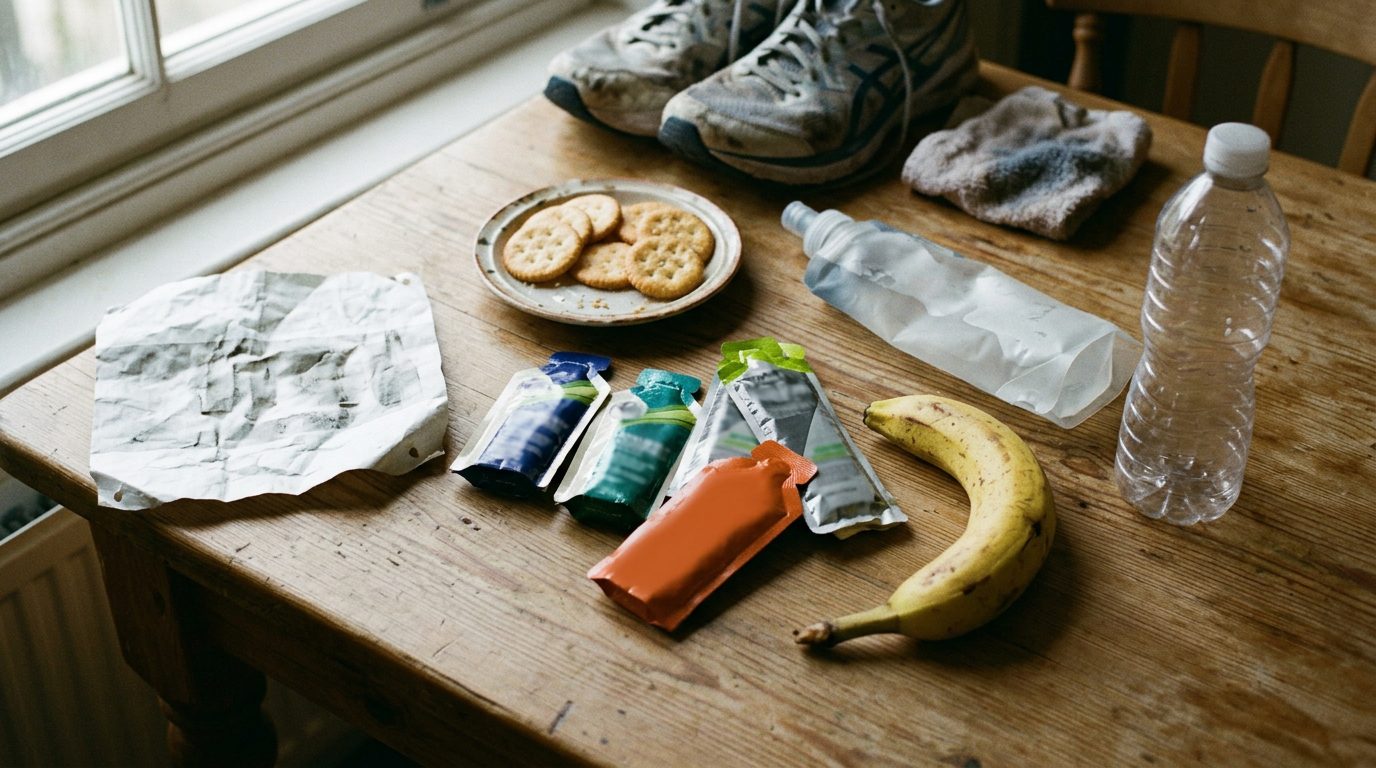
A recreational runner weighing around 70 kilograms has roughly 400–500 grams of glycogen stored — about two hours of work at marathon pace; a lighter runner has less. Anything longer runs into fuel, not muscles or willpower: either you keep supplying it, or your pace drops. That's the famous "wall" at the 30-kilometre mark — not a metaphor, just simple arithmetic.
The good news is that the arithmetic is solvable. The bad news is that your stomach works worse while running than at rest, so simply "eating more" won't cut it.
Why 60 grams is the ceiling
Glucose is absorbed in the intestine through a transport protein, and its capacity is limited: about 60 grams per hour, no matter how much you eat. The excess stays in the intestinal lumen, draws water there, and ends up causing that very cramp halfway through the distance.
The workaround is simple: fructose uses a different transport protein. If you take a mix of glucose and fructose at roughly a two-to-one ratio, both channels work at the same time, and absorption rises to 90 grams per hour. That's why you see two types of sugar on a sports gel label, not one — it's not marketing, it's the physiology of absorption.
The upper limit has been pushed further in recent years: in studies, well-trained athletes tolerated 120 grams per hour during three-hour efforts. But that's the ceiling for those who deliberately worked up to it. For a recreational runner, the right target is 60–90, and only after those doses have been practised in training.
How much to take for your distance
| Duration | Carbs per hour | Comment |
|---|---|---|
| up to 60 minutes | not needed | stores are enough, water is sufficient |
| 60–90 minutes | up to 30 g | helps during intense work, not necessary on an easy one |
| 1.5–2.5 hours | 30–60 g | glucose alone is enough |
| 2.5–4 hours | 60–90 g | a mix of two sugars is essential |
| longer than 4 hours | 80–90 g and above | plus salt and solid food |
A practical translation into familiar items: a sports gel is usually 22–30 grams of carbs, a banana is about 25, a half-litre bottle of isotonic drink is 30–35, a bar is 25–40. Ninety grams per hour in a marathon means a gel every 20 minutes plus fluids, and that's noticeably more than the average recreational runner carries.
Trail running and ultras have their own logic. The pace is lower, digestion works better, and on long distances people switch to real food: broth, potatoes with salt, sandwiches. By the tenth hour, sweets stop going down at all, and salty and fatty foods become a saviour. It's useful to read about timing and checkpoints together with the material on cutoff times in trail running and on time on feet.
Stomach training
The gut adapts to the load just like muscles: regular practice increases both the number of transport proteins and tolerance. Studies on this topic show noticeable progress in just two weeks, while a full cycle takes 4–6.
A working approach:
- Pick one workout per week — usually the long one — and make it a "nutrition" session: fuel strictly according to your race plan, with the same products.
- Start with the dose that currently goes down without issues: for example, 40 grams per hour.
- Add 10 grams per hour every one to two weeks until you reach your target.
- Increase fluids along with carbs: a concentrated solution without water is a direct path to cramps.
- In the last two to three weeks before the race, practise exactly the fuelling plan you'll use on race day.
An iron rule: nothing new on race day. Not a brand, not a flavour, not a dose you haven't tried in training. Gels at aid stations are a lottery with your stomach as the stake.
What to do when you can't get it down
The classic third-hour situation: a gel makes you gag, sweet things turn your stomach, but you have to eat. Here are a few tricks that work.
- Alternate flavours and formats. A gel, then chews, then an isotonic drink, then something salty. Monotony kills appetite faster than fatigue.
- Reduce the dose but don't stop fuelling. Forty grams per hour is better than zero, and zero in the fifth hour will almost certainly end in a pace collapse.
- Check your fluids. Nausea is more often about concentration: chase the gel with water, not with an isotonic drink.
- Slow down for a few minutes. At a high heart rate, blood flow shifts away from the gut, and any food sits like a rock. Five minutes of easy running often brings back the ability to eat.
- Salty and liquid. Broth on an ultra isn't gastronomy — it's a way to get sodium and calories when sweet things no longer go down.
A note on salt: sodium is lost through sweat, and on a long run in the heat it needs to be replaced — 300–700 milligrams per litre of fluid. More on losses and thresholds is in the article about running in the heat. It's best not to overdo plain water "just in case": diluted blood is more dangerous than mild dehydration.
Before and after
Carb loading the day before works, but not the way it's usually understood: what matters isn't a giant plate of pasta in the evening, but a higher share of carbs 1–3 days before the race with a reduced training volume. Breakfast before the race is familiar food 2.5–3 hours ahead, 1–3 grams of carbs per kilogram of body weight, without fibre or fat.
After a long run, the first 30–60 minutes are the most effective window for recovery: carbs plus protein in a ratio of roughly three to one. This isn't a dogma, but a way to avoid starting your next workout with half-empty stores. If you keep a nutrition diary, this part is easy to track in numbers — how it works in the service is described in the article about the nutrition diary.
In 1trAIner, the AI coach knows the duration and type of every workout in the plan and suggests a nutrition breakdown for it, while the nutrition diary and weight are pulled into the same context as your watch data. The first 7 days are free.
This material is for informational purposes and does not replace a consultation with a doctor or sports dietitian. If you have gastrointestinal conditions, diabetes, or metabolic disorders, agree on your nutrition plan during workouts with a doctor.