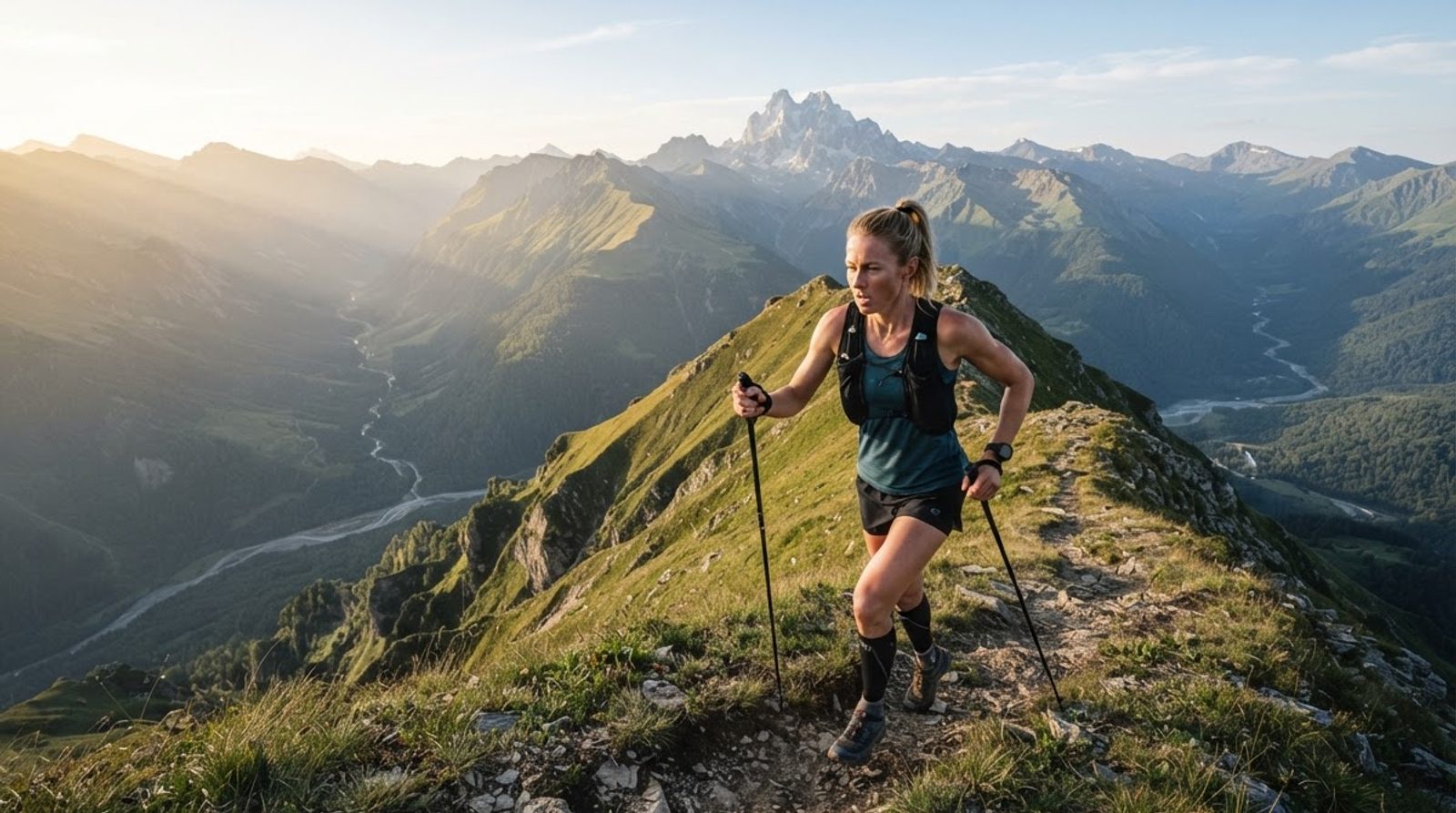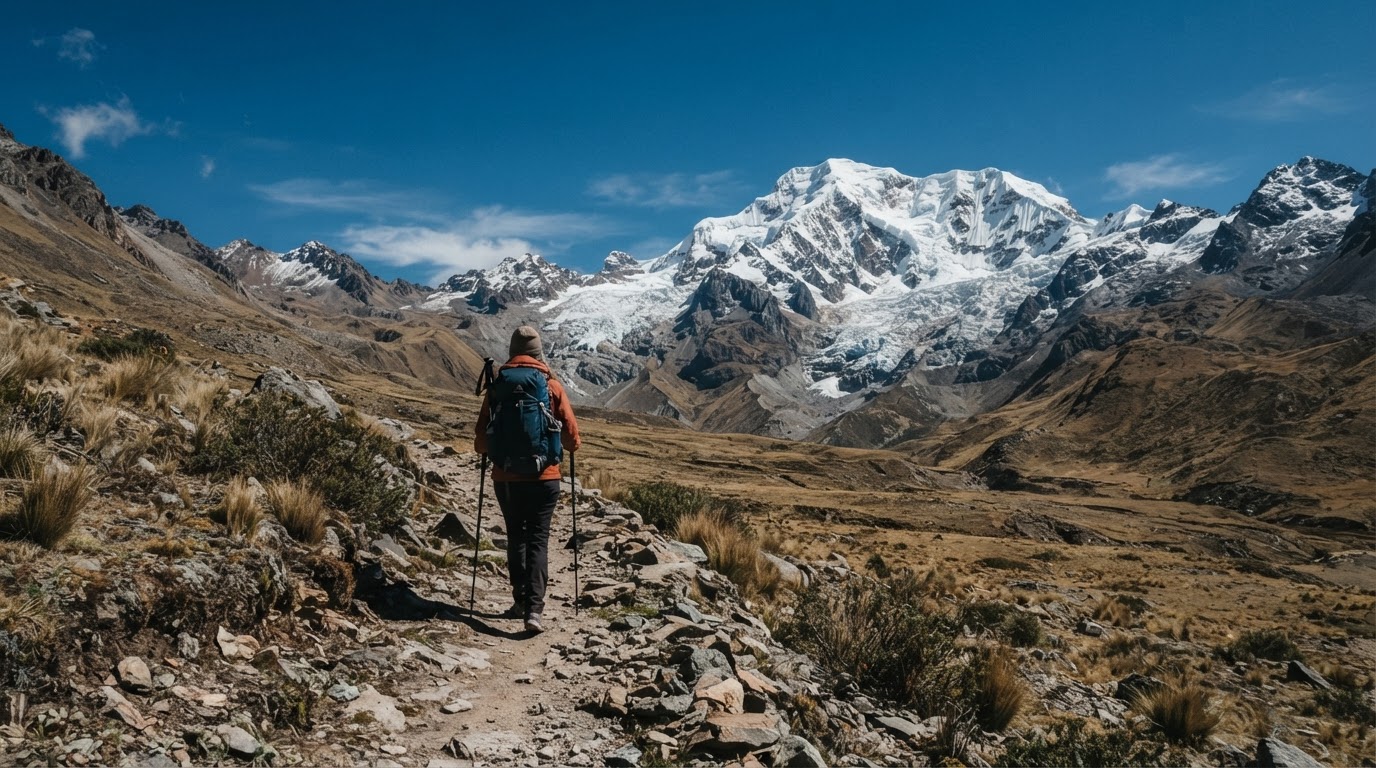

10 km in a park and 10 km with 800 metres of gain are the same distance but different work. On climbs, effort, pace and time on feet change, while descents add load that the kilometre counter doesn't notice. So it's useful to plan a trail week with a vertical budget: decide in advance how many metres up you'll gain and in which workouts. This isn't a replacement for kilometres and hours, but another coordinate of the plan.
Why kilometres don't describe the whole load
On a flat, familiar route, distance helps compare weeks fairly well. In trail running it works less well: one route is run almost entirely, on another you have to walk up a steep climb, step around rocks and descend carefully. Even the same distance and gain don't make workouts equal. A gentle dirt road and short steep slopes require different movement and leave a different feeling of fatigue.
- Elevation gain, or D+. The sum of all climbs in a workout. If you go up a 60 m hill five times, that's about 300 m of gain, even if the finish is near the start.
- Elevation loss, or D−. The sum of descents. On a loop route it's usually close to the gain, but on a treadmill with incline there are no descents at all. For planning, this is a significant difference.
- Time and nature of effort. Two hours of easy movement and an hour of intense repeats can't be considered interchangeable just because the watch showed the same metres up.
Next to kilometres, record gain, duration and a short note about the terrain: gentle, steep, technical, lots of walking. Descents are also worth noting separately, especially unfamiliar ones. There's no need to reduce everything to a single 'equivalent mileage': a convenient formula will inevitably lose part of the work. The vertical budget is useful precisely as an additional constraint, not as a new single metric.
How to set a budget and increase it
Start with the average gain over the last three or four normal weeks that you handled without accumulating noticeable fatigue. Don't use a one-off trip to the mountains or your best long run as a basis. For example, weeks with 700, 900, 800 and 800 m give an average of 800 m. This is a reasonable starting point for planning, not an obligation to add immediately. If recent weeks have been unstable, first establish a repeatable volume.
For this approach, set a limit: gain growth should be no more than 10–15% relative to the previous normal loading week. This is an upper benchmark, not a scientifically established safety guarantee and not a mandatory weekly step. From 800 m, the increase would be about 80–120 m; round to the available route, preferably down. It's not worth increasing gain, mileage, climbing speed and descent difficulty at the same time: otherwise it will be hard to tell which stimulus was too much.
- First three weeks. You can keep the volume the same or increase it cautiously. A conditional sequence of 800 → 880 → 960 m shows the principle of small steps, but repeating 800 m three times is also acceptable.
- Every fourth week. Plan a recovery. For example, cut gain by about 20–30% from the third week and remove some intense work. In this example, that would be around 670–770 m; the exact amount depends on overall load and recovery.
- Next block. Use the last sustainably tolerated volume before the recovery as your reference, and don't count returning to it as new growth. If fatigue persists, start lower and don't try to make up for missed metres.
Percentages don't help much if there was almost no gain before: adding to zero explains nothing. In that case, first add a small portion of familiar gentle terrain without lengthening the whole week, and see how it fits with the other workouts. Benchmarks for revising the budget are: usual easy sessions have become noticeably harder, descents worsen the quality of subsequent workouts, there isn't enough time for rest. The budget can be reduced at any time, without waiting for the fourth week.
Benchmarks for 20–30 km, 50 km, and one hundred miles
The length of the race alone does not determine the weekly gain. First look at the profile: total D+, length of continuous climbs, steepness, surface, and the nature of the descents. Then compare them with your experience, available time, and current volume. Below are broad benchmarks that appear in preparation for hilly and mountainous distances among runners who already train regularly. This is not a standard, not an average across all participants, and not a requirement for the first week.
- Race at 20–30 km. In working weeks you may see roughly 600–1500 m of gain. For a moderately hilly course, a smaller volume is often enough, while a mountainous profile requires separate attention to long climbs. It matters not only to accumulate the total but also to get used to moving uphill for more than a few minutes at a time.
- Race at 50 km. An approximate range for some mountain plans is 1500–3000 m per week. Its meaning appears only together with sufficient time on your feet and tolerance of a long workout. A week with a lot of D+ but sessions that are too short does not replicate the demands of a long race.
- Hundred-mile distance, around 161 km. In mountain preparation for experienced runners, weeks with 2500–5000 m and more occur. This is a large volume that cannot be assigned just because you registered. For a relatively flat course, the vertical may be substantially less, while for a very mountainous one, individual decisions are needed rather than chasing the upper limit.
These ranges overlap in meaning: a technically difficult 25 km may require more specific work on the terrain than a gentle 50 km. It is useful to assess the density of gain: 1500 m over 30 km is an average of 50 m uphill per kilometre. This is a hint for choosing some of your training routes, not a rule for the whole week. The average also hides the profile: one long climb and dozens of short hills prepare you for different tasks.
You do not need to repeat the entire race gain every week or exceed it by a set number of times. The total is made up of workouts with different purposes, and the peak of preparation differs from a regular week and from the taper before the race. If there is a large gap between your sustainable volume and the chosen benchmark, revise the preparation timeline and available load rather than accelerating the percentage increase.
How to divide the metres between workouts
A simple scheme is one long workout with gain, one separate vertical session, and the remaining outings mostly on flat terrain and in an easy mode. It allows each session to have a clear purpose. The long one develops the ability to move over terrain for a long time, the vertical session provides manageable work on the climb, and easy days do not turn into hidden hard workouts for the sake of a nice D+ total.
- Long run with gain. As a starting scheme, you can allocate about 50–60% of the weekly metres to it. Choose terrain that matches your goal profile and do not speed up for the sake of pace on flat ground. Walking on steep sections can be part of the task, not a failed run.
- Vertical session. Another roughly 25–35% can be accumulated through hill repeats or continuous uphill movement. It does not have to be intense: prolonged easy walking uphill and fast short repeats are different sessions.
- Other days. The remaining metres are the small natural terrain of easy routes. Between the two key sessions, leave easy days or rest; the specific interval depends on how you recover.
For example, a budget of 1200 m can be divided into 660 m in the long run, 360 m in the vertical session, and 180 m in other outings. This is an example of arithmetic, not a ready-made schedule. If the long run already includes difficult descents, it makes sense to make the second session easier in terms of surface and effort. Do not make up the missing 100 m in the evening of the last day: the budget is a planned limit with allowance for the route, not a debt that must be paid off.
What can replace the mountains and what the replacement will not give
Without mountains, you can prepare part of the uphill work if you make it regular and measurable. Choose an available option, but record it separately from outdoor trail running. The same metres on different surfaces do not mean the same workout, and the absence of descents cannot be compensated for by simply increasing the incline.
- Treadmill with incline. Convenient for continuous climbing and effort control. At a 10% incline, a kilometre of movement gives roughly 100 m of conditional gain; accuracy depends on the calibration and calculation method of the treadmill. Do not confuse incline percentages with degrees. There is no uneven footing, no choice of line, and no downhill load here.
- Stairs. They allow you to accumulate vertical in a small space. Count the actual height of the climb, not conditional floors: floor heights vary. Steps set a fixed stride that does not exist on most trails, and descending them adds separate work. Choose a place that does not obstruct other people.
- Repeats on a single hill. The closest replacement to outdoor terrain. A hill with a 40 m drop over eight ascents will give about 320 m D+. But eight short repeats with pauses on the descent are not equal to one continuous 320 m climb; take this into account when choosing the task.
For short repeats, it helps to check the route's elevation change once and then count the repetitions: GPS elevation can be quite noisy. Compare weeks using the same data source, and mark a treadmill-based set separately. If you can occasionally ride on hilly terrain, use the ride to get familiar with long climbs, surfaces, and descents. Don't turn a rare ride into an attempt to cram a month's budget into two days.
In 1trAIner, the AI coach builds the plan as a cascade Season → Month → Week → Day. Data from Garmin and Apple Watch watches syncs automatically, and the week is recalculated after each workout. The first 7 days are free.
This material is for informational purposes only and does not replace a doctor's consultation.